Government Moves To Accelerate MSME Payments Through TReDS Mandate
ECONOMY & POLICY

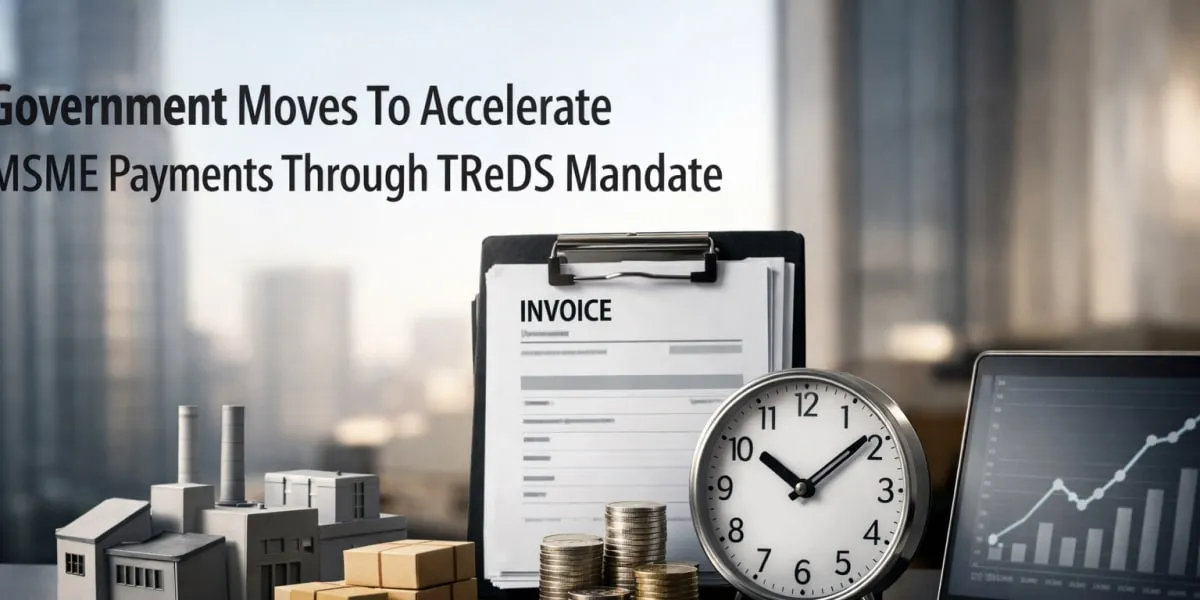
Government Moves To Accelerate MSME Payments Through TReDS Mandate

The government has announced a mandate to expand the use of the Trade Receivables Discounting System, TReDS, to accelerate payments to micro, small and medium enterprises. The measure is designed to shorten receivable cycles and to strengthen liquidity for suppliers across sectors. Under the proposal, buyers and financiers will route eligible invoices through registered TReDS platforms so that invoices can be discounted and settled faster than under conventional payment terms.

The rule is intended to make cash conversion more predictable for smaller firms that often face long payment delays from larger corporates and public sector purchasers. TReDS platforms will provide a marketplace where financiers and investors can bid to purchase receivables, reducing dependency on traditional bank lending. Faster conversion of invoices into cash is intended to ease working capital constraints and to lower the cost of short term credit for suppliers.

The policy also aims to broaden access to formal credit for firms that are currently reliant on informal financing arrangements. Implementation will rely on strengthened regulatory oversight of TReDS operators and on wider onboarding of buyers and sellers onto digital platforms. Regulators will monitor compliance and will work with industry bodies to ensure interoperability between systems and to reduce onboarding friction.

The mandate will require changes in corporate procurement practices and in internal payment cycles for large buyers to align with electronic settlement processes. The government will provide guidance and support measures to help smaller firms adopt digital invoice financing and to streamline registration on TReDS platforms. Broader uptake of TReDS is intended to accelerate the formalisation of supply chains and to smooth cash flows across tiers of suppliers.

The government has announced a mandate to expand the use of the Trade Receivables Discounting System, TReDS, to accelerate payments to micro, small and medium enterprises. The measure is designed to shorten receivable cycles and to strengthen liquidity for suppliers across sectors. Under the proposal, buyers and financiers will route eligible invoices through registered TReDS platforms so that invoices can be discounted and settled faster than under conventional payment terms. The rule is intended to make cash conversion more predictable for smaller firms that often face long payment delays from larger corporates and public sector purchasers. TReDS platforms will provide a marketplace where financiers and investors can bid to purchase receivables, reducing dependency on traditional bank lending. Faster conversion of invoices into cash is intended to ease working capital constraints and to lower the cost of short term credit for suppliers. The policy also aims to broaden access to formal credit for firms that are currently reliant on informal financing arrangements. Implementation will rely on strengthened regulatory oversight of TReDS operators and on wider onboarding of buyers and sellers onto digital platforms. Regulators will monitor compliance and will work with industry bodies to ensure interoperability between systems and to reduce onboarding friction. The mandate will require changes in corporate procurement practices and in internal payment cycles for large buyers to align with electronic settlement processes. The government will provide guidance and support measures to help smaller firms adopt digital invoice financing and to streamline registration on TReDS platforms. Broader uptake of TReDS is intended to accelerate the formalisation of supply chains and to smooth cash flows across tiers of suppliers.

Next Story
Infrastructure Urban

Centre Examines Duty Relief Under MOOWR For Battery Storage Imports

The finance ministry is examining whether to continue customs warehousing benefits under the Manufacture and Other Operations in Warehouse Regulations, 2019 framework for imported battery energy storage systems. It plans consultations with the ministries of power and new and renewable energy to decide on the future scope of duty and GST deferment for such imports. The review follows concerns from the renewable energy sector that the current approach is creating an uneven playing field. Under the regulations, companies may import goods without paying customs duty or goods and services tax upfro..

Next Story
Infrastructure Urban

Jamshedpur MP Seeks Rs 4,820 Million Plan For Tatanagar Platforms

Member of Parliament Bidyut Baran Mahato held a meeting with Vikas Jain, Executive Director (Public Grievances) of the Railway Board, following a special session of Parliament to press for accelerated rail infrastructure work around Jamshedpur and Tatanagar. The discussions addressed a range of projects that the ministry is prioritising for the area. Final Location Surveys for the construction of the fourth and fifth railway lines between Pandrasali and Kandra and for the development of a satellite station near Tatanagar have already been approved, clearing the way for detailed planning. Mahat..

Next Story
Infrastructure Energy

Final Batch Of Two 3,300 HP Locomotives Reach Mozambique

The final batch of two 3,300 horsepower (hp) locomotives manufactured by Banaras Locomotive Works (BLW) has reached Mozambique, marking completion of an export consignment. The locomotives arrived at Maputo harbour and were cleared for onward movement to the national rail operator. The shipment closes a programme that began with earlier consignments delivered over the past months. Banaras Locomotive Works, a production unit of Indian Railways, built the locomotives under a contract with the Mozambican rail authority and managed the final inspections and commissioning preparations prior to disp..

Advertisement

Subscribe to Our Newsletter

Get daily newsletters around different themes from Construction world.

STAY CONNECTED

Advertisement

Advertisement

Advertisement