+
Government Notifies New Fuel Efficiency Norms for Passenger Vehicles
ECONOMY & POLICY

Government Notifies New Fuel Efficiency Norms for Passenger Vehicles

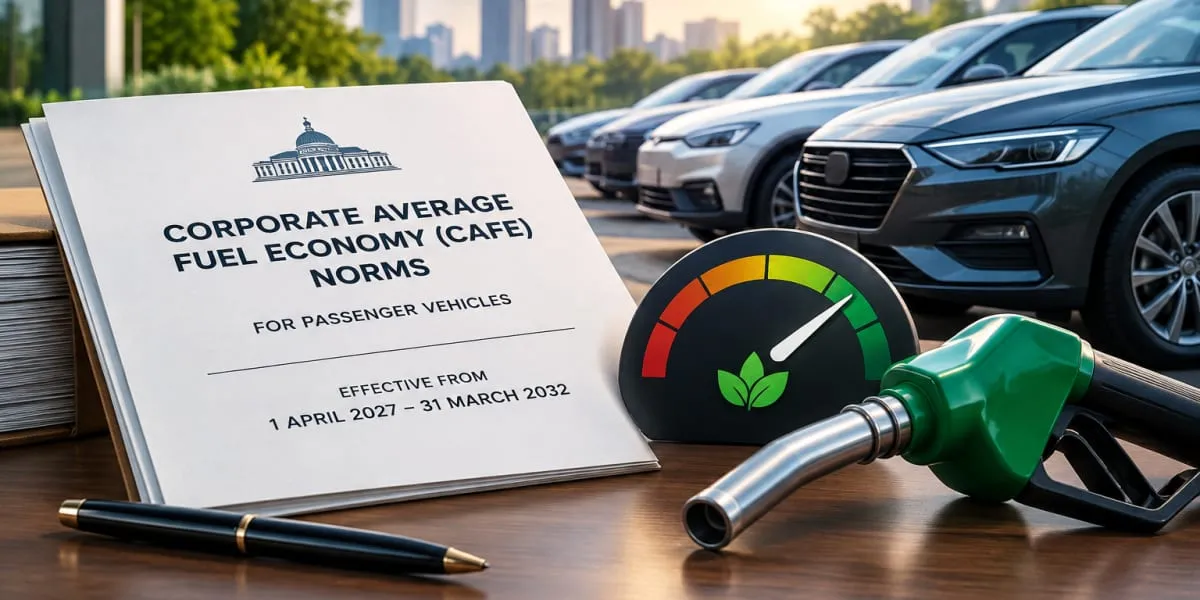
The government has notified new Corporate Average Fuel Economy (CAFE) norms for passenger vehicles, replacing the existing framework. The rules will apply from 1 April 2027 and remain in force until 31 March 2032, covering new passenger vehicles manufactured or imported for sale in India.

The CAFE system sets a benchmark for the average fuel consumption and efficiency of all passenger vehicles produced by an individual vehicle company. Under the notified framework, manufacturers will be assessed on the combined fuel performance of the passenger vehicles they make for the Indian market.

According to the Ministry of Energy, the fuel efficiency targets will become stricter each year during the period covered by the rules. The standard for fuel consumption will be reduced from 3.9 litres per 100 kilometres in 2027-28 to 3.32 litres per 100 kilometres in 2031-32.

The change represents an improvement of more than 16 per cent in fuel efficiency over the period. The annual tightening of the benchmark is intended to reduce the average fuel consumption of passenger vehicles covered by the regulations.

The government said the new norms would provide the automobile industry with greater regulatory clarity and a stable policy framework. The rules are also intended to support technological innovation, improve energy efficiency and encourage lower fuel consumption across India’s passenger vehicle sector.

The norms will therefore guide the industry through a defined five-year implementation period, with progressively higher efficiency requirements. Their application to both domestically manufactured and imported vehicles means that new passenger vehicles offered for sale in India will be covered by the same regulatory framework.

The government has notified new Corporate Average Fuel Economy (CAFE) norms for passenger vehicles, replacing the existing framework. The rules will apply from 1 April 2027 and remain in force until 31 March 2032, covering new passenger vehicles manufactured or imported for sale in India. The CAFE system sets a benchmark for the average fuel consumption and efficiency of all passenger vehicles produced by an individual vehicle company. Under the notified framework, manufacturers will be assessed on the combined fuel performance of the passenger vehicles they make for the Indian market. According to the Ministry of Energy, the fuel efficiency targets will become stricter each year during the period covered by the rules. The standard for fuel consumption will be reduced from 3.9 litres per 100 kilometres in 2027-28 to 3.32 litres per 100 kilometres in 2031-32. The change represents an improvement of more than 16 per cent in fuel efficiency over the period. The annual tightening of the benchmark is intended to reduce the average fuel consumption of passenger vehicles covered by the regulations. The government said the new norms would provide the automobile industry with greater regulatory clarity and a stable policy framework. The rules are also intended to support technological innovation, improve energy efficiency and encourage lower fuel consumption across India’s passenger vehicle sector. The norms will therefore guide the industry through a defined five-year implementation period, with progressively higher efficiency requirements. Their application to both domestically manufactured and imported vehicles means that new passenger vehicles offered for sale in India will be covered by the same regulatory framework.

Related Stories

Gold Stories

Next Story
Infrastructure Urban

VECV Sales Rise 49.6% to 11,396 Units in September

VE Commercial Vehicles Ltd (VECV), a joint venture between Volvo Group and Eicher Motors, recorded sales of 11,396 units in September 2026, up 49.6 per cent from 7,619 units in September 2025.The total included 11,146 units under the Eicher brand and 250 units under the Volvo brand.Eicher-branded trucks and buses recorded sales of 11,146 units during the month, compared with 7,352 units in September 2025, registering growth of 51.6 per cent.In the domestic commercial vehicle market, Eicher trucks and buses reported sales of 10,479 units, up 57.5 per cent from 6,652 units in the corresponding p..

Next Story
Infrastructure Urban

"Agentic AI set to transform supply chain decision-making."

Interview with: Lalit Das, Founder & CEO, Agentra AIWhy the next phase of supply chain technology will be about AI that acts, not just advises?Supply chains no longer have a visibility problem. They have a decision-latency problem. It takes about 8.7 hours to detect a disruption and more than 40 more to understand its impact, all before anyone acts. Meanwhile, disruption costs the global economy an estimated $184 billion a year.Enterprises already own excellent systems of record. What they lack is a system of action. Copilots don't fix that, they just give faster answers about a broken pro..

Next Story
Real Estate

BNW Developments Opens Sydney Office to Target UAE Investors

BNW Developments has expanded its international presence with the opening of a new office in Sydney, Australia, aimed at strengthening engagement with Australian investors interested in the UAE residential property market.The Sydney office will serve as a local platform for investors, wealth advisers, brokerage firms and real estate professionals exploring opportunities in Dubai and Ras Al Khaimah.Headquartered in Dubai, BNW Developments has launched 13 projects and has another 16 projects in its pipeline, representing a combined gross development value of around AED 32 billion (USD 8.7 billio..

Advertisement

Subscribe to Our Newsletter

Get daily newsletters around different themes from Construction world.

STAY CONNECTED

Advertisement

SPECIAL OFFER
QR Code