Government To Expand MSME-SPICE Scheme To Greenfield Units
ECONOMY & POLICY

Government To Expand MSME-SPICE Scheme To Greenfield Units

The Government of India plans to expand the scope of its MSME-SPICE scheme by allowing greenfield units—newly established enterprises—to participate, following lower-than-expected uptake from existing businesses.

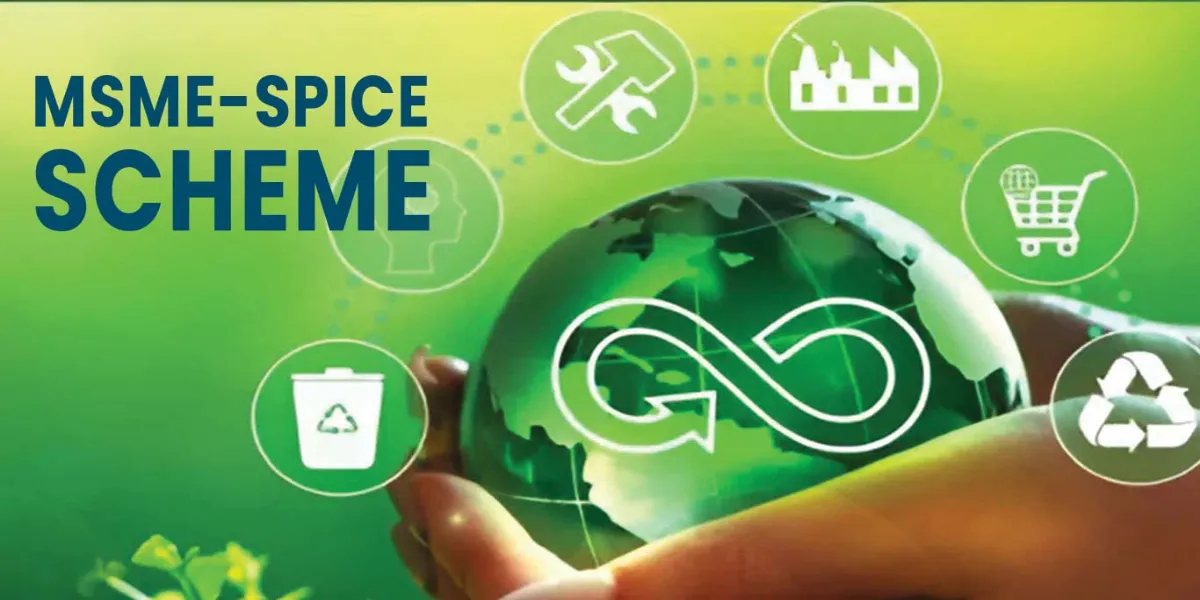
Launched in December 2023, the MSME-SPICE (Scheme for Promotion and Investment in Circular Economy) supports micro, small and medium enterprises (MSMEs) in adopting circular economy practices such as recycling, waste reduction, and resource efficiency. The scheme provides capital subsidies to help enterprises upgrade their equipment and production processes to more sustainable standards.

Initially restricted to existing (“brownfield”) units, the scheme has seen limited participation, with only six MSMEs availing incentives so far—far below the target of 3,400 enterprises by FY2026-27. Out of the Rs 5 billion allocated for the initiative, just Rs 20 million has been disbursed to date.

A senior government official told Moneycontrol that expanding the scheme to include new entrants could improve adoption rates. “We expect more MSMEs to invest in plant and machinery that support circular processes once greenfield units are made eligible,” the official said.

Under the current framework, MSMEs can receive a capital subsidy of up to 25 per cent of the cost of plant and machinery, capped at Rs 1.25 million per unit, to help offset upfront investment in green technologies. The scheme is being implemented by the Small Industries Development Bank of India (SIDBI).

By broadening eligibility, the government hopes to stimulate greater participation, encourage sustainable industrial practices, and advance India’s transition towards a greener, more resource-efficient economy.

The Government of India plans to expand the scope of its MSME-SPICE scheme by allowing greenfield units—newly established enterprises—to participate, following lower-than-expected uptake from existing businesses. Launched in December 2023, the MSME-SPICE (Scheme for Promotion and Investment in Circular Economy) supports micro, small and medium enterprises (MSMEs) in adopting circular economy practices such as recycling, waste reduction, and resource efficiency. The scheme provides capital subsidies to help enterprises upgrade their equipment and production processes to more sustainable standards. Initially restricted to existing (“brownfield”) units, the scheme has seen limited participation, with only six MSMEs availing incentives so far—far below the target of 3,400 enterprises by FY2026-27. Out of the Rs 5 billion allocated for the initiative, just Rs 20 million has been disbursed to date. A senior government official told Moneycontrol that expanding the scheme to include new entrants could improve adoption rates. “We expect more MSMEs to invest in plant and machinery that support circular processes once greenfield units are made eligible,” the official said. Under the current framework, MSMEs can receive a capital subsidy of up to 25 per cent of the cost of plant and machinery, capped at Rs 1.25 million per unit, to help offset upfront investment in green technologies. The scheme is being implemented by the Small Industries Development Bank of India (SIDBI). By broadening eligibility, the government hopes to stimulate greater participation, encourage sustainable industrial practices, and advance India’s transition towards a greener, more resource-efficient economy.

Next Story
Infrastructure Transport

India Becomes First to Produce Bio-Bitumen for Roads

India has become the first country in the world to commercially produce bio-bitumen for use in road construction, according to Road, Transport and Highways Minister Nitin Gadkari. Bitumen, a black and viscous hydrocarbon derived from crude oil, is a key binding material in road building, and the bio-based alternative is expected to significantly improve the sector’s environmental footprint.Addressing the CSIR Technology Transfer Ceremony in New Delhi, Mr Gadkari congratulated Council of Scientific and Industrial Research on achieving the milestone, noting that the initiative would help curb ..

Next Story
Infrastructure Urban

HILT Policy Seen Boosting Telangana Revenue Sharply

The Hyderabad Industrial Land Transformation (HILT) Policy is expected to generate around Rs 1.08 billion in revenue for the Telangana state exchequer, according to Deputy Chief Minister Bhatti Vikramarka Mallu. Speaking in the Telangana Legislative Assembly, he said the policy would be implemented within a six-month timeframe in a transparent manner, with uniform rules applicable to all stakeholders. Mr Vikramarka noted that without the HILT Policy, the state would have earned only about Rs 1.2 million per acre. Under the new framework, however, revenue is projected to rise sharply to Rs 70 ..

Next Story
Infrastructure Urban

India Post, MoRD Tie Up to Boost Rural Inclusion

The Department of Posts and the Ministry of Rural Development have signed a Memorandum of Understanding to accelerate rural transformation and expand financial, digital and logistics services for Self-Help Groups (SHGs) and rural households across India. The agreement was signed in the presence of Union Minister of Communications and Development of North Eastern Region Jyotiraditya M. Scindia and Union Minister of Rural Development and Agriculture and Farmers’ Welfare Shivraj Singh Chouhan. The collaboration aligns with the government’s “Dak Sewa, Jan Sewa” vision and seeks to repositi..

Advertisement

Subscribe to Our Newsletter

Get daily newsletters around different themes from Construction world.

STAY CONNECTED

Advertisement

Advertisement

Advertisement

Advertisement

Open In App