Heavy Industries Ministry Frees 4.4 Million Sq Ft Under SCDPM 5.0
ECONOMY & POLICY

Heavy Industries Ministry Frees 4.4 Million Sq Ft Under SCDPM 5.0

Inspired by the Prime Minister’s vision to institutionalise Swachhata and clear long-pending matters, the Ministry of Heavy Industries (MHI), along with its Central Public Sector Enterprises (CPSEs) and Autonomous Bodies (ABs), actively participated in the fifth consecutive year of the Special Campaign for Disposal of Pending Matters (SCDPM) 5.0, held from 2 to 31 October 2025.

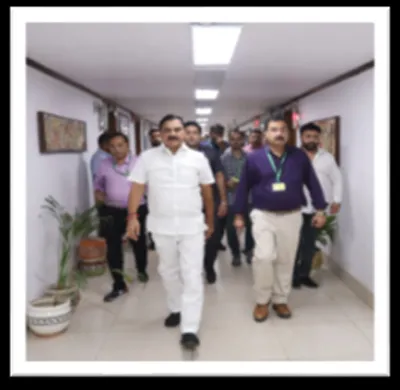
Throughout the campaign, MHI worked closely with the Department of Administrative Reforms and Public Grievances, reporting daily progress on a dedicated monitoring portal. Shri Bhupathi Raju Srinivasa Varma, Minister of State for Heavy Industries, reviewed the campaign’s activities and appreciated the Ministry’s commitment to efficiency and cleanliness. Senior officials and the Secretary of MHI also conducted inspections of office premises at Udyog Bhawan to ensure cleanliness and compliance.

Under Special Campaign 5.0, MHI and its affiliated CPSEs and ABs achieved notable outcomes:

Cleanliness drives were conducted across 1,373 sites nationwide.

4.44 million sq. ft. of office space was freed through systematic disposal of clutter.

Scrap disposal generated Rs 98.8 million in revenue.

All 28 public grievances and 10 appeals were resolved, achieving 100 per cent disposal.

41,539 physical files were reviewed, with 34,426 files weeded out.

1.06 million e-files were reviewed, and 0.95 million closed after evaluation.

To ensure greater public engagement, 438 social media posts were shared on X (formerly Twitter) through official handles, and four Press Information Bureau (PIB) releases were issued, highlighting key achievements across the Ministry and its CPSEs.

The Ministry’s CPSEs and ABs also undertook a range of activities under the campaign, reinforcing their commitment to transparency, efficiency, and the Prime Minister’s call for cleaner, accountable governance. The outcomes of SCDPM 5.0 reflect MHI’s dedication to operational reform, digital record management, and sustainable workplace practices.

Inspired by the Prime Minister’s vision to institutionalise Swachhata and clear long-pending matters, the Ministry of Heavy Industries (MHI), along with its Central Public Sector Enterprises (CPSEs) and Autonomous Bodies (ABs), actively participated in the fifth consecutive year of the Special Campaign for Disposal of Pending Matters (SCDPM) 5.0, held from 2 to 31 October 2025. Throughout the campaign, MHI worked closely with the Department of Administrative Reforms and Public Grievances, reporting daily progress on a dedicated monitoring portal. Shri Bhupathi Raju Srinivasa Varma, Minister of State for Heavy Industries, reviewed the campaign’s activities and appreciated the Ministry’s commitment to efficiency and cleanliness. Senior officials and the Secretary of MHI also conducted inspections of office premises at Udyog Bhawan to ensure cleanliness and compliance. Under Special Campaign 5.0, MHI and its affiliated CPSEs and ABs achieved notable outcomes: Cleanliness drives were conducted across 1,373 sites nationwide. 4.44 million sq. ft. of office space was freed through systematic disposal of clutter. Scrap disposal generated Rs 98.8 million in revenue. All 28 public grievances and 10 appeals were resolved, achieving 100 per cent disposal. 41,539 physical files were reviewed, with 34,426 files weeded out. 1.06 million e-files were reviewed, and 0.95 million closed after evaluation. To ensure greater public engagement, 438 social media posts were shared on X (formerly Twitter) through official handles, and four Press Information Bureau (PIB) releases were issued, highlighting key achievements across the Ministry and its CPSEs. The Ministry’s CPSEs and ABs also undertook a range of activities under the campaign, reinforcing their commitment to transparency, efficiency, and the Prime Minister’s call for cleaner, accountable governance. The outcomes of SCDPM 5.0 reflect MHI’s dedication to operational reform, digital record management, and sustainable workplace practices.

Next Story
Infrastructure Urban

Implementation Status of Jal Jeevan Mission

Since August 2019 the Government has implemented Jal Jeevan Mission to provide assured potable water through household tap connections in rural India. At the start of the mission only 32.3 million (mn) rural households, representing 16.7 per cent, were reported to have tap water connections. States and union territories have reported that 125.8 mn additional rural households have since been provided with tap connections. As a result, of about 193.6 mn rural households roughly 158.2 mn, or 81.71 per cent, are reported to have tap water supply at home.\n\nThe State, district and village level st..

Next Story
Infrastructure Urban

Jal Jeevan Mission Reaches Eighty One Per Cent Rural Coverage

The Government reported substantial progress under the Jal Jeevan Mission, launched in August 2019 to provide tap water to every rural household. At launch only 32.3 million (mn) rural households had tap connections and states and Union territories reported provision of 125.8 mn additional households by March 2026. Consequently, out of about 193.6 mn rural households around 158.2 mn, or 81.71 per cent, are reported to have tap water at home. The Finance Minister announced extension of the mission until 2028 in the 2025-26 budget speech. The Swachh Bharat Mission Grameen, launched in October 20..

Next Story
Infrastructure Urban

Empowering Local Governance for Sustainable Rural Water Supply

The Ministry of Jal Shakti has aligned the Jal Jeevan Mission (JJM) with the 73rd Amendment to strengthen village level planning and community ownership of water supply. Gram Panchayats, village water and sanitation committees and Pani Samitis are to plan, implement, manage and maintain piped water systems, with gram sabha processes formalising handover and oversight. Implementation support agencies including non government organisations, community based organisations and self help groups have been empanelled to train local committees and promote women participation. Under JJM, the department ..

Advertisement

Subscribe to Our Newsletter

Get daily newsletters around different themes from Construction world.

STAY CONNECTED

Advertisement

Advertisement

Advertisement