



India To Launch E85 Fuel On World Environment Day
ECONOMY & POLICY

India To Launch E85 Fuel On World Environment Day

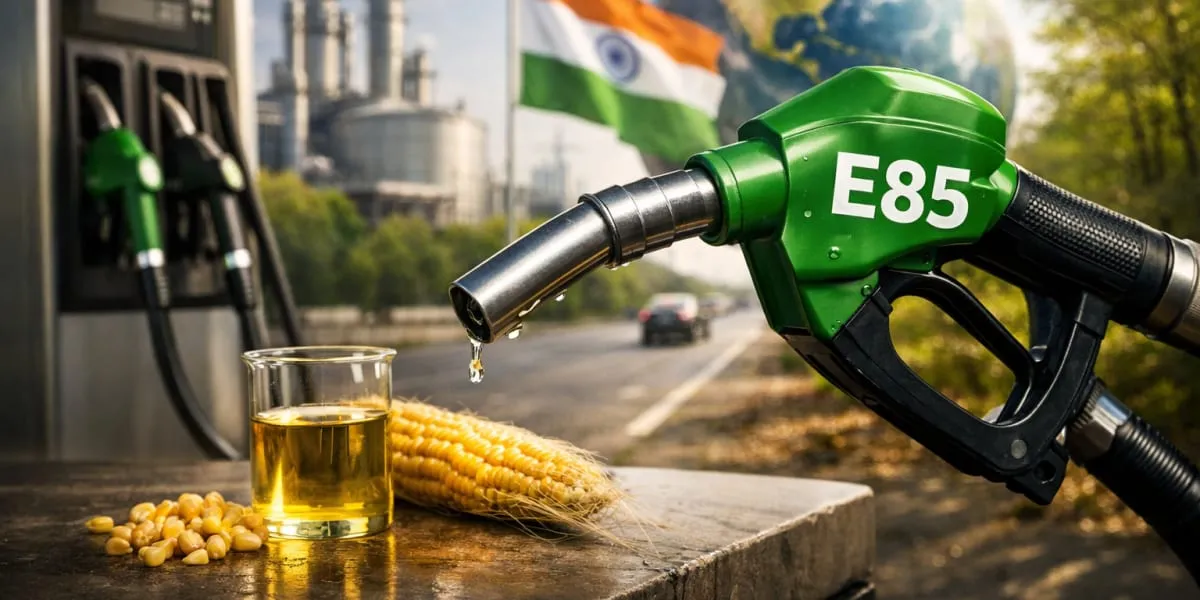
India will introduce E85 fuel on World Environment Day as part of a push for flex-fuel mobility, the government said. The move is designed to deepen the shift towards ethanol blending in road transport and to reduce reliance on fossil fuels. Implementation will involve oil marketing companies, vehicle manufacturers and fuel retailers in a coordinated rollout.

E85 comprises 85 per cent ethanol and 15 per cent gasoline, enabling higher domestic ethanol use in internal combustion engines. The blend can lower tailpipe emissions compared with standard petrol and support energy security objectives. Its introduction follows years of policy focus on biofuels and additive blends.

Flex-fuel vehicles that can run on high ethanol blends will be central to the strategy, and manufacturers will be encouraged to certify and market such models. Fuel pumps will need equipment upgrades and quality checks to handle the corrosive properties of high ethanol content. Regulators will set standards to ensure vehicle compatibility and supply chain integrity.

The change will boost demand for ethanol from sugarcane and other feedstocks, creating new market opportunities for farmers and processors. Investments in logistics and storage will be necessary to move increased volumes to retail outlets. The policy frames environmental goals alongside rural income support and domestic industry development.

An initial rollout will focus on pilot stations equipped to dispense the blend and on certification protocols for service stations. Coordination across central ministries, state agencies and oil marketing companies will govern supply, distribution and quality assurance during the rollout. Officials will monitor vehicle performance, consumer uptake and pricing dynamics to guide any scale up while ensuring warranties and safety standards are maintained.

India will introduce E85 fuel on World Environment Day as part of a push for flex-fuel mobility, the government said. The move is designed to deepen the shift towards ethanol blending in road transport and to reduce reliance on fossil fuels. Implementation will involve oil marketing companies, vehicle manufacturers and fuel retailers in a coordinated rollout. E85 comprises 85 per cent ethanol and 15 per cent gasoline, enabling higher domestic ethanol use in internal combustion engines. The blend can lower tailpipe emissions compared with standard petrol and support energy security objectives. Its introduction follows years of policy focus on biofuels and additive blends. Flex-fuel vehicles that can run on high ethanol blends will be central to the strategy, and manufacturers will be encouraged to certify and market such models. Fuel pumps will need equipment upgrades and quality checks to handle the corrosive properties of high ethanol content. Regulators will set standards to ensure vehicle compatibility and supply chain integrity. The change will boost demand for ethanol from sugarcane and other feedstocks, creating new market opportunities for farmers and processors. Investments in logistics and storage will be necessary to move increased volumes to retail outlets. The policy frames environmental goals alongside rural income support and domestic industry development. An initial rollout will focus on pilot stations equipped to dispense the blend and on certification protocols for service stations. Coordination across central ministries, state agencies and oil marketing companies will govern supply, distribution and quality assurance during the rollout. Officials will monitor vehicle performance, consumer uptake and pricing dynamics to guide any scale up while ensuring warranties and safety standards are maintained.

Next Story
Real Estate

AI: The New Recruit

From getting ideas to evaluating designs, presenting concepts to clients and tracking projects, artificial intelligence (AI) is helping architects work better and faster.“AI allows architects to spend more time doing what only they can do: think critically, synthesise complexity and design with intent,” says Dikshu C Kukreja, Managing Principal, CP Kukreja Architects. “Every minute reclaimed from repetitive processes can be invested in creativity, contextual understanding, interdisciplinary collaboration and innovation – the qualities that define meaningful architecture.”To read the ..

Next Story
Real Estate

Redevelopment 2.0

In 2017, Mumbai identified 160,000 ageing buildings due for structural audit. Close to half of these were in the Western Suburbs. Redeveloping the oldest and structurally weakest of these would help unlock new housing, much needed given the city’s growing population density and constant developed area of 437.7 sq km. At 30,600 people per sq km in 2024, Mumbai’s density was almost thrice that of Gurugram, and 60 per cent higher than Bengaluru’s.Essentially, Mumbai’s realty market has demand. It has capital. It has realty development potential.Fast forward to 2026. Mumbai has 1,094 regis..

Next Story
Technology

Cost intelligence will become a strategic contributor to project success

As India's construction industry accelerates its digital transformation, integrated platforms, AI and connected data are becoming essential to improving cost certainty, project efficiency and sustainability. Ravi Kumar, Sales Director – India, RIB Software India, shares how digital workflows are reshaping project planning, commercial management and decision-making across the construction value chain.India's construction sector is embracing digital technologies at an unprecedented pace. From your perspective, what are the biggest shifts driving this transformation and how is RIB Software enab..

Advertisement

Subscribe to Our Newsletter

Get daily newsletters around different themes from Construction world.

STAY CONNECTED

Advertisement

Advertisement

Advertisement














