JERA and AM Green Sign Five-Year Deal for 70,000 t of Green Ammonia
ECONOMY & POLICY

JERA and AM Green Sign Five-Year Deal for 70,000 t of Green Ammonia

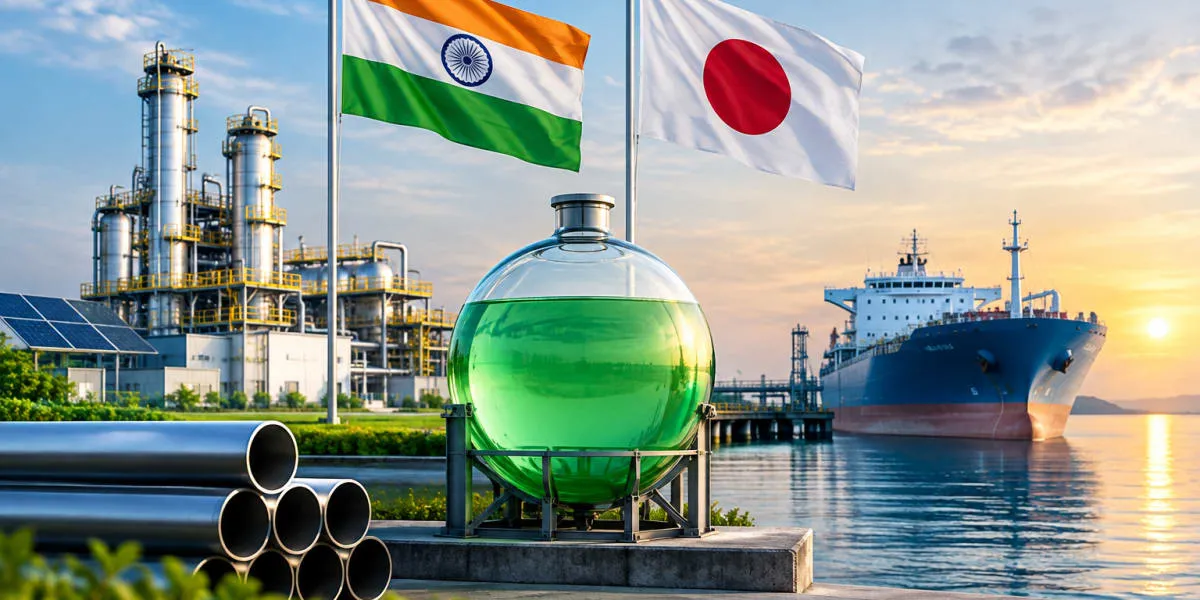
JERA and AM Green Ammonia have signed a binding Heads of Agreement for the supply of green ammonia produced in India for maritime decarbonisation in Japan. The agreement covers approximately 70,000 t of green ammonia annually for five years, with an option to extend the arrangement for additional supplies.

The ammonia is planned to be produced at AM Green’s facility in Kakinada, Andhra Pradesh, which is scheduled for commissioning in 2028-29. The plant will use advanced alkaline electrolysis technology and round-the-clock renewable energy supported by pumped-hydro energy storage, providing a consistent supply of renewable-based ammonia for international markets.

The product will be received, stored and distributed through facilities being developed next to JERA’s Hekinan Thermal Power Station in Aichi Prefecture, Japan. These facilities will support several applications, including maritime transportation and the distribution of ammonia fuel.

The supply is primarily intended for a business venture to be established by Kawasaki Kisen Kaisha and Nippon Yusen. The venture plans to use an ammonia bunkering vessel to deliver fuel to ammonia-powered car carriers, creating one of the first large-scale green ammonia bunkering projects globally and supporting wider adoption of lower-carbon fuels in shipping.

The agreement forms part of JERA’s strategy to build an integrated low-carbon ammonia value chain spanning production, transport, storage and utilisation. It expands the company’s ammonia activities beyond power generation into maritime fuel and may support broader industrial and commercial applications in Japan. The supply is expected to meet internationally recognised low-carbon standards and be benchmarked against European market requirements. Procurement from India will diversify JERA’s planned portfolio, strengthen supply security and support customers’ decarbonisation needs.

For AM Green, the agreement is among its first delivered-basis supply contracts in Asia. The company said the Kakinada project would support Japan’s decarbonisation objectives, respond to maritime demand for green fuels and reinforce India’s potential role as a global supplier of renewable ammonia.

JERA and AM Green Ammonia have signed a binding Heads of Agreement for the supply of green ammonia produced in India for maritime decarbonisation in Japan. The agreement covers approximately 70,000 t of green ammonia annually for five years, with an option to extend the arrangement for additional supplies. The ammonia is planned to be produced at AM Green’s facility in Kakinada, Andhra Pradesh, which is scheduled for commissioning in 2028-29. The plant will use advanced alkaline electrolysis technology and round-the-clock renewable energy supported by pumped-hydro energy storage, providing a consistent supply of renewable-based ammonia for international markets. The product will be received, stored and distributed through facilities being developed next to JERA’s Hekinan Thermal Power Station in Aichi Prefecture, Japan. These facilities will support several applications, including maritime transportation and the distribution of ammonia fuel. The supply is primarily intended for a business venture to be established by Kawasaki Kisen Kaisha and Nippon Yusen. The venture plans to use an ammonia bunkering vessel to deliver fuel to ammonia-powered car carriers, creating one of the first large-scale green ammonia bunkering projects globally and supporting wider adoption of lower-carbon fuels in shipping. The agreement forms part of JERA’s strategy to build an integrated low-carbon ammonia value chain spanning production, transport, storage and utilisation. It expands the company’s ammonia activities beyond power generation into maritime fuel and may support broader industrial and commercial applications in Japan. The supply is expected to meet internationally recognised low-carbon standards and be benchmarked against European market requirements. Procurement from India will diversify JERA’s planned portfolio, strengthen supply security and support customers’ decarbonisation needs. For AM Green, the agreement is among its first delivered-basis supply contracts in Asia. The company said the Kakinada project would support Japan’s decarbonisation objectives, respond to maritime demand for green fuels and reinforce India’s potential role as a global supplier of renewable ammonia.

Related Stories

Gold Stories

Next Story
Infrastructure Urban

Bajaj Auto to Raise Monthly Electric 2W Capacity to 80,000 by March

Bajaj Auto plans to raise monthly production capacity for electric two-wheelers to around 80,000 units by the end of March, as demand for its Chetak electric scooter continues to exceed available output. The company currently has capacity for around 60,000 electric two-wheelers a month. Joint Managing Director Rakesh Sharma said production had returned to the existing full capacity after a supply chain disruption affected output. The issue had reduced recent production to around 40,000 units, resulting in a shortfall of 20,000 vehicles despite strong demand. The company expects to remove produ..

Next Story
Infrastructure Transport

India’s Domestic Air Passenger Traffic Falls 6.5% in September

India’s domestic air passenger traffic declined 6.49 per cent month on month to 11.8 mn in September, according to data released by the Directorate General of Civil Aviation (DGCA). IndiGo retained its leading position, carrying nearly two-thirds of domestic passengers, while the Air India Group remained the second-largest operator. IndiGo held a 65.4 per cent market share and transported 7.73 mn passengers during the month. The Air India Group accounted for 26.8 per cent of the market, carrying 3.165 mn passengers, based on data from the aviation regulator. Akasa Air ranked third with a 5.6..

Next Story
Infrastructure Urban

DPIIT Advances Trust-Based Governance Across India

The Department for Promotion of Industry and Internal Trade (DPIIT), under the Ministry of Commerce and Industry, is shifting India’s regulatory approach from permission-based administration to trust-based governance. The reforms seek to reduce business compliance, support startups, attract investment and simplify approvals across the country. According to an official statement, 47,957 compliance requirements have been reduced across Central Ministries and States and Union Territories. Of these, 22,290 have been digitised, 16,141 simplified, 5,255 decriminalised and 4,271 eliminated. The Jan..

Advertisement

Subscribe to Our Newsletter

Get daily newsletters around different themes from Construction world.

STAY CONNECTED

Advertisement

SPECIAL OFFER
QR Code