+
Land Drives Housing Inflation As Construction Costs Rise
ECONOMY & POLICY

Land Drives Housing Inflation As Construction Costs Rise

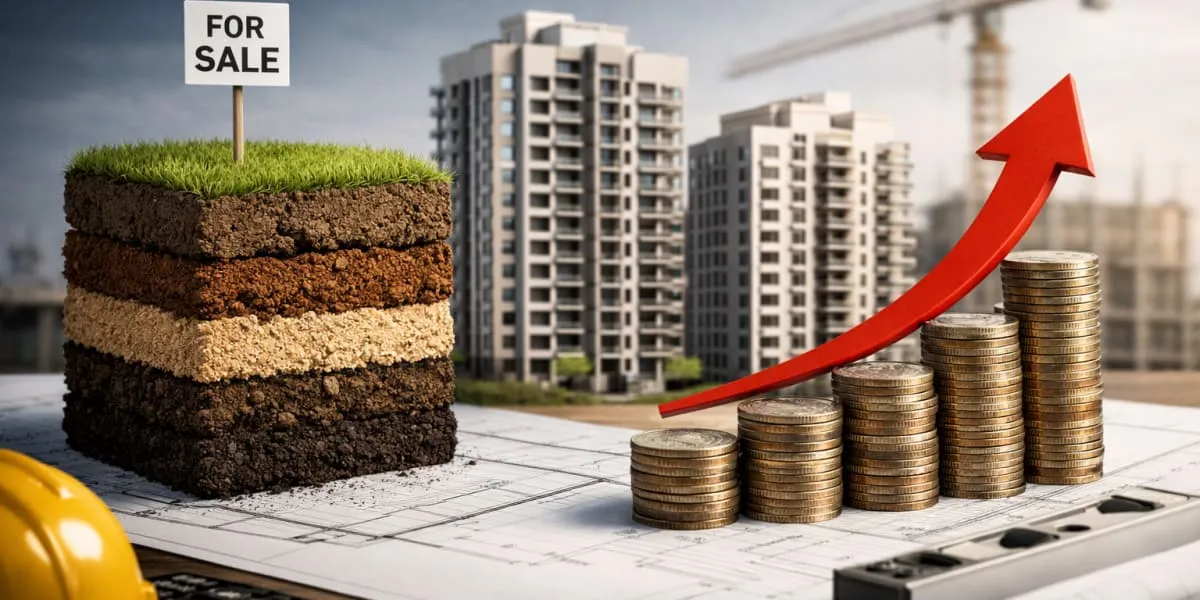
Anarock Research data shows housing prices in India’s top seven cities have risen markedly faster than construction costs over the past five years, with capital values up 59 per cent versus a 34 per cent rise in construction costs. Between 2021 and 2025 the average standard-plus construction cost climbed from Rs 2,681 per sq ft to Rs 3,604 per sq ft, implying around a 34 per cent increase and a compound annual growth rate of about six point nine per cent. Residential capital values moved from Rs 5,826 per sq ft to Rs 9,260 per sq ft in the same period, a 59 per cent gain.

The widening gap is driven largely by land prices, developer margins and demand-supply dynamics rather than building inputs alone. Land values across the seven cities rose by between 50 and 120 per cent from 2021 to the first half of 2026, with the National Capital Region (NCR) and Bengaluru recording some of the steepest rises. Anarock attributed the moves to infrastructure-led appreciation, location premiums and developer pricing, noting high acquisition costs in established corridors.

Geopolitical tensions in the Middle East added fresh pressure on construction inputs, with disruption between March and July estimated to have contributed eight to 10 per cent to overall costs. Steel and fuel-linked logistics were the biggest cost movers, with TMT bar prices reaching about Rs 72,000 per tonne (t) and fuel-related logistics rising by 15 to 20 per cent. Finishing materials were around eight to 12 per cent costlier while mechanical, electrical and plumbing (MEP) costs rose by nine to 13 per cent.

Labour remains the single largest cost head, accounting for around 25 to 30 per cent of project expenditure and rising by approximately five to six per cent due to skilled-worker shortages and new labour codes. Core building costs rose 13 per cent between 2023 and 2025, while MEP increased by more than 17 per cent, raising MEP’s share of total costs. Developers with largely sold projects face margin compression as input costs rise, whereas new projects allow repricing subject to buyer affordability. The widening gap between build costs and buyer prices is likely to remain a structural challenge for India’s residential market.

Anarock Research data shows housing prices in India’s top seven cities have risen markedly faster than construction costs over the past five years, with capital values up 59 per cent versus a 34 per cent rise in construction costs. Between 2021 and 2025 the average standard-plus construction cost climbed from Rs 2,681 per sq ft to Rs 3,604 per sq ft, implying around a 34 per cent increase and a compound annual growth rate of about six point nine per cent. Residential capital values moved from Rs 5,826 per sq ft to Rs 9,260 per sq ft in the same period, a 59 per cent gain. The widening gap is driven largely by land prices, developer margins and demand-supply dynamics rather than building inputs alone. Land values across the seven cities rose by between 50 and 120 per cent from 2021 to the first half of 2026, with the National Capital Region (NCR) and Bengaluru recording some of the steepest rises. Anarock attributed the moves to infrastructure-led appreciation, location premiums and developer pricing, noting high acquisition costs in established corridors. Geopolitical tensions in the Middle East added fresh pressure on construction inputs, with disruption between March and July estimated to have contributed eight to 10 per cent to overall costs. Steel and fuel-linked logistics were the biggest cost movers, with TMT bar prices reaching about Rs 72,000 per tonne (t) and fuel-related logistics rising by 15 to 20 per cent. Finishing materials were around eight to 12 per cent costlier while mechanical, electrical and plumbing (MEP) costs rose by nine to 13 per cent. Labour remains the single largest cost head, accounting for around 25 to 30 per cent of project expenditure and rising by approximately five to six per cent due to skilled-worker shortages and new labour codes. Core building costs rose 13 per cent between 2023 and 2025, while MEP increased by more than 17 per cent, raising MEP’s share of total costs. Developers with largely sold projects face margin compression as input costs rise, whereas new projects allow repricing subject to buyer affordability. The widening gap between build costs and buyer prices is likely to remain a structural challenge for India’s residential market.

Related Stories

Gold Stories

Next Story
Infrastructure Urban

TransIndia Launches World View Collection at Meridian

TransIndia Group has recently launched ‘The World View Collection’ at TransIndia Meridian, its residential development in Mumbai’s Sion-Matunga Corridor. The campaign introduces residences located on the 22nd floor and above, offering expansive views of the cityscape, Eastern Bay and the sea.The collection positions elevation as an integral part of the living experience, with the higher-floor homes designed around openness, changing skylines and wider city views. Rather than focusing only on floor height, the campaign highlights how elevated residences can offer a different perspective o..

Next Story
Real Estate

Villaro Design Studio Opens on MG Road in Delhi

Furniture designer Yuvraj Vohra has recently launched the new Villaro Design Studio on MG Road, Delhi, introducing a furniture brand built around an architectural approach to design, materiality and craftsmanship.Trained as an architect, Vohra approaches furniture as an integral part of the spatial experience rather than as standalone objects. Villaro's design philosophy focuses on proportion, material expression and the relationship between furniture and its surrounding architecture.The collection explores combinations of stone, marble, wood, metal and upholstery, with materials treated as st..

Next Story
Infrastructure Urban

India-Belgium Trade Shows Signs of Recovery in FY2026

India-Belgium economic relations are gaining renewed momentum following Belgian Prime Minister Bart De Wever’s three-day official visit to India from September 2–4, 2026. The visit, the first by a Belgian Prime Minister to India in two decades, focused on strengthening cooperation across trade, investment, defence, technology, connectivity and logistics.Belgium is an important European investment and trading partner for India, with cumulative foreign direct investment inflows of around $4.25 billion between April 2000 and March 2026. The country is a major European manufacturing, trade and..

Advertisement

Subscribe to Our Newsletter

Get daily newsletters around different themes from Construction world.

STAY CONNECTED

Advertisement

SPECIAL OFFER
QR Code