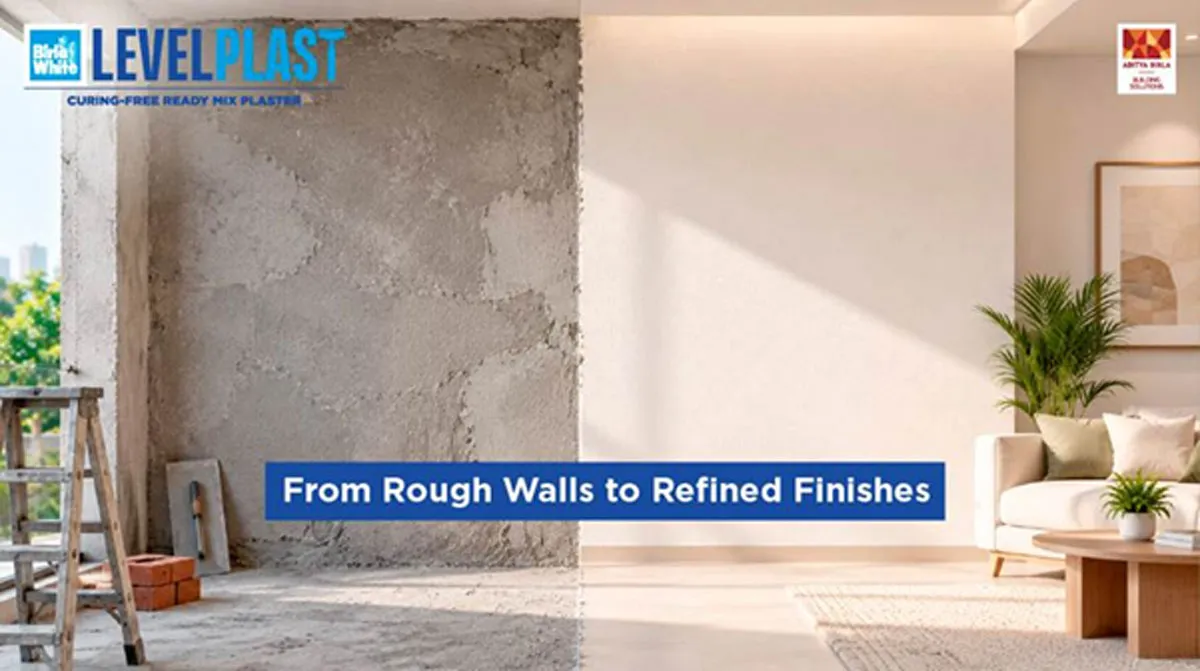
From Rough to Refined: How Modern Plastering Is Changing Wall Finishes
The Beginning: When Walls Are More Than Just Four Sides

Traditional construction often leaves masonry surfaces uneven. Bricks, blocks, joints and variations in the substrate can create an inconsistent surface.
This is where wall plastering becomes an important part of the construction process.
Plastering helps create a more uniform surface over masonry and prepares walls for subsequent finishing layers. When properly applied, wall plaster can improve surface regularity and provide a suitable base for finishing.
For Rohan, this was the first step in transforming his rough walls into the refined interiors he had envisioned.
But plastering itself was changing.
From Conventional Plastering to Modern Wall Finishes
As construction practices have evolved, so have expectations from plaster.
Today, homeowners and construction professionals are looking beyond simply covering a wall. They want:
- More consistent surfaces
- Better workability
- Efficient application
- Reduced surface imperfections
- Improved finish quality
- Compatibility with modern finishing systems
- Faster and more predictable construction
This has contributed to the growing interest in modern plastering solutions.
Instead of treating plaster as just another construction layer, modern approaches focus on achieving a more controlled and finish-ready surface.
A Wall Is Now Part of the Design
Rohan's contractor explained it simply:
“Earlier, plaster was mostly about making the wall level. Today, we're thinking about what the wall needs to become.”
That distinction is important.
The plaster layer can influence how subsequent products—such as wall putty, primer and paint—perform and appear. A properly prepared substrate can help create a smoother transition between construction and finishing stages.
In other words, the journey from rough to refined happens layer by layer.
What Makes Modern Plastering Different?
Modern plastering is not necessarily about abandoning conventional methods. Instead, it is about using improved materials, application practices and construction techniques to achieve greater consistency and efficiency.
One option used in modern construction is cementitious plaster, which is based on cement and suitable aggregates and is commonly used to create a durable plaster layer over appropriate masonry or concrete substrates.
Depending on the product and application, modern plaster solutions can offer properties such as improved workability, adhesion, finish quality and consistency.
This gives applicators greater control during the plastering process.
1. Improved Material Formulations
Modern plaster products are designed with specific performance and application requirements in mind.
For example, cementitious plaster formulations can be developed for different substrates and application requirements. Selecting the appropriate product should always depend on the surface, location, required thickness and manufacturer's recommendations.
2. More Consistent Application
The quality of a finished wall depends not only on the material but also on how it is applied.
Correct substrate preparation, mixing, thickness control, curing and finishing practices can all influence the result.
Whether the project involves individual walls or complete wall-to-wall plastering, maintaining consistency throughout the application is important for achieving a uniform surface.
Modern plastering therefore puts greater emphasis on process consistency, rather than simply applying material to the wall.
3. Better Preparation for Finishing
Rohan soon noticed something interesting.
The smoother and more uniform the plaster looked, the easier it became to imagine the final painted wall.
A well-prepared plaster surface can provide a better starting point for subsequent finishing layers, although the exact preparation required depends on the plaster, substrate and finishing system being used.
This is particularly important when homeowners are aiming for clean, contemporary interiors where unevenness can become more noticeable under certain lighting conditions.
The Transformation: From Masonry to a Finished Wall
Think about a wall as a story told in several chapters.
Chapter 1: Masonry
Bricks, blocks or other masonry materials create the basic structure.
↓
Chapter 2: Plastering
The wall plaster layer helps create a more uniform surface and prepares the wall for finishing.
↓
Chapter 3: Surface Preparation
Depending on the finishing system, additional preparation may be required to address minor imperfections and create the desired surface.
↓
Chapter 4: Primer
Primer helps prepare the surface for the final coating and can improve paint adhesion and uniformity.
↓
Chapter 5: Paint
The final colour and finish bring the homeowner's vision to life.
For Rohan, the transformation suddenly made sense.
The paint wasn't creating the wall.
It was revealing the quality of everything underneath it.
Why Modern Plastering Matters for Today's Homes
Modern homes increasingly feature minimal interiors, large open spaces and carefully planned lighting.
These design choices can make wall imperfections more visible.
A small uneven patch that might have gone unnoticed in a heavily decorated room can become obvious when sunlight falls across a plain wall.
This is one reason modern wall plastering has become increasingly relevant to contemporary construction.
A properly planned plastering system can help create a consistent foundation for the finishing stages while supporting the aesthetic expectations of modern interiors.
Choosing the Right Wall Plaster
By now, Rohan had learned an important lesson:
Not every plastering requirement is the same.
The appropriate wall plaster depends on factors such as:
- Type of substrate
- Internal or external application
- Required thickness
- Site conditions
- Desired finish
- Application method
- Environmental exposure
- Manufacturer's recommendations
Choosing the right plaster for walls should therefore be based on the specific construction requirement rather than simply selecting a product because it is commonly used.
For larger projects involving extensive wall to wall plastering, professional guidance and adherence to the product's technical specifications can also help ensure appropriate application.
Modern Plastering Is About More Than Smoothness

It is easy to think of plastering as a simple quest for a smooth wall.
But modern plastering is about much more.
It is about creating a controlled transition between the structural surface and the final finish.
It is about improving application consistency.
It is about selecting suitable materials, including appropriate cementitious plaster solutions where required.
And ultimately, it is about building a surface that allows the final design to look the way it was intended to look.
From Construction to Craftsmanship
Rohan's home was finally painted.
The walls were clean, even and refined. His furniture stood out against the fresh surfaces, and the natural light moved smoothly across the rooms.
Standing in the living room, he remembered the rough walls he had seen months earlier.
The transformation hadn't happened overnight.
It had happened one layer at a time.
And somewhere beneath the final colour was the layer that had started it all—the wall plaster.
The Future of Wall Finishes Is Being Built Beneath the Paint
The construction industry continues to evolve, and wall finishing is evolving with it.
From improved formulations to more efficient application practices, modern plastering is helping redefine how construction professionals approach wall surfaces.
From solutions to improved application techniques, the focus is increasingly on creating consistent surfaces that are ready for the finishing stages.
For homeowners, the lesson is simple:
Don't judge a wall only by its final colour. Look at the surface beneath it.
Because a refined finish doesn't begin when the paintbrush touches the wall.
It begins much earlier—with the right substrate preparation, the right approach and attention to every layer that follows.
From rough masonry to refined interiors, modern plastering is turning walls from a construction necessity into the foundation of a better finish.
A Smoother Start with Levelplast
As Rohan explored his options, his contractor introduced him Levelplast, a plastering solution designed to help create a more uniform and level surface. By supporting easier application and consistent wall finishing, it can help customers achieve smoother-looking walls while making the subsequent stages of putty and painting more convenient—bringing them one step closer to the refined finish they envisioned for their home.
For customers, the advantage is simple: a better-prepared wall surface can mean a smoother transition from plastering to the final decorative finish.
Related Stories
Gold Stories




Embraer to Acquire 51 Per Cent Stake in Mahindra Aerospace Arm
Brazilian aerospace major Embraer will acquire a 51 per cent equity stake in Novavayu Aerospace, a step-down subsidiary of Mahindra and Mahindra, under an Investment Agreement notified by the automobile company in an exchange filing. The transaction will give Embraer control of the aerospace business. Following completion of the acquisition, Novavayu Aerospace will cease to be a wholly owned subsidiary and become an associate of Mahindra Defence Systems, which is a step-down wholly owned subsidiary of Mahindra and Mahindra. The agreement is expected to be completed on or before December 1. Mah..

RBI Opens Special Dollar Window for Three State-Run OMCs
The Reserve Bank of India (RBI) has opened a special facility to meet the entire daily US dollar requirements of three public sector oil marketing companies (OMCs), in a move aimed at easing pressure on the Indian rupee. The facility will take effect on October 12, 2026, and remain available until further notice. Indian Oil Corporation, Hindustan Petroleum Corporation and Bharat Petroleum Corporation are eligible to use the arrangement. Under the facility, the RBI will sell US dollars to the three companies through designated banks, allowing them to meet their oil-import payments without sourc..

Cement Prices Likely to Rise Rs. 10-15 per Bag from Mid-October
Cement manufacturers in India are likely to raise prices by Rs. 10-15 per bag from mid-October, as they seek to offset persistent increases in power and fuel costs. Emkay Research said its channel checks indicated a high probability of an increase from October 12, supported by the start of the busy construction season and favourable demand-supply conditions. The sector had implemented similar rate adjustments of Rs. 10-15 per bag during the first quarter, but the increases were insufficient to cover higher operating costs. Prices also softened during July and August because of the monsoon, wid..
Related Articles
Latest Updates