Lok Sabha Speaker: One Nation, One Tax Has Made Tax System Transparent
ECONOMY & POLICY

Lok Sabha Speaker: One Nation, One Tax Has Made Tax System Transparent

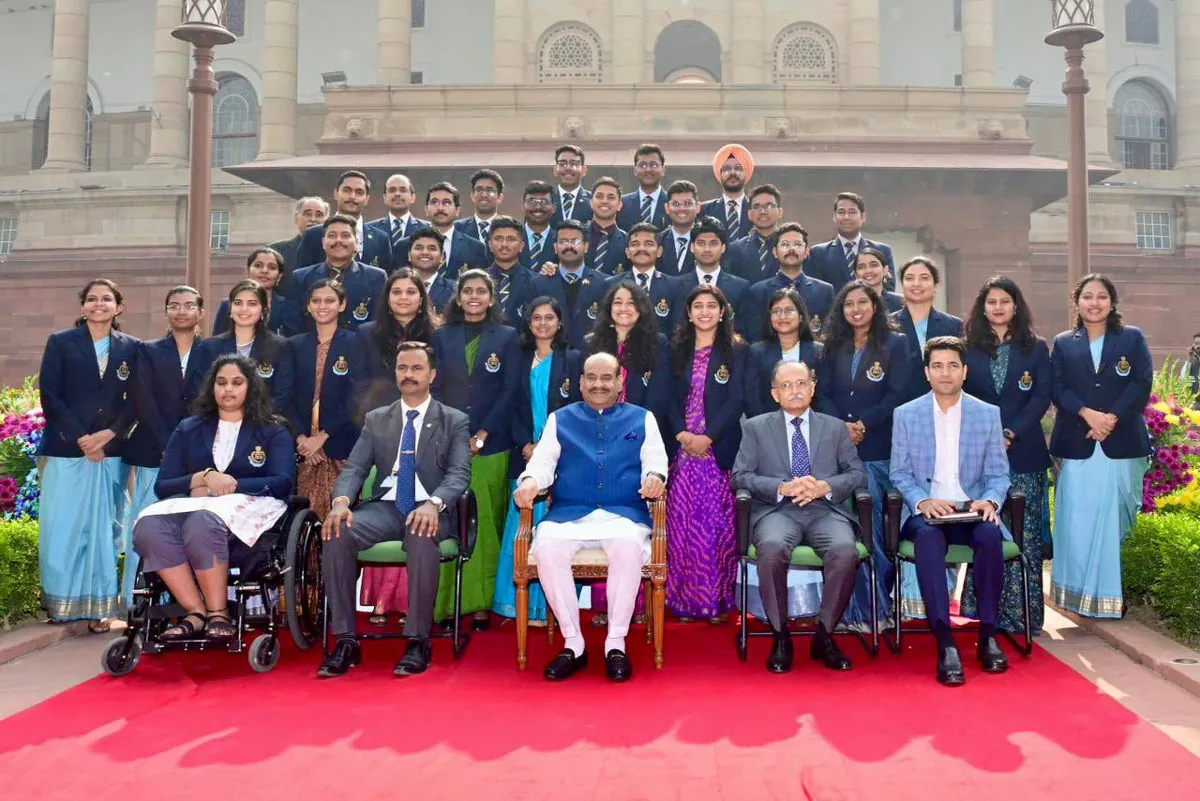
Lok Sabha Speaker Shri Om Birla said that reforms in direct and indirect taxes—along with the “One Nation, One Tax” GST framework—have made India’s tax structure simpler, more transparent and conducive to economic growth. He added that revenue service officers carry the responsibility of upholding and strengthening this transparent system.

He was addressing Officer Trainees of the 76th Batch of the Indian Revenue Service (IRS–C&IT), who are attending an Appreciation Course on Parliamentary Processes and Procedures organised by the Parliamentary Research and Training Institute for Democracies (PRIDE) in the Parliament House Complex.

Shri Birla expressed satisfaction at the growing representation of women in Central and All India Services, noting that their increasing presence reflects India’s aspirations and progress. He praised the technical capabilities of the younger generation, highlighting their proficiency in advanced technologies, research and innovation. Their fresh perspectives, he said, will help drive India towards global leadership and support the goal of Viksit Bharat envisioned by Prime Minister Shri Narendra Modi.

Calling Parliament the centre of India’s democratic policymaking, the Speaker said IRS officers will become key pillars of the nation’s economic strength. He emphasised that their role extends beyond tax collection to respecting honest taxpayers, facilitating business, curbing illegal trade and money laundering, and upholding financial discipline.

He reiterated the government’s aim to create a simpler, fairer and more transparent taxation system that strengthens citizens’ trust and ensures taxes are collected strictly in accordance with the law. Significant improvements have been achieved in recent years, he noted.

Shri Birla highlighted the role of digital tax systems, AI-based assessments and data analytics in enhancing transparency and accountability. He urged the trainees to study taxation laws, parliamentary debates and recent legislation closely to understand both the letter and spirit of the law. He expressed confidence that the new batch—equipped with strong technical skills and dedication—will strengthen India’s tax administration and contribute meaningfully to the country’s economic progress.

The 76th Batch of the IRS–C&IT includes 79 Officer Trainees, among them five from Bhutan. Women make up 40 per cent of the batch, while 32 per cent come from rural backgrounds. The average age is 28, and 51 of the trainees have prior work experience. Shri Utpal Kumar Singh, Secretary General of Lok Sabha, delivered the welcome address.

Lok Sabha Speaker Shri Om Birla said that reforms in direct and indirect taxes—along with the “One Nation, One Tax” GST framework—have made India’s tax structure simpler, more transparent and conducive to economic growth. He added that revenue service officers carry the responsibility of upholding and strengthening this transparent system.He was addressing Officer Trainees of the 76th Batch of the Indian Revenue Service (IRS–C&IT), who are attending an Appreciation Course on Parliamentary Processes and Procedures organised by the Parliamentary Research and Training Institute for Democracies (PRIDE) in the Parliament House Complex.Shri Birla expressed satisfaction at the growing representation of women in Central and All India Services, noting that their increasing presence reflects India’s aspirations and progress. He praised the technical capabilities of the younger generation, highlighting their proficiency in advanced technologies, research and innovation. Their fresh perspectives, he said, will help drive India towards global leadership and support the goal of Viksit Bharat envisioned by Prime Minister Shri Narendra Modi.Calling Parliament the centre of India’s democratic policymaking, the Speaker said IRS officers will become key pillars of the nation’s economic strength. He emphasised that their role extends beyond tax collection to respecting honest taxpayers, facilitating business, curbing illegal trade and money laundering, and upholding financial discipline.He reiterated the government’s aim to create a simpler, fairer and more transparent taxation system that strengthens citizens’ trust and ensures taxes are collected strictly in accordance with the law. Significant improvements have been achieved in recent years, he noted.Shri Birla highlighted the role of digital tax systems, AI-based assessments and data analytics in enhancing transparency and accountability. He urged the trainees to study taxation laws, parliamentary debates and recent legislation closely to understand both the letter and spirit of the law. He expressed confidence that the new batch—equipped with strong technical skills and dedication—will strengthen India’s tax administration and contribute meaningfully to the country’s economic progress.The 76th Batch of the IRS–C&IT includes 79 Officer Trainees, among them five from Bhutan. Women make up 40 per cent of the batch, while 32 per cent come from rural backgrounds. The average age is 28, and 51 of the trainees have prior work experience. Shri Utpal Kumar Singh, Secretary General of Lok Sabha, delivered the welcome address.

Next Story
Real Estate

AI: The New Recruit

From getting ideas to evaluating designs, presenting concepts to clients and tracking projects, artificial intelligence (AI) is helping architects work better and faster.“AI allows architects to spend more time doing what only they can do: think critically, synthesise complexity and design with intent,” says Dikshu C Kukreja, Managing Principal, CP Kukreja Architects. “Every minute reclaimed from repetitive processes can be invested in creativity, contextual understanding, interdisciplinary collaboration and innovation – the qualities that define meaningful architecture.”To read the ..

Next Story
Real Estate

Redevelopment 2.0

In 2017, Mumbai identified 160,000 ageing buildings due for structural audit. Close to half of these were in the Western Suburbs. Redeveloping the oldest and structurally weakest of these would help unlock new housing, much needed given the city’s growing population density and constant developed area of 437.7 sq km. At 30,600 people per sq km in 2024, Mumbai’s density was almost thrice that of Gurugram, and 60 per cent higher than Bengaluru’s.Essentially, Mumbai’s realty market has demand. It has capital. It has realty development potential.Fast forward to 2026. Mumbai has 1,094 regis..

Next Story
Technology

Cost intelligence will become a strategic contributor to project success

As India's construction industry accelerates its digital transformation, integrated platforms, AI and connected data are becoming essential to improving cost certainty, project efficiency and sustainability. Ravi Kumar, Sales Director – India, RIB Software India, shares how digital workflows are reshaping project planning, commercial management and decision-making across the construction value chain.India's construction sector is embracing digital technologies at an unprecedented pace. From your perspective, what are the biggest shifts driving this transformation and how is RIB Software enab..

Advertisement

Subscribe to Our Newsletter

Get daily newsletters around different themes from Construction world.

STAY CONNECTED

Advertisement

Advertisement

Advertisement