Madras High Court Strikes Down Tamil Nadu Mineral Transport Ban
ECONOMY & POLICY

Madras High Court Strikes Down Tamil Nadu Mineral Transport Ban

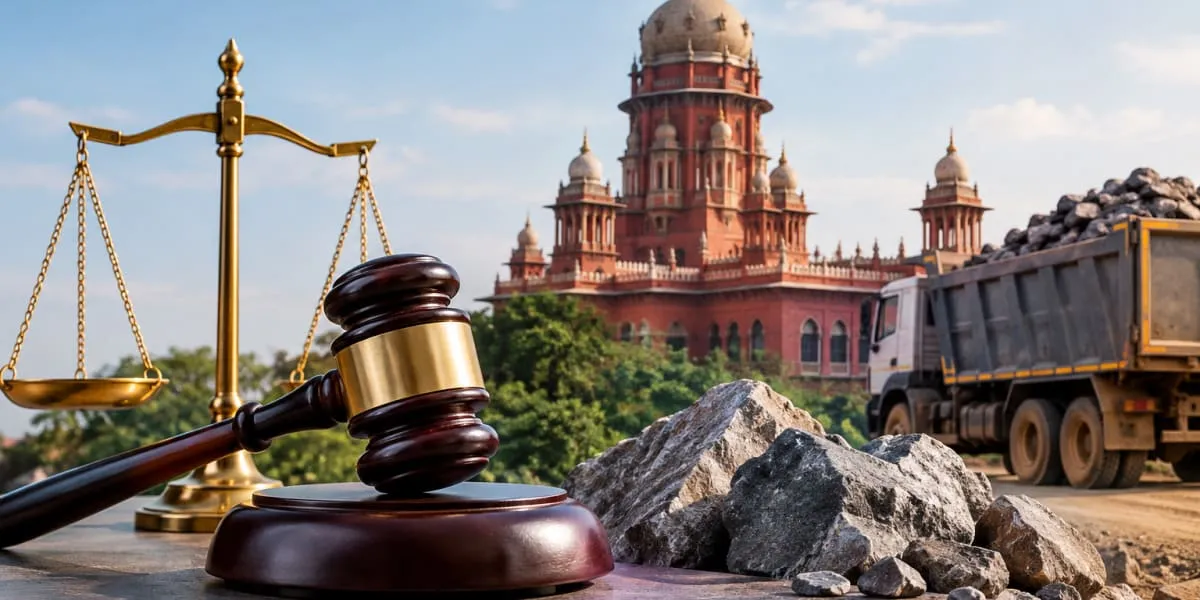
The Madras High Court has declared unconstitutional Rule 3-A of the Tamil Nadu Prevention of Illegal Mining, Transportation and Storage of Minerals and Mineral Dealers’ Rules, 2011. The provision allowed the state to impose a ban on transporting minerals to other states.

A bench comprising Chief Justice Sushrut Arvind Dharmadhikari and Justice G Arul Murugan quashed the geology and mining director’s order of July 27, 2026, which imposed a temporary three-month ban on transporting rough stones to neighbouring states. The verdict was delivered on Tuesday in a batch of petitions, including one filed by Krishnagiri resident Premanathan challenging the rule and the ban.

Tamil Nadu had justified the restriction by saying it was needed to maintain construction material supplies for infrastructure projects undertaken by private developers, the National Highways Authority of India (NHAI) and other government agencies. The state also said the measure would help curb illegal mining amid strong demand and limited supplies. Tamil Nadu has more than 2,000 stone quarries operating under valid permits.

The restriction was estimated to have halted the movement of 15 to 20 per cent of the state’s construction aggregates, particularly from about 200 quarries in border districts including Kanniyakumari, Tenkasi, Tirunelveli, Coimbatore, Krishnagiri and Dharmapuri. Kerala Chief Minister VD Satheesan had earlier urged Tamil Nadu Chief Minister C Joseph Vijay to support supplies for ongoing National Highway projects, citing Kerala’s limited availability of stone aggregates for major infrastructure works.

The court held that Section 23-C of the Mines and Minerals (Development and Regulation) Act, 1957, deals exclusively with illegal mining. It cannot be used to restrict minerals transported under valid leases after payment of seigniorage, the bench said. The court found Rule 3-A inconsistent with Part XIII of the Constitution, beyond the state’s legislative competence and contrary to Sections 15 and 23-C of the Act. It also reiterated that delegated legislation must remain within the powers granted by its parent law, declaring the rule unconstitutional and invalid.

The Madras High Court has declared unconstitutional Rule 3-A of the Tamil Nadu Prevention of Illegal Mining, Transportation and Storage of Minerals and Mineral Dealers’ Rules, 2011. The provision allowed the state to impose a ban on transporting minerals to other states. A bench comprising Chief Justice Sushrut Arvind Dharmadhikari and Justice G Arul Murugan quashed the geology and mining director’s order of July 27, 2026, which imposed a temporary three-month ban on transporting rough stones to neighbouring states. The verdict was delivered on Tuesday in a batch of petitions, including one filed by Krishnagiri resident Premanathan challenging the rule and the ban. Tamil Nadu had justified the restriction by saying it was needed to maintain construction material supplies for infrastructure projects undertaken by private developers, the National Highways Authority of India (NHAI) and other government agencies. The state also said the measure would help curb illegal mining amid strong demand and limited supplies. Tamil Nadu has more than 2,000 stone quarries operating under valid permits. The restriction was estimated to have halted the movement of 15 to 20 per cent of the state’s construction aggregates, particularly from about 200 quarries in border districts including Kanniyakumari, Tenkasi, Tirunelveli, Coimbatore, Krishnagiri and Dharmapuri. Kerala Chief Minister VD Satheesan had earlier urged Tamil Nadu Chief Minister C Joseph Vijay to support supplies for ongoing National Highway projects, citing Kerala’s limited availability of stone aggregates for major infrastructure works. The court held that Section 23-C of the Mines and Minerals (Development and Regulation) Act, 1957, deals exclusively with illegal mining. It cannot be used to restrict minerals transported under valid leases after payment of seigniorage, the bench said. The court found Rule 3-A inconsistent with Part XIII of the Constitution, beyond the state’s legislative competence and contrary to Sections 15 and 23-C of the Act. It also reiterated that delegated legislation must remain within the powers granted by its parent law, declaring the rule unconstitutional and invalid.

Related Stories

Gold Stories

Next Story
Infrastructure Transport

Signature Global Consortium Wins 475-Acre Raigad Parcel for Rs. 1.94 bn

Signature Global has emerged as the successful bidder for a 474.66-acre land parcel in Maharashtra’s Raigad district for Rs. 1.94 bn through an online auction conducted under the asset monetisation process of PACL. The acquisition marks the Gurugram-based developer’s entry into the Mumbai Metropolitan Region (MMR). The consortium was led by Maa Vaishno Net-Tech, a wholly owned subsidiary of Signature Global. Under the consortium arrangement, 35 per cent equity in the subsidiary will be diluted, subject to necessary approvals, with the other partners acquiring the stake. Signature Global wi..

Next Story
Real Estate

K Raheja Corp to Develop 165-Acre Township in Mumbai MMR

Mumbai-based real estate developer K Raheja Corp has entered into a joint development agreement with landowners to develop a 165-acre mixed-use township in Panvel, within the Mumbai Metropolitan Region. The agreement provides for revenue sharing between the developer and the landowners. Real estate data analytics firm CRE Matrix reviewed the joint development agreement, which was registered earlier this month. The document covers a large land parcel in Panvel, a growing development centre in the Mumbai Metropolitan Region and an important part of the wider Mumbai property market. Under the arr..

Next Story
Infrastructure Urban

Khan Market Ranks 24th Among World's Most Expensive Retail Streets

Delhi’s Khan Market has retained its 24th position among the world’s most expensive high-street retail locations, with annual rents rising 14 per cent year-on-year to about USD 238 per sq ft, according to real estate consultant Cushman & Wakefield. The market remains India’s most expensive high street. New York City’s Upper Fifth Avenue reclaimed the top position globally, overtaking London’s New Bond Street. Annual rents on the New York street increased 35 per cent to USD 2,700 per sq ft, after it ranked third in 2025. New Bond Street was second at USD 2,230 per sq ft, while Milanâ€..

Advertisement

Subscribe to Our Newsletter

Get daily newsletters around different themes from Construction world.

STAY CONNECTED

Advertisement

SPECIAL OFFER
QR Code