MIT-WPU Develops Hybrid Nanofluid Cooling to Prevent EV Fires
ECONOMY & POLICY

MIT-WPU Develops Hybrid Nanofluid Cooling to Prevent EV Fires

Researchers at MIT World Peace University (MIT-WPU), Pune, have developed a patented passive hybrid cooling system that significantly improves thermal management in electric-vehicle (EV) batteries. The innovation, registered under the Indian patent “System for Thermal Management of Battery of Vehicle” (Patent No. 202121029238), is designed to enhance performance and safety in India’s high-temperature conditions while addressing the rising incidence of EV fire events.
The research team—comprising Dr Vaibhav Deshmukh, Dr S Radhakrishnan and Dr Vaidehi Deshmukh—has engineered a system that combines high-efficiency heat pipes with a specially formulated nanofluid to create a pump-free, energy-efficient alternative to conventional cooling systems. Operating entirely through natural convection and phase-change processes, the system does not require fans, pumps or any additional electrical power.
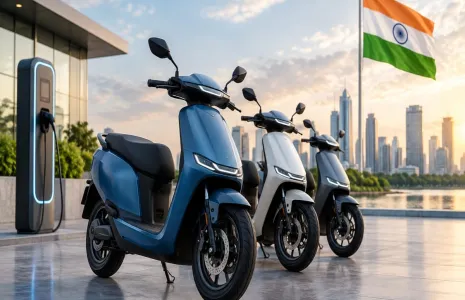
The custom-engineered nanofluid, enhanced with thermally conductive nanoparticles and low-boiling-point liquids, enables rapid heat removal from battery hotspots. When used alongside heat pipes, the system maintains stable thermal conditions even under extreme ambient temperatures. As a result, it offers high reliability, zero energy consumption for cooling and improved safety—making it especially suitable for Indian EVs, particularly two-wheelers.
By maintaining consistent thermal balance, the design improves battery lifespan, enhances charging efficiency and reduces the risk of thermal runaway. Dr Vaibhav Deshmukh said the system ensures that battery packs remain within safe limits without drawing power from the vehicle. Dr Radhakrishnan emphasised that the aim was to eliminate mechanical components that could fail or consume additional energy, while Dr Vaidehi Deshmukh highlighted its effectiveness in addressing energy overheads and thermal hotspots—two of the most persistent challenges faced by EV manufacturers.
The breakthrough comes at a time when global and domestic markets for battery-thermal-management solutions are expanding rapidly. The international BTMS market, valued at about USD 5.41 billion in 2024, is projected to reach USD 29.09 billion by 2030. In India, the EV-battery cooling market is expected to grow from USD 138 million in 2025 to nearly USD 470 million by 2034, while the broader Battery Management System market may rise from USD 199 million in 2024 to USD 8.39 billion by 2035.
With EV penetration reaching around 7.8 per cent in FY 2024–25 and concerns over thermal-safety incidents increasing, the need for reliable, energy-efficient thermal-management systems has become critical. The MIT-WPU innovation addresses this need by offering a scalable, compact and maintenance-friendly cooling solution suited to India’s climatic and operational realities.

Researchers at MIT World Peace University (MIT-WPU), Pune, have developed a patented passive hybrid cooling system that significantly improves thermal management in electric-vehicle (EV) batteries. The innovation, registered under the Indian patent “System for Thermal Management of Battery of Vehicle” (Patent No. 202121029238), is designed to enhance performance and safety in India’s high-temperature conditions while addressing the rising incidence of EV fire events.The research team—comprising Dr Vaibhav Deshmukh, Dr S Radhakrishnan and Dr Vaidehi Deshmukh—has engineered a system that combines high-efficiency heat pipes with a specially formulated nanofluid to create a pump-free, energy-efficient alternative to conventional cooling systems. Operating entirely through natural convection and phase-change processes, the system does not require fans, pumps or any additional electrical power.The custom-engineered nanofluid, enhanced with thermally conductive nanoparticles and low-boiling-point liquids, enables rapid heat removal from battery hotspots. When used alongside heat pipes, the system maintains stable thermal conditions even under extreme ambient temperatures. As a result, it offers high reliability, zero energy consumption for cooling and improved safety—making it especially suitable for Indian EVs, particularly two-wheelers.By maintaining consistent thermal balance, the design improves battery lifespan, enhances charging efficiency and reduces the risk of thermal runaway. Dr Vaibhav Deshmukh said the system ensures that battery packs remain within safe limits without drawing power from the vehicle. Dr Radhakrishnan emphasised that the aim was to eliminate mechanical components that could fail or consume additional energy, while Dr Vaidehi Deshmukh highlighted its effectiveness in addressing energy overheads and thermal hotspots—two of the most persistent challenges faced by EV manufacturers.The breakthrough comes at a time when global and domestic markets for battery-thermal-management solutions are expanding rapidly. The international BTMS market, valued at about USD 5.41 billion in 2024, is projected to reach USD 29.09 billion by 2030. In India, the EV-battery cooling market is expected to grow from USD 138 million in 2025 to nearly USD 470 million by 2034, while the broader Battery Management System market may rise from USD 199 million in 2024 to USD 8.39 billion by 2035.With EV penetration reaching around 7.8 per cent in FY 2024–25 and concerns over thermal-safety incidents increasing, the need for reliable, energy-efficient thermal-management systems has become critical. The MIT-WPU innovation addresses this need by offering a scalable, compact and maintenance-friendly cooling solution suited to India’s climatic and operational realities.

Next Story
Infrastructure Energy

Delhi HC Stays PGCIL Order against KEC International

KEC International has informed stock exchanges of a significant legal development concerning its eligibility to participate in tenders floated by Power Grid Corporation of India (PGCIL), in a disclosure made under Regulation 30 of the SEBI (Listing Obligations and Disclosure Requirements) Regulations.The update follows the company’s earlier intimation dated November 18, 2025, regarding an order issued by PGCIL that excluded KEC International from participating in its tenders for a period of nine months. Challenging the said order, the company filed a writ petition before the Hon’ble High C..

Next Story
Building Material

LANXESS Advances Pigment Solutions for New-Age Concrete Technologies

LANXESS is deepening its engagement with next-generation concrete technologies by advancing research into the performance of iron oxide pigments across emerging construction applications, including self-compacting concrete (SCC), geopolymers and 3D-printed concrete. Through extensive investigations and long-term weathering tests, iron oxide pigments have proven their suitability for a wide range of concrete construction materials, though their use in new formulations requires a thorough understanding of construction chemistry and material interactions.According to Oliver Fleschentraeger, Techn..

Next Story
Infrastructure Urban

JHS Svendgaard to Invest Rs 250 Million in Kala Amb Expansion

JHS Svendgaard Laboratories (JHS), a leading Indian manufacturer of oral care products, has announced an investment of Rs 250 million to expand its manufacturing footprint in Kala Amb, Himachal Pradesh. The investment is aimed at strengthening production capacity, introducing advanced technologies and supporting the company’s next phase of growth in response to rising domestic and global demand.As part of the expansion plan, JHS will construct a new 100,000 sq ft manufacturing facility on its existing five-acre land parcel at Kala Amb. The project is expected to be executed over a two-year p..

Advertisement

Subscribe to Our Newsletter

Get daily newsletters around different themes from Construction world.

STAY CONNECTED

Advertisement

Advertisement

Advertisement

Advertisement

Open In App