MSME Rail Freight Can Add Rs 87 bn To Indian Railways
ECONOMY & POLICY

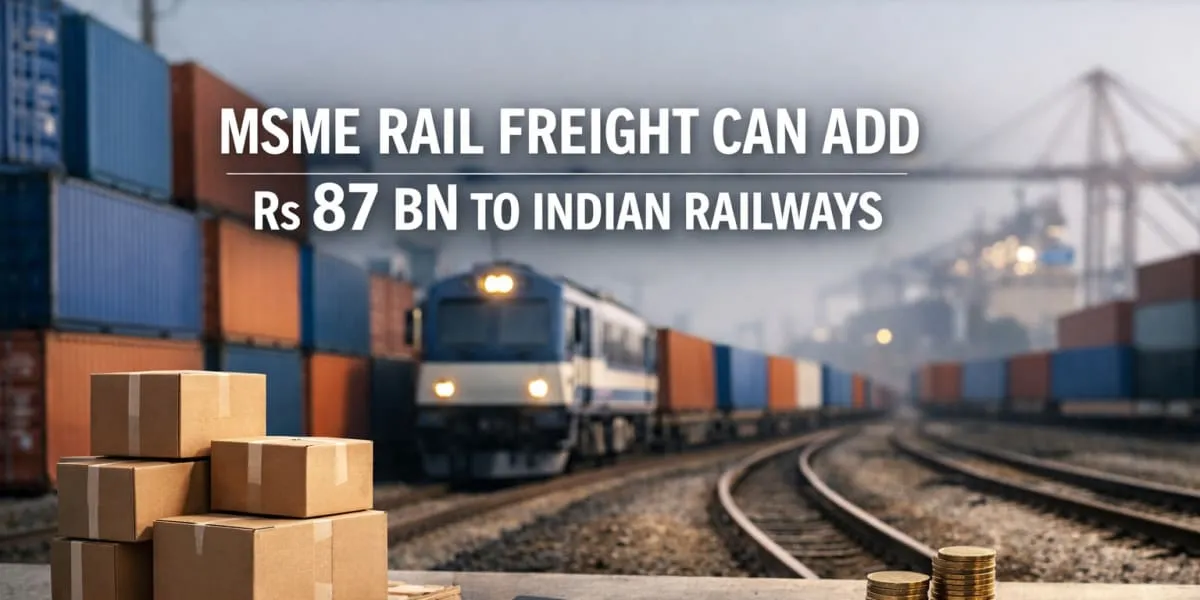
MSME Rail Freight Can Add Rs 87 bn To Indian Railways

A joint FICCI and KPMG in India report finds Indian Railways could unlock Rs 87 bn in annual freight earnings by making rail freight more accessible to micro, small and medium enterprises. The study estimates an addressable MSME freight market of 100 million tonnes (mn t) annually and says Indian Railways can realistically capture about 100 mn t in the non-bulk segment. It identifies access to rail logistics infrastructure as the main barrier rather than freight pricing.

The report places national logistics costs at Rs 24.01 tn, or seven point ninety seven per cent of gross domestic product, and notes smaller firms incur a higher burden. Rail is cheaper per tonne-kilometre at Rs one point ninety six versus Rs three point seventy eight for road, but first- and last-mile connectivity and terminal handling, inventory carrying and service uncertainty often remove that edge. A Total Logistics Cost and Impact framework is proposed to capture these time related and uncertainty costs.

The report describes a two-tier terminal ecosystem where modern private sidings and private freight terminals serve larger customers while many common-user goods sheds lack connectivity, warehousing and mechanisation. Private terminals form about 37 per cent of identified terminals yet handle nearly 70 per cent of inward and 72 per cent of outward traffic, exposing the access gap for smaller firms. To tackle this the study proposes a Market Aligned Terminal Accessibility model for terminal modernisation, aggregation and digitised services and a Wagon Access and Availability model for demand led wagon planning and private sector maintenance.

The study estimates capturing the 100 mn t opportunity could generate 50 bn net tonne-kilometres (NTKM) annually for Indian Railways and yield Rs 87 bn in freight earnings. It finds a modal shift could cut annual freight emissions by four point five mn t of CO2 equivalent, aiding decarbonisation. Drawing on Japan and China, the report urges integrated logistics hubs, improved first- and last-mile services and better digital freight booking to broaden access for firms.

A joint FICCI and KPMG in India report finds Indian Railways could unlock Rs 87 bn in annual freight earnings by making rail freight more accessible to micro, small and medium enterprises. The study estimates an addressable MSME freight market of 100 million tonnes (mn t) annually and says Indian Railways can realistically capture about 100 mn t in the non-bulk segment. It identifies access to rail logistics infrastructure as the main barrier rather than freight pricing. The report places national logistics costs at Rs 24.01 tn, or seven point ninety seven per cent of gross domestic product, and notes smaller firms incur a higher burden. Rail is cheaper per tonne-kilometre at Rs one point ninety six versus Rs three point seventy eight for road, but first- and last-mile connectivity and terminal handling, inventory carrying and service uncertainty often remove that edge. A Total Logistics Cost and Impact framework is proposed to capture these time related and uncertainty costs. The report describes a two-tier terminal ecosystem where modern private sidings and private freight terminals serve larger customers while many common-user goods sheds lack connectivity, warehousing and mechanisation. Private terminals form about 37 per cent of identified terminals yet handle nearly 70 per cent of inward and 72 per cent of outward traffic, exposing the access gap for smaller firms. To tackle this the study proposes a Market Aligned Terminal Accessibility model for terminal modernisation, aggregation and digitised services and a Wagon Access and Availability model for demand led wagon planning and private sector maintenance. The study estimates capturing the 100 mn t opportunity could generate 50 bn net tonne-kilometres (NTKM) annually for Indian Railways and yield Rs 87 bn in freight earnings. It finds a modal shift could cut annual freight emissions by four point five mn t of CO2 equivalent, aiding decarbonisation. Drawing on Japan and China, the report urges integrated logistics hubs, improved first- and last-mile services and better digital freight booking to broaden access for firms.

Next Story
Technology

AI-Enabled Workflows Lift Profitability and Productivity

Organisations modernising frontline workflows with artificial intelligence, automation and real-time data are reporting stronger financial performance, higher productivity and improved employee engagement, according to a global study by Zebra Technologies and Oxford Economics.The research covered 1,000 senior leaders across retail, manufacturing, transportation and logistics in the US, Mexico, the UK, Germany, India, Japan, Australia and New Zealand.In transportation and logistics, 54 per cent of companies that improved picking and packing operations reported faster operational performance, wh..

Next Story
Real Estate

India Leads Global AI Readiness but Implementation Lags

Indian companies lead global averages across all eight artificial intelligence readiness indicators tracked by JLL, but only 19 per cent have started making changes to their workplaces, according to the JLL 2026 Future of Work Survey.The study found that 77 per cent of Indian business leaders expect AI to change their office requirements, creating a 58-percentage-point gap between awareness and implementation. The survey covered more than 2,200 CEOs, CFOs and real estate leaders across 21 countries during the first quarter of 2026.Despite concerns over automation, 58 per cent of Indian leaders..

Next Story
Equipment

Three WOLFF Cranes Build Riyadh Cable-Stayed Bridges

Three WOLFF 180 B luffing jib cranes are supporting the construction of two cable-stayed bridges alongside the existing Wadi Laban Bridge in Riyadh, Saudi Arabia. The project is being developed for the Royal Commission for Riyadh City and executed by the ICRC joint venture comprising IC Ictas and Al Rashid Trading & Contracting Company.The cranes are handling lifting operations including formwork, reinforcement, concrete placement, work platforms, surveying equipment and other construction materials. Each crane is fitted with a 40 m jib, reaches a hook height of 157 m and offers a maximum ..

Advertisement

Subscribe to Our Newsletter

Get daily newsletters around different themes from Construction world.

STAY CONNECTED

Advertisement

Advertisement

Advertisement