NCPOR Marks 25 Years as Key Pillar of India’s Polar Research
ECONOMY & POLICY

NCPOR Marks 25 Years as Key Pillar of India’s Polar Research

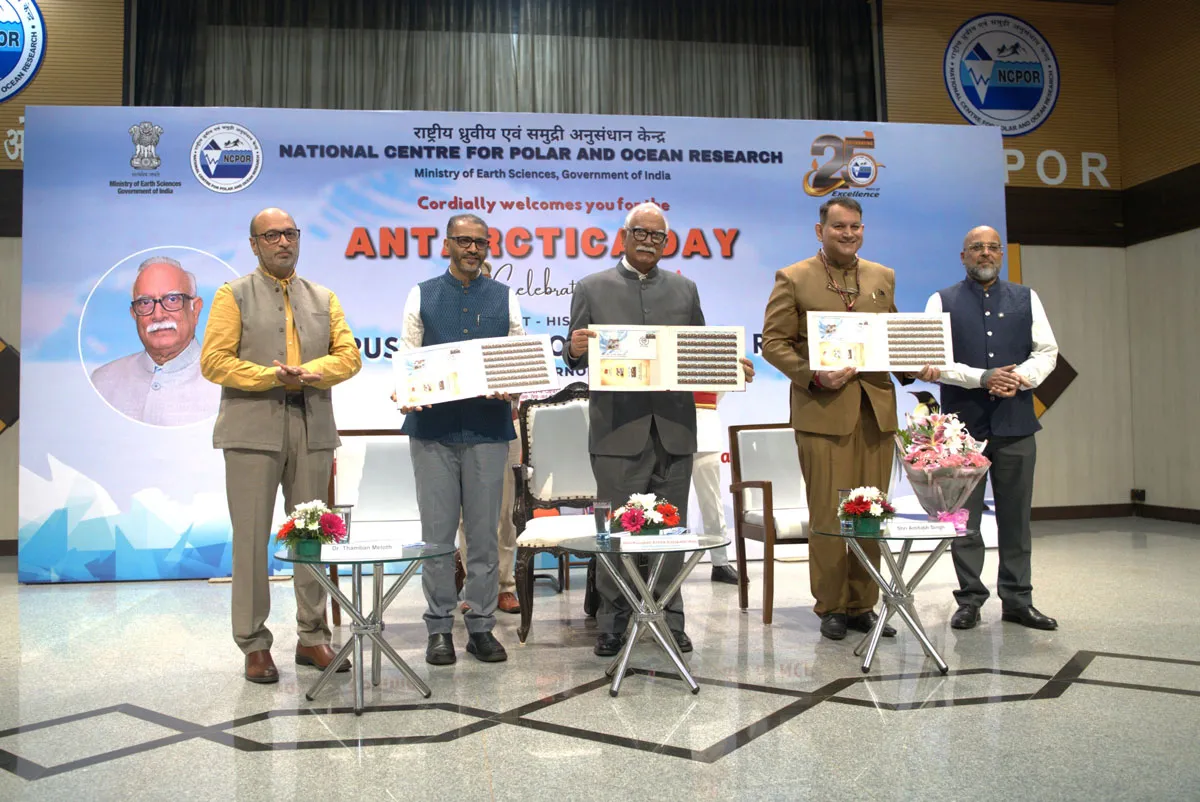
The National Centre for Polar and Ocean Research (NCPOR) has emerged as the anchor of India’s polar and oceanic exploration, said Goa Governor Pusapati Ashok Gajapathi Raju at the Antarctica Day celebrations held at the institute’s Vasco-da-Gama campus on 1 December 2025. Antarctica Day commemorates the signing of the Antarctica Treaty in 1959, which designates the continent for peaceful and scientific pursuits.
As Chief Guest, the Governor released a special commemorative postage stamp issued by the Department of Posts to mark the Silver Jubilee of NCPOR, recognising 25 years of its contribution to India’s scientific advancement since its establishment on 5 April 2000.
He said the institute had expanded India’s scientific reach into some of the world’s most challenging environments and had taken a leadership role in the Deep Ocean Mission. Highlighting the global significance of polar regions, he noted that Antarctica contains nearly 70 per cent of the planet’s fresh water and plays a critical role in sea-level balance and climate stability. For a nation aspiring to become developed by 2047, understanding and anticipating these changes was vital, he said.
The Governor added that Goa was proud to host an institution of such importance, assuring full support for its scientific activities.
Chief Postmaster General (Maharashtra Circle) Amitabh Singh, the Guest of Honour, said the commemorative stamp symbolised the Department of Posts’ support for NCPOR’s scientific work.
In his welcome address, NCPOR Director Dr Thamban Meloth said the Government of India had granted in-principle approval for two major polar initiatives: a new state-of-the-art research station, Maitri-II, and India’s first indigenous ice-class research vessel. He noted that the government had consistently supported the institute’s efforts.
NCPOR leads India’s scientific expeditions and research programmes across the Polar regions and the Southern Ocean. It operates permanent Indian research stations—Dakshin Gangotri, Maitri and Bharati in Antarctica, and Himadri in the Arctic—along with the Himalayan research station, Himansh.

The National Centre for Polar and Ocean Research (NCPOR) has emerged as the anchor of India’s polar and oceanic exploration, said Goa Governor Pusapati Ashok Gajapathi Raju at the Antarctica Day celebrations held at the institute’s Vasco-da-Gama campus on 1 December 2025. Antarctica Day commemorates the signing of the Antarctica Treaty in 1959, which designates the continent for peaceful and scientific pursuits.As Chief Guest, the Governor released a special commemorative postage stamp issued by the Department of Posts to mark the Silver Jubilee of NCPOR, recognising 25 years of its contribution to India’s scientific advancement since its establishment on 5 April 2000.He said the institute had expanded India’s scientific reach into some of the world’s most challenging environments and had taken a leadership role in the Deep Ocean Mission. Highlighting the global significance of polar regions, he noted that Antarctica contains nearly 70 per cent of the planet’s fresh water and plays a critical role in sea-level balance and climate stability. For a nation aspiring to become developed by 2047, understanding and anticipating these changes was vital, he said.The Governor added that Goa was proud to host an institution of such importance, assuring full support for its scientific activities.Chief Postmaster General (Maharashtra Circle) Amitabh Singh, the Guest of Honour, said the commemorative stamp symbolised the Department of Posts’ support for NCPOR’s scientific work.In his welcome address, NCPOR Director Dr Thamban Meloth said the Government of India had granted in-principle approval for two major polar initiatives: a new state-of-the-art research station, Maitri-II, and India’s first indigenous ice-class research vessel. He noted that the government had consistently supported the institute’s efforts.NCPOR leads India’s scientific expeditions and research programmes across the Polar regions and the Southern Ocean. It operates permanent Indian research stations—Dakshin Gangotri, Maitri and Bharati in Antarctica, and Himadri in the Arctic—along with the Himalayan research station, Himansh.

Next Story
Infrastructure Urban

Rosatom Delivers Nuclear Fuel for Kudankulam Unit 3

Rosatom has recently supplied nuclear fuel for the initial loading of the VVER-1000 reactor core at Unit 3 of the Kudankulam Nuclear Power Plant, marking a key milestone in the second stage of the Russian-designed nuclear power project in southern India.The fuel was supplied by Rosatom’s Nuclear Fuel Division, managed by TVEL, and manufactured at the Novosibirsk Chemical Concentrates Plant. The delivery includes the initial reactor load along with reserve fuel assemblies and is part of a long-term contract covering the entire operational life of Units 3 and 4.Building on operational experien..

Next Story
Infrastructure Transport

CBL International Enables First LNG Bunkering at Xiaomo Port

CBL International recently completed the first-ever LNG bunkering operation at Xiaomo Port, supplying liquefied natural gas to vessels operated by BYD in support of its maritime decarbonisation strategy. The operation was facilitated through a physical supplier in collaboration with China National Offshore Oil Corporation (CNOOC), which supported the port’s inaugural LNG bunkering activity. The milestone represents a strategic expansion of CBL International's sustainable fuel offerings beyond biofuels, while also diversifying revenue streams. As global shipping intensifies efforts to cut em..

Next Story
Infrastructure Urban

Aimtron, Aurassure Partner for IoT Weather Systems

Aimtron Electronics has recently entered into an OEM manufacturing engagement with Aurassure to produce new-age, IoT-enabled weather and environmental monitoring systems in India. The collaboration supports the growing demand for real-time environmental intelligence across urban, industrial and infrastructure applications. The engagement comes as global focus on climate-risk management and data-driven planning accelerates. The global weather monitoring systems market, valued at around USD 2.1 billion in 2024, is projected to reach nearly USD 4.8 billion by 2034, driven by the rapid adoption o..

Advertisement

Subscribe to Our Newsletter

Get daily newsletters around different themes from Construction world.

STAY CONNECTED

Advertisement

Advertisement

Advertisement

Advertisement

Open In App