




NISG Hosts Summit On AI And DPI For Viksit Bharat
ECONOMY & POLICY

NISG Hosts Summit On AI And DPI For Viksit Bharat

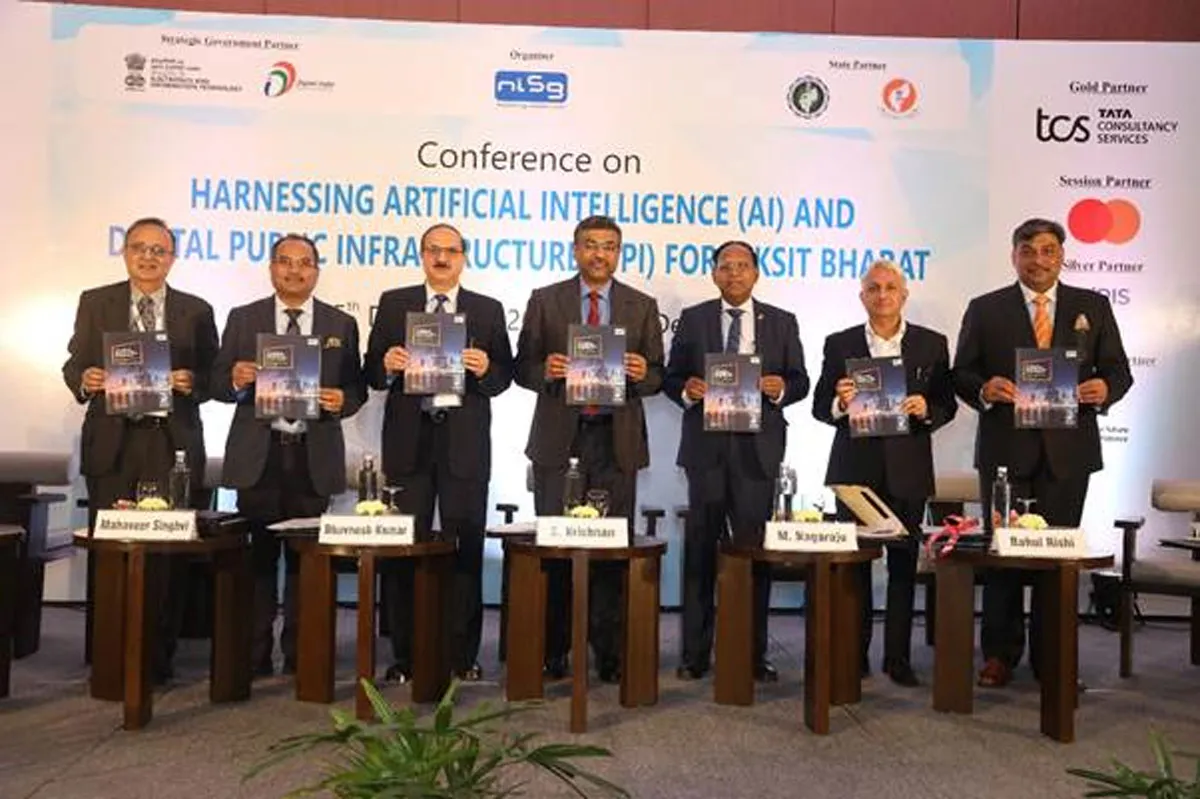
The National Institute for Smart Government (NISG), in partnership with the Ministry of Electronics and Information Technology (MeitY) and the Directorate of IT, Government of Tripura, organised a high-level conference titled “Harnessing AI and Digital Public Infrastructure (DPI) for Viksit Bharat” on 5 December 2025 in New Delhi. EY served as the Knowledge Partner.

The conference brought together policymakers, technologists, industry leaders and AI experts to discuss how Artificial Intelligence and Digital Public Infrastructure can transform governance, improve public service delivery and support India’s ambition of becoming a developed nation by 2047.

The inaugural session was attended by Shri S. Krishnan, Secretary, MeitY, who delivered the keynote address on India’s digital empowerment vision and the role of DPI and AI in achieving Viksit Bharat 2047. He stressed that India’s technology ecosystem thrives when government, private sector, academia and civil society work together. Democratising technology—making it accessible, affordable and citizen-centric—will continue to shape the evolution of DPI.

Shri M. Nagaraju, Secretary, Department of Financial Services, Ministry of Finance, delivered a Special Address on India’s Digital Decade and positioning India as a global leader in digital governance. He noted that India is progressing steadily towards becoming a USD 5 trillion economy. Strong fundamentals, infrastructure-led growth and resilient supply chains underpin this momentum. Over the last decade, Jan Dhan and DPI initiatives have expanded financial inclusion from 21 per cent in 2008 to more than 80 per cent.

In his welcome address, Shri Bhuvnesh Kumar, CEO of UIDAI and CEO of NISG, highlighted NISG’s hybrid operating model, which combines the pace of government decision-making with private-sector efficiency. This, he said, has enabled NISG to lead DPI programmes effectively and guide the ecosystem toward faster AI adoption.

Shri Mahaveer Singhvi, Joint Secretary, NEST Division, Ministry of External Affairs, noted in his keynote that AI is already embedded in daily life. For India, the strategic question is whether the country will merely consume AI or also create it. Through the IndiaAI Mission, India has commited to building its own compute capacity, datasets, foundational models and innovation frameworks that reflect Indian needs and realities.

EY leaders contributed perspectives on the scale of opportunity. Mr Rahul Rishi said that while DPI has been a force multiplier for India during the past decade, the convergence of AI and DPI could unlock “not just 10x but 100x” possibilities across sectors such as energy and water. Mr Pankaj Khurana added that India’s DPI stack — Aadhaar, UPI, DigiLocker and related layers — already forms a strong base for next-generation public services, with AI increasingly enabling systems that are anticipatory, responsive and scalable.

Major Ranjeet Goswami (Retd.), Global Head, Corporate Affairs at TCS, emphasised that industry measures success by real-world impact. DPI is trusted not because it uses sophisticated technology, but because 1.4 billion Indians rely on it. This trust, he said, gives India the confidence to offer its DPI model globally.

A major highlight of the event was the release of the NISG–EY Report, which captures the shared consensus that the convergence of AI and India’s DPI stack will accelerate economic empowerment, strengthen governance and deliver citizen-centric public services at scale.

The National Institute for Smart Government (NISG), in partnership with the Ministry of Electronics and Information Technology (MeitY) and the Directorate of IT, Government of Tripura, organised a high-level conference titled “Harnessing AI and Digital Public Infrastructure (DPI) for Viksit Bharat” on 5 December 2025 in New Delhi. EY served as the Knowledge Partner. The conference brought together policymakers, technologists, industry leaders and AI experts to discuss how Artificial Intelligence and Digital Public Infrastructure can transform governance, improve public service delivery and support India’s ambition of becoming a developed nation by 2047. The inaugural session was attended by Shri S. Krishnan, Secretary, MeitY, who delivered the keynote address on India’s digital empowerment vision and the role of DPI and AI in achieving Viksit Bharat 2047. He stressed that India’s technology ecosystem thrives when government, private sector, academia and civil society work together. Democratising technology—making it accessible, affordable and citizen-centric—will continue to shape the evolution of DPI. Shri M. Nagaraju, Secretary, Department of Financial Services, Ministry of Finance, delivered a Special Address on India’s Digital Decade and positioning India as a global leader in digital governance. He noted that India is progressing steadily towards becoming a USD 5 trillion economy. Strong fundamentals, infrastructure-led growth and resilient supply chains underpin this momentum. Over the last decade, Jan Dhan and DPI initiatives have expanded financial inclusion from 21 per cent in 2008 to more than 80 per cent. In his welcome address, Shri Bhuvnesh Kumar, CEO of UIDAI and CEO of NISG, highlighted NISG’s hybrid operating model, which combines the pace of government decision-making with private-sector efficiency. This, he said, has enabled NISG to lead DPI programmes effectively and guide the ecosystem toward faster AI adoption. Shri Mahaveer Singhvi, Joint Secretary, NEST Division, Ministry of External Affairs, noted in his keynote that AI is already embedded in daily life. For India, the strategic question is whether the country will merely consume AI or also create it. Through the IndiaAI Mission, India has commited to building its own compute capacity, datasets, foundational models and innovation frameworks that reflect Indian needs and realities. EY leaders contributed perspectives on the scale of opportunity. Mr Rahul Rishi said that while DPI has been a force multiplier for India during the past decade, the convergence of AI and DPI could unlock “not just 10x but 100x” possibilities across sectors such as energy and water. Mr Pankaj Khurana added that India’s DPI stack — Aadhaar, UPI, DigiLocker and related layers — already forms a strong base for next-generation public services, with AI increasingly enabling systems that are anticipatory, responsive and scalable. Major Ranjeet Goswami (Retd.), Global Head, Corporate Affairs at TCS, emphasised that industry measures success by real-world impact. DPI is trusted not because it uses sophisticated technology, but because 1.4 billion Indians rely on it. This trust, he said, gives India the confidence to offer its DPI model globally. A major highlight of the event was the release of the NISG–EY Report, which captures the shared consensus that the convergence of AI and India’s DPI stack will accelerate economic empowerment, strengthen governance and deliver citizen-centric public services at scale.

Next Story
Infrastructure Urban

Centre Boosts FPO Growth With New Credit And Market Support

The Government is implementing the Central Sector Scheme on the formation and promotion of 10,000 Farmer Producer Organisations (FPOs), under which all 10,000 FPOs have now been registered. The scheme provides Rs 1.8 million per FPO for three years as management support, a matching equity grant of up to Rs 1.5 million, and a credit guarantee of up to Rs 0.02 billion through eligible lending institutions. It also offers assistance for training, market linkages and alignment with other schemes. FPOs receive support to obtain input licences for seed, fertiliser and pesticide supplies, as well as..

Next Story
Infrastructure Urban

PM-KISAN Drives Farm Income Gains And Rural Stability

The PM-KISAN scheme, a central sector initiative launched in February 2019, aims to support the financial needs of farmers holding cultivable land. Under the scheme, Rs 6,000 per year is transferred in three equal instalments to Aadhaar-seeded bank accounts through Direct Benefit Transfer. Eligibility is based primarily on cultivable landholding, with certain exclusions for individuals of higher economic status. A farmer-centric digital infrastructure ensures scheme benefits reach farmers across India without intermediaries. With full transparency in registration and verification, the Governm..

Next Story
Infrastructure Urban

Govt Extends Pro Tem Security Certificate To Two Years

In a further push to improve ease of doing business and ensure continuity for the telecom industry, the National Centre for Communication Security (NCCS) under the Department of Telecommunications has extended the validity of the Pro Tem Security Certification from six months to two years. The Pro Tem Certification, initially launched in October 2024 with a six-month validity, was designed to prevent business disruption for IP Router and Wi-Fi CPE products, which became subject to mandatory security certification from 1 October 2024. Under this certification, OEMs submit a declaration confirm..

Advertisement

Subscribe to Our Newsletter

Get daily newsletters around different themes from Construction world.

STAY CONNECTED

Advertisement

Advertisement

Advertisement

Advertisement

Open In App














