+
NITI Aayog Releases Reports On Viksit Bharat And Net Zero
ECONOMY & POLICY

NITI Aayog Releases Reports On Viksit Bharat And Net Zero

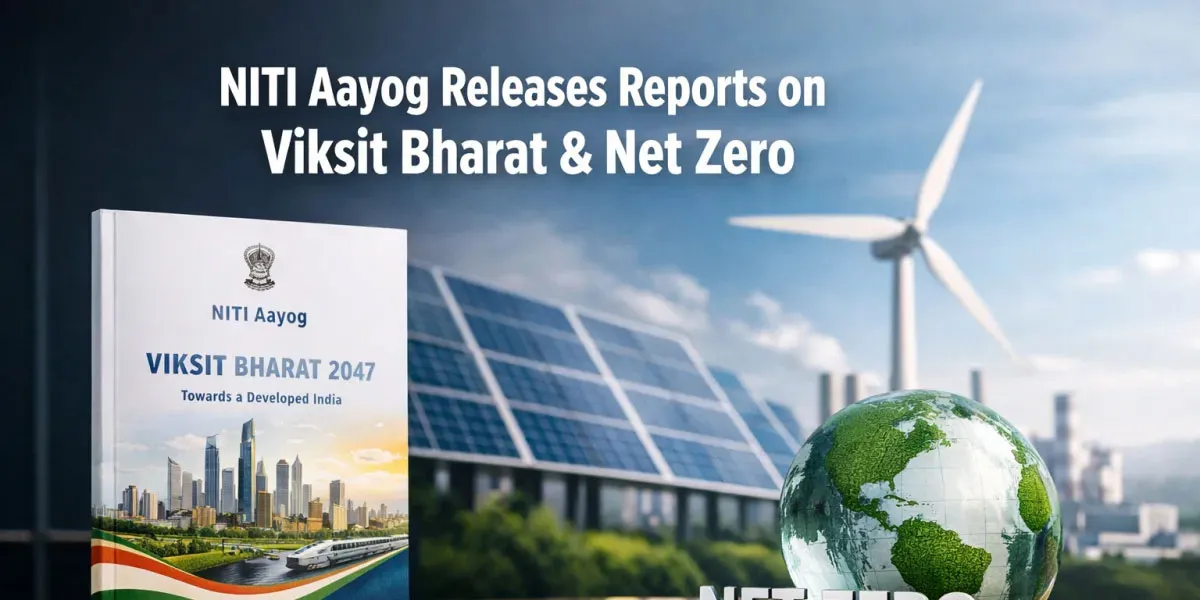
NITI Aayog released 11 study reports on scenarios towards Viksit Bharat and Net Zero across two days on nine and 10 February 2026, with a second set of four reports unveiled on the morning of 10 February at the Ambedkar International Centre in New Delhi. The launch was attended by senior NITI Aayog and ministry officials including the member and the chief executive officer of NITI Aayog and secretaries from the ministries of power and new and renewable energy. The four reports cover sectoral insights for transport, industry, power and a critical mineral assessment.

The studies find that electrification, circularity and energy efficiency could lower final energy demand by 20 per cent by 2070 while coal consumption is likely to rise until 2047 even under Net Zero pathways. Electricity’s share of final energy could increase from 21 per cent in 2025 to as high as 60 per cent in 2070, and non?fossil generation could rise from 23 per cent to between 80 and 85 per cent. Urbanisation, cooling needs, digitalisation and electric mobility are identified as key drivers of higher electricity demand.

In transport, electricity, biofuels and hydrogen could meet nearly 90 per cent of energy demand by 2070, aided by modal shifts towards public and shared mobility and greater use of rail and waterways. In industry, demand for steel, cement and aluminium is expected to rise by four to six times by 2070, with electrification, material efficiency, recycling and green hydrogen forming the basis of industrial energy. The assessments stress technology adoption and structural change to manage growth while limiting emissions.

The critical mineral analysis indicates recycling could supply 20 to 25 per cent of copper and graphite demand by mid?century, helping to reduce import dependence. A panel discussion emphasised renewables and storage as the least cost pathway and said detailed policy interventions and implementation will be required to realise the scenarios. Officials noted roadmaps including a 500 gigawatt (GW) renewables target and stressed the need to keep distribution companies financially healthy while pursuing long term low carbon objectives.

NITI Aayog released 11 study reports on scenarios towards Viksit Bharat and Net Zero across two days on nine and 10 February 2026, with a second set of four reports unveiled on the morning of 10 February at the Ambedkar International Centre in New Delhi. The launch was attended by senior NITI Aayog and ministry officials including the member and the chief executive officer of NITI Aayog and secretaries from the ministries of power and new and renewable energy. The four reports cover sectoral insights for transport, industry, power and a critical mineral assessment. The studies find that electrification, circularity and energy efficiency could lower final energy demand by 20 per cent by 2070 while coal consumption is likely to rise until 2047 even under Net Zero pathways. Electricity’s share of final energy could increase from 21 per cent in 2025 to as high as 60 per cent in 2070, and non?fossil generation could rise from 23 per cent to between 80 and 85 per cent. Urbanisation, cooling needs, digitalisation and electric mobility are identified as key drivers of higher electricity demand. In transport, electricity, biofuels and hydrogen could meet nearly 90 per cent of energy demand by 2070, aided by modal shifts towards public and shared mobility and greater use of rail and waterways. In industry, demand for steel, cement and aluminium is expected to rise by four to six times by 2070, with electrification, material efficiency, recycling and green hydrogen forming the basis of industrial energy. The assessments stress technology adoption and structural change to manage growth while limiting emissions. The critical mineral analysis indicates recycling could supply 20 to 25 per cent of copper and graphite demand by mid?century, helping to reduce import dependence. A panel discussion emphasised renewables and storage as the least cost pathway and said detailed policy interventions and implementation will be required to realise the scenarios. Officials noted roadmaps including a 500 gigawatt (GW) renewables target and stressed the need to keep distribution companies financially healthy while pursuing long term low carbon objectives.

Next Story
Infrastructure Energy

Jyoti Structures expands manufacturing capacity in Nashik

The announcement Jyoti Structures (JSL) reported steady operational performance in 2025, supported by stable project execution across its power transmission portfolio. The company commissioned galvanisation operations at its second Nashik manufacturing unit, adding 33,000 MT of annual capacity. This increased aggregate tower manufacturing capability at Nashik to approximately 69,000 MT per annum, aimed at improving fabrication accuracy, scheduling control and delivery predictability. JSL also expanded its workforce to over 750 employees, onboarding more than 70 engineers during the year. C..

Next Story
Infrastructure Energy

TSPL Mega Health Camp Reaches 338 Residents in Mansa

Talwandi Sabo Power (TSPL), Punjab’s largest and North India’s largest private thermal power plant, organised a Mega Health Camp at Village Raipur, Mansa, under its flagship healthcare initiative Project SEHAT. The camp benefitted 338 community members through free consultations and diagnostic services.A team comprising a General Physician, Gynaecologist, Dermatologist and Dentist provided medical advice and treatment. Beneficiaries received free diagnostic tests including BP, HB, blood sugar, malaria, dengue and blood group tests, along with free medicines.The camp was inaugurated by Vill..

Next Story
Infrastructure Transport

Mumbai Coastal Road Musical Path Plays Jai Ho

Mumbai inaugurated India’s first musical path on the Coastal Road that plays the song Jai Ho for motorists. The civic administration said the installation used Hungarian technology and that the intention was to implement the concept of Sangeet Marg in future projects. A senior official suggested implementing a pilot on the Samruddhi Expressway, which connects Mumbai and Nagpur. City officials described the inauguration as a symbolic demonstration of collaboration between municipal authorities and foreign partners. The inauguration was attended by the Consul General of Hungary Ferenc Jari, f..

Advertisement

Subscribe to Our Newsletter

Get daily newsletters around different themes from Construction world.

STAY CONNECTED

Advertisement

Advertisement

Advertisement

Open In App