Ola Electric Secures ARAI Certification for 4680 Bharat Cell-Powered Vehicles
ECONOMY & POLICY

Ola Electric Secures ARAI Certification for 4680 Bharat Cell-Powered Vehicles

Ola Electric has achieved a major milestone in India’s electric mobility journey with its indigenously developed 4680 Bharat Cell battery pack (5.2 kWh configuration) receiving ARAI certification under the latest AIS-156 Amendment 4 standards issued by the Ministry of Road Transport and Highways.

With this certification, Ola Electric is set to roll out its first vehicles powered by its homegrown 4680 Bharat Cells, marking a breakthrough in India’s EV technology and manufacturing ecosystem. The certified pack will debut on the Ola S1 Pro+ (5.2 kWh) — the first Ola vehicle to be powered entirely by in-house cell technology.

Speaking on the announcement, an Ola Electric spokesperson said, “With the ARAI certification of our 4680 Bharat Cell battery pack, we are ready to deliver our first vehicles powered by our own cells. This is a defining milestone in our mission to establish India’s EV technology leadership and reduce dependence on global supply chains. Customers will soon experience the enhanced range, performance, and reliability that our homegrown cells bring to our scooters and motorcycles.”

Until now, Ola Electric has relied on third-party cells across its scooter and motorcycle range, all certified under AIS-156. The transition to 5.2 kWh battery packs built on its 4680 Bharat Cells marks a decisive step toward vertical integration — a move expected to significantly improve range, performance, and unit economics while reducing import dependence. The development aligns with Ola’s broader plan to scale production through its upcoming Gigafactory, strengthening India’s position in the global EV supply chain.

The certification process for the 4680 Bharat Cell battery pack involved one of the world’s most rigorous testing standards, covering safety, electrical reliability, and performance under extreme climatic and operational conditions. The packs successfully cleared stringent tests including water immersion, vibration durability, and thermal shock resistance, underscoring Ola’s commitment to safety, quality, and innovation.

This certification marks a pivotal moment in Ola Electric’s journey toward developing world-class electric vehicle technology in India — powered by indigenous innovation and advanced cell manufacturing capabilities.

Ola Electric has achieved a major milestone in India’s electric mobility journey with its indigenously developed 4680 Bharat Cell battery pack (5.2 kWh configuration) receiving ARAI certification under the latest AIS-156 Amendment 4 standards issued by the Ministry of Road Transport and Highways.With this certification, Ola Electric is set to roll out its first vehicles powered by its homegrown 4680 Bharat Cells, marking a breakthrough in India’s EV technology and manufacturing ecosystem. The certified pack will debut on the Ola S1 Pro+ (5.2 kWh) — the first Ola vehicle to be powered entirely by in-house cell technology.Speaking on the announcement, an Ola Electric spokesperson said, “With the ARAI certification of our 4680 Bharat Cell battery pack, we are ready to deliver our first vehicles powered by our own cells. This is a defining milestone in our mission to establish India’s EV technology leadership and reduce dependence on global supply chains. Customers will soon experience the enhanced range, performance, and reliability that our homegrown cells bring to our scooters and motorcycles.”Until now, Ola Electric has relied on third-party cells across its scooter and motorcycle range, all certified under AIS-156. The transition to 5.2 kWh battery packs built on its 4680 Bharat Cells marks a decisive step toward vertical integration — a move expected to significantly improve range, performance, and unit economics while reducing import dependence. The development aligns with Ola’s broader plan to scale production through its upcoming Gigafactory, strengthening India’s position in the global EV supply chain.The certification process for the 4680 Bharat Cell battery pack involved one of the world’s most rigorous testing standards, covering safety, electrical reliability, and performance under extreme climatic and operational conditions. The packs successfully cleared stringent tests including water immersion, vibration durability, and thermal shock resistance, underscoring Ola’s commitment to safety, quality, and innovation.This certification marks a pivotal moment in Ola Electric’s journey toward developing world-class electric vehicle technology in India — powered by indigenous innovation and advanced cell manufacturing capabilities.

Related Stories

Gold Stories

Next Story
Infrastructure Urban

KONE Opens India's First Digital Experience Centre in Pune

KONE, a global elevator and escalator manufacturer, has inaugurated its first Digital Experience Centre (DEC) in India, located in Pune. The facility aims to showcase how artificial intelligence (AI), connectivity and data-driven technologies can enhance customer experiences and improve building operations.The centre was inaugurated by Jussi Herlin, Executive Vice Chair, KONE Corporation; Philippe Delorme, President and CEO, KONE; and Nandan Nilekani, Co-founder and Chairman of the Board, Infosys.Designed as an interactive customer environment, the facility demonstrates digital solutions cover..

Next Story
Infrastructure Urban

CII GreenCo Launches Circularity Guidelines for Indian Industry

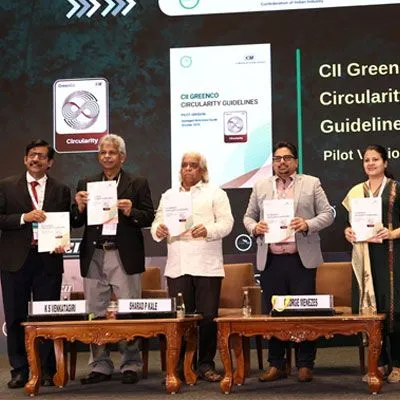
The Confederation of Indian Industry (CII) GreenCo Council has launched the CII GreenCo Circularity Guidelines – Pilot Version at the 17th CII GreenCo Waste & Resource Management Summit 2026 in Chennai. The initiative aims to strengthen resource efficiency, waste reduction and circular economy practices across Indian manufacturing and process industries.The guidelines introduce a structured framework with circularity indices covering raw materials, consumables, packaging and other resource inputs. These indicators will help industries assess existing practices, identify opportunities to ..

Next Story
Infrastructure Energy

Global Electronics Association Launches IPC-1783-CO2E Standard

The Global Electronics Association has introduced IPC-1783-CO2E, a new international standard aimed at improving consistency, transparency and comparability in product carbon footprint reporting across the electronics manufacturing industry.The standard, titled International Standard for Data Collection and Reporting of CO2 Equivalent (CO2e) Emissions for the Electronics Manufacturing Supply Chain, provides industry-specific guidance for collecting, estimating and reporting carbon emissions data.With increasing regulatory requirements and customer expectations, electronics manufacturers face c..

Advertisement

Subscribe to Our Newsletter

Get daily newsletters around different themes from Construction world.

STAY CONNECTED

Advertisement

SPECIAL OFFER
QR Code