PM Modi Releases 19th PM-KISAN Installment, Unveils Projects in Bihar
ECONOMY & POLICY

PM Modi Releases 19th PM-KISAN Installment, Unveils Projects in Bihar

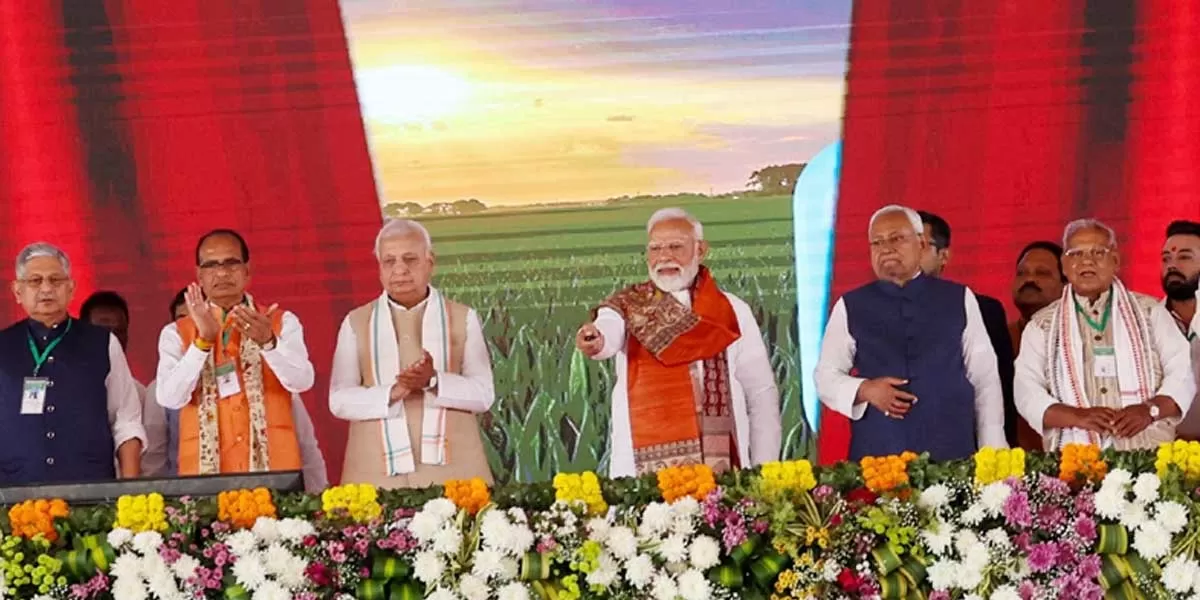
Prime Minister Narendra Modi released the 19th installment of the PM-KISAN scheme from Bhagalpur, Bihar, crediting Rs 220 billion directly into farmers' bank accounts via Direct Benefit Transfer. He highlighted that around 7.5 million farmer families in Bihar benefited, with Rs 16 billion transferred to them. 

Emphasising the four pillars of Viksit Bharat—poor, farmers, youth, and women—Modi reaffirmed his government's commitment to agricultural welfare. He outlined reforms, including the provision of modern seed varieties, affordable fertilisers, and irrigation support. He credited his government with reducing fertiliser costs, ensuring adequate supply, and reviving the Barauni fertiliser plant. 

Modi also highlighted the success of the PM Kisan Samman Nidhi scheme, which has transferred Rs 3.7 trillion to farmers since its inception. He criticised previous governments for neglecting farmers and emphasised his administration's achievements, such as the PM Fasal Bima Yojana, which has disbursed Rs 1.75 trillion in insurance claims. 

The Prime Minister underscored initiatives in animal husbandry, including the creation of Lakhpati Didis and the expansion of dairy farming. He noted that India’s milk production has risen from 140 million tons to 240 million tons in the last decade. Bihar’s dairy industry, he said, now sees cooperative unions purchasing 3 million litres of milk daily, generating Rs 30 million annually for farmers. 

For the first time, fishermen have been issued Kisan Credit Cards, contributing to Bihar's rise as a top-five fish-producing state. Modi also stressed the importance of agricultural exports, announcing the formation of a Makhana Board to promote Bihar’s Makhana globally. 

He unveiled key infrastructure projects, including a new highway from Munger to Bhagalpur to Mirza Chauki, a four-lane road widening project, and a new rail bridge from Vikramshila to Kataria. He also announced the establishment of a National Institute of Food Technology and Entrepreneurship and three Centers of Excellence for agriculture in Bihar. 

Reaffirming his vision for Bihar’s development, Modi highlighted industrial and connectivity advancements, including coal supply approvals for a new power plant in Bhagalpur. He reiterated his commitment to modernising Bihar and ensuring farmers' prosperity, asserting that his government remains dedicated to their welfare. 

The event was attended by Bihar Governor Arif Mohammed Khan, Chief Minister Nitish Kumar, Union Ministers, and other dignitaries. 

(PIB)        

Prime Minister Narendra Modi released the 19th installment of the PM-KISAN scheme from Bhagalpur, Bihar, crediting Rs 220 billion directly into farmers' bank accounts via Direct Benefit Transfer. He highlighted that around 7.5 million farmer families in Bihar benefited, with Rs 16 billion transferred to them. Emphasising the four pillars of Viksit Bharat—poor, farmers, youth, and women—Modi reaffirmed his government's commitment to agricultural welfare. He outlined reforms, including the provision of modern seed varieties, affordable fertilisers, and irrigation support. He credited his government with reducing fertiliser costs, ensuring adequate supply, and reviving the Barauni fertiliser plant. Modi also highlighted the success of the PM Kisan Samman Nidhi scheme, which has transferred Rs 3.7 trillion to farmers since its inception. He criticised previous governments for neglecting farmers and emphasised his administration's achievements, such as the PM Fasal Bima Yojana, which has disbursed Rs 1.75 trillion in insurance claims. The Prime Minister underscored initiatives in animal husbandry, including the creation of Lakhpati Didis and the expansion of dairy farming. He noted that India’s milk production has risen from 140 million tons to 240 million tons in the last decade. Bihar’s dairy industry, he said, now sees cooperative unions purchasing 3 million litres of milk daily, generating Rs 30 million annually for farmers. For the first time, fishermen have been issued Kisan Credit Cards, contributing to Bihar's rise as a top-five fish-producing state. Modi also stressed the importance of agricultural exports, announcing the formation of a Makhana Board to promote Bihar’s Makhana globally. He unveiled key infrastructure projects, including a new highway from Munger to Bhagalpur to Mirza Chauki, a four-lane road widening project, and a new rail bridge from Vikramshila to Kataria. He also announced the establishment of a National Institute of Food Technology and Entrepreneurship and three Centers of Excellence for agriculture in Bihar. Reaffirming his vision for Bihar’s development, Modi highlighted industrial and connectivity advancements, including coal supply approvals for a new power plant in Bhagalpur. He reiterated his commitment to modernising Bihar and ensuring farmers' prosperity, asserting that his government remains dedicated to their welfare. The event was attended by Bihar Governor Arif Mohammed Khan, Chief Minister Nitish Kumar, Union Ministers, and other dignitaries. (PIB)        

Next Story
Infrastructure Urban

Implementation Status of Jal Jeevan Mission

Since August 2019 the Government has implemented Jal Jeevan Mission to provide assured potable water through household tap connections in rural India. At the start of the mission only 32.3 million (mn) rural households, representing 16.7 per cent, were reported to have tap water connections. States and union territories have reported that 125.8 mn additional rural households have since been provided with tap connections. As a result, of about 193.6 mn rural households roughly 158.2 mn, or 81.71 per cent, are reported to have tap water supply at home.\n\nThe State, district and village level st..

Next Story
Infrastructure Urban

Jal Jeevan Mission Reaches Eighty One Per Cent Rural Coverage

The Government reported substantial progress under the Jal Jeevan Mission, launched in August 2019 to provide tap water to every rural household. At launch only 32.3 million (mn) rural households had tap connections and states and Union territories reported provision of 125.8 mn additional households by March 2026. Consequently, out of about 193.6 mn rural households around 158.2 mn, or 81.71 per cent, are reported to have tap water at home. The Finance Minister announced extension of the mission until 2028 in the 2025-26 budget speech. The Swachh Bharat Mission Grameen, launched in October 20..

Next Story
Infrastructure Urban

Empowering Local Governance for Sustainable Rural Water Supply

The Ministry of Jal Shakti has aligned the Jal Jeevan Mission (JJM) with the 73rd Amendment to strengthen village level planning and community ownership of water supply. Gram Panchayats, village water and sanitation committees and Pani Samitis are to plan, implement, manage and maintain piped water systems, with gram sabha processes formalising handover and oversight. Implementation support agencies including non government organisations, community based organisations and self help groups have been empanelled to train local committees and promote women participation. Under JJM, the department ..

Advertisement

Subscribe to Our Newsletter

Get daily newsletters around different themes from Construction world.

STAY CONNECTED

Advertisement

Advertisement

Advertisement