Policy Support to Raise E-Bus Penetration to 30 Per Cent by FY30
ECONOMY & POLICY

Policy Support to Raise E-Bus Penetration to 30 Per Cent by FY30

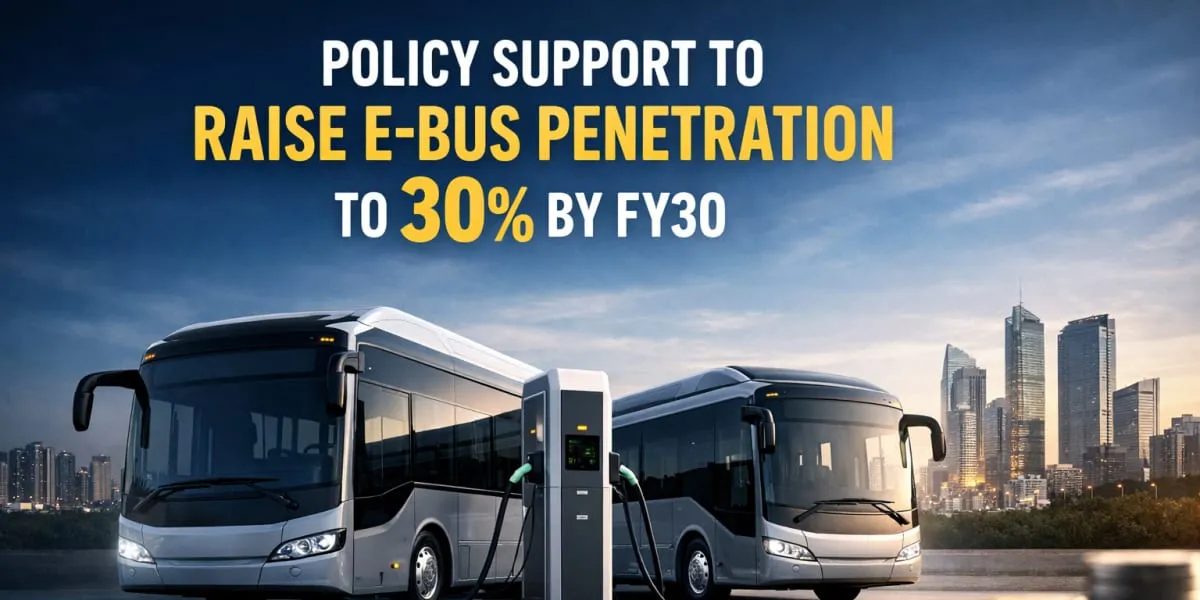
Icra said policy support and lower costs could lift adoption of electric buses to 30 per cent by FY30 as fresh tenders under the PM E-Drive scheme accelerate. The agency said achieving the target implies a sharp rise in adoption from the current financial year and that tendering and execution should improve as more states adopt the Payment Security Mechanism (PSM). It said PSM has encouraged greater participation from manufacturers and operators.

Despite higher upfront prices, Icra estimated lifecycle economics remain favourable. It said a 12-metre air-conditioned electric bus priced at around Rs ten million (mn) has a total cost of ownership of about Rs 39 per kilometre, compared with Rs 51 per kilometre for a diesel bus and Rs 48 per kilometre for a compressed natural gas bus after subsidies. The agency said the segment offers a large market opportunity for original equipment manufacturers and operators.

The report highlighted the gross cost contract model under which operators own and maintain buses while public transport authorities pay a fixed per kilometre fee. Icra said rated projects have generally performed well, with daily operations exceeding contracted kilometre commitments and project cost overruns remaining below 10 per cent. It warned that execution delays and payment risks persist, with several projects facing commercialisation delays of six months to one year due to slow depot handovers.

Icra noted that operators remain exposed to battery replacement costs and supply-chain disruptions because of dependence on imported battery cells and components, even as localisation improves for pack assembly and many other parts. The agency said the Payment Security Mechanism, implemented through Convergence Energy Services Limited (CESL) and backed by a direct debit mandate linked to state government accounts and the Reserve Bank of India (RBI), could improve credit profiles by ensuring timely payments. It added that private adoption will remain gradual given charging infrastructure concerns, higher upfront costs and uncertain passenger demand, while the entry of large strategic and financial investors and falling battery prices strengthens long-term growth prospects.

Icra said policy support and lower costs could lift adoption of electric buses to 30 per cent by FY30 as fresh tenders under the PM E-Drive scheme accelerate. The agency said achieving the target implies a sharp rise in adoption from the current financial year and that tendering and execution should improve as more states adopt the Payment Security Mechanism (PSM). It said PSM has encouraged greater participation from manufacturers and operators. Despite higher upfront prices, Icra estimated lifecycle economics remain favourable. It said a 12-metre air-conditioned electric bus priced at around Rs ten million (mn) has a total cost of ownership of about Rs 39 per kilometre, compared with Rs 51 per kilometre for a diesel bus and Rs 48 per kilometre for a compressed natural gas bus after subsidies. The agency said the segment offers a large market opportunity for original equipment manufacturers and operators. The report highlighted the gross cost contract model under which operators own and maintain buses while public transport authorities pay a fixed per kilometre fee. Icra said rated projects have generally performed well, with daily operations exceeding contracted kilometre commitments and project cost overruns remaining below 10 per cent. It warned that execution delays and payment risks persist, with several projects facing commercialisation delays of six months to one year due to slow depot handovers. Icra noted that operators remain exposed to battery replacement costs and supply-chain disruptions because of dependence on imported battery cells and components, even as localisation improves for pack assembly and many other parts. The agency said the Payment Security Mechanism, implemented through Convergence Energy Services Limited (CESL) and backed by a direct debit mandate linked to state government accounts and the Reserve Bank of India (RBI), could improve credit profiles by ensuring timely payments. It added that private adoption will remain gradual given charging infrastructure concerns, higher upfront costs and uncertain passenger demand, while the entry of large strategic and financial investors and falling battery prices strengthens long-term growth prospects.

Related Stories

Gold Stories

Next Story
Infrastructure Transport

Garuda Aerospace, Goa Partner to Train Women Drone Pilots

Garuda Aerospace has partnered with the Goa Information Technology Development Corporation (GITDC) and the Department of Information Technology, Electronics & Communications (DITE&C) to support the government’s broader ‘Drone Didi’ initiative in Goa.The programme aims to train 100 women every financial year and create 300 certified women drone pilots over three years, subject to statewide approval by DITE&C. The initiative seeks to strengthen rural livelihoods, encourage women-led entrepreneurship and develop a digitally skilled workforce.The first cohort of 12 women, recogni..

Next Story
Infrastructure Urban

Bondada Group Hosts ‘Bharat Unbound’ for Young Entrepreneurs

Bondada Group recently hosted ‘Bharat Unbound – Celebrating the Freedom to Dream, Create & Lead’ in Hyderabad, bringing together students and young entrepreneurs to discuss entrepreneurship, leadership, resilience and emerging opportunities in India.Held at Bondada House as part of the Group’s Independence Day celebrations, the event featured a fireside conversation with Dr Bondada Raghavendra Rao, Chairman and Managing Director, Bondada Group. He shared insights from his entrepreneurial journey and discussed how young people can use their freedom to pursue ideas, create opportunit..

Next Story
Infrastructure Urban

REC Backs Six Mobile Medical Units in Chhattisgarh

REC Limited, under its Corporate Social Responsibility (CSR) initiative, has supported six Mobile Medical Units (MMUs) worth Rs 7.21 crore in Chhattisgarh to strengthen healthcare access in underserved areas.Chhattisgarh Governor Shri Ramen Deka recently flagged off the six MMUs at Lok Bhawan, Chhattisgarh. The ceremony was attended by Shri Satyaban Sahoo, Chief Project Manager, Regional Office Raipur, REC Limited, along with officials from REC Limited and the Indian Red Cross Society (IRCS), Chhattisgarh.The mobile medical units are aimed at bridging healthcare gaps and improving last-mile de..

Advertisement

Subscribe to Our Newsletter

Get daily newsletters around different themes from Construction world.

STAY CONNECTED

Advertisement