Saluting Engineers on Engineer’s Day!
India’s
infrastructure story is often told through kilometres of highways, soaring
bridges, expanding metro networks and tunnels through some of the country’s
toughest terrain.
Less visible are the
engineering decisions behind them.
A railway through
the Himalayas. A bridge across Mumbai Bay. A metro system built beneath a
crowded capital. A 182-m-high structural landmark. A new generation of
high-speed highways. Each demanded years of design, testing, coordination and
problem-solving, often in conditions where there was little room for error.
This Engineers’ Day, we look at five engineers whose work and leadership have been closely associated with some of India’s most challenging infrastructure assignments.

E. Sreedharan
The engineer who
changed India’s urban mobility story
Project: Delhi Metro
Role: First Managing Director, Delhi Metro Rail Corporation
When Delhi Metro was
taking shape, India was embarking on a new era of urban rail. E. Sreedharan
became DMRC’s first Managing Director in 1997, bringing with him decades of
railway experience, including his leadership of the Konkan Railway project.
DMRC has described him as having played an iconic role in implementing the
Delhi Metro project.
Under his
leadership, the organisation developed a reputation for disciplined project
execution and professional management, helping establish a model that would
influence metro development across the country.
Legacy: Delhi Metro
became a benchmark for urban rail development and demonstrated how complex
public infrastructure could be delivered through engineering discipline and
institutional leadership.

Sandeep Gupta
The railway
engineer who took on the Himalayas
Project:
Udhampur–Srinagar–Baramulla Rail Link
Role: Former Chief Engineer and Chief Administrative Officer, USBRL
Organisation: Indian Railways
For more than a
decade, Sandeep Gupta was closely involved with one of India’s most difficult
railway projects. An Indian Infrastructure profile identifies him as a
1989-batch Indian Railway Service of Engineers officer with more than three
decades of experience in the planning, surveying, design and construction of
tunnels and bridges in Himalayan terrain. It also credits his involvement with
the Chenab Bridge and India’s first cable-stayed railway bridge.
The USBRL project
ultimately delivered the 1,315-m-long Chenab Bridge, rising 359 m above the
river, as well as the Anji Bridge, India's first cable-stayed railway bridge.
Gupta’s own account
of the project offers a sense of the conditions in which the engineering was
undertaken. Early surveys involved engineers travelling through remote terrain
on horses and mules, while construction demanded years of work in difficult
Himalayan conditions.
Legacy: USBRL
demonstrates how engineering expertise, persistence and adaptation can overcome
some of India's most difficult terrain.

Dr S. H. Robin Sham,
CBE
Engineering
India’s bridge across the sea
Project: Mumbai
Trans Harbour Link — Atal Setu
Role: Engineer and Team Leader, General Consultant
Organisation: AECOM-led General Consultant consortium
Atal Setu spans 21.8
km, including approximately 16.5 km over the sea, connecting Mumbai with Navi
Mumbai.
MMRDA project
documentation identifies Dr S. H. Robin Sham as the Engineer and Team Leader of
the General Consultants for the project. His role placed him at the centre of
the technical oversight of a project involving marine construction, structural
engineering, foundations, navigation requirements and multiple construction
packages.
The scale alone made
the assignment formidable. But the challenge was also one of coordination —
bringing together different engineering disciplines, contractors and technical
requirements into a single functioning infrastructure system.
Legacy: Atal Setu
represents a significant step forward in India’s ability to plan and execute
large-scale marine bridge infrastructure.
S. Sekaran
The engineer who
helped make the impossible stand
Project: Statue of
Unity
Role: Deputy Project Director – Statue of Unity
Organisation: Larsen & Toubro
At 182 m, the Statue
of Unity presented a structural challenge unlike a conventional building
project. S. Sekaran was part of the L&T team entrusted with delivering it.
L&T’s own
engineering publication identifies Sekaran as Deputy Project Director – Statue
of Unity and describes the assignment as one of the toughest projects
undertaken by the company. Sekaran joined the Statue of Unity project in 2015
after a career spanning several major L&T construction assignments.
The project demanded
precision in structural engineering, fabrication, construction planning and
execution on Sadhu Bet in the Narmada. L&T was responsible for the design,
engineering, construction, operation and maintenance contract for the monument.
Legacy: The Statue
of Unity demonstrated the ability of Indian engineering and construction teams
to deliver a structure of exceptional scale and complexity.

Mudit Garg
Engineering a new
generation of highways
Project:
Delhi–Mumbai Expressway — Sohna section
Role: Project Director, PIU-Sohna
Organisation: National Highways Authority of India
The Delhi–Mumbai
Expressway represents a shift towards access-controlled, high-speed highway
infrastructure, with greater emphasis on safety, pavement performance and
technology.
Mudit Garg served as
Project Director, NHAI, PIU-Sohna, and was closely associated with the
Sohna–Dausa section of the expressway. In an interview with Mobility Outlook,
Garg discussed the engineering and safety features that set the corridor apart,
describing it as a project intended to establish standards for future
expressways.
His inclusion here
is specifically for his role on the Sohna section — not as the sole engineer
responsible for the entire Delhi–Mumbai Expressway.
Legacy: The
expressway reflects India’s transition towards a new generation of high-speed,
access-controlled transport corridors.
Beyond the names
These five engineers
offer individual windows into a much larger engineering story. Behind every
landmark project are multidisciplinary teams working across structural, civil,
geotechnical, transportation, construction and project-management disciplines.
Much of that work
becomes invisible once a project opens. Calculations disappear beneath
foundations; engineering decisions become part of steel, concrete and asphalt.
Yet as India takes
on larger bridges, deeper tunnels, complex urban infrastructure and
increasingly demanding transport corridors, that expertise will become even
more critical.
The projects may
carry the names of cities, governments or institutions. Their physical form may
be measured in kilometres, metres and tonnes.
But behind every
such measure is an engineering decision — and behind those decisions are people
turning ambition into infrastructure.
Related Stories

Gold Stories




Vedanta Secures Two Offshore Blocks in KG Basin Under DSF IV
Vedanta Oil and Gas has secured two offshore blocks in the Krishna Godavari (KG) Basin under the Government of India's Discovered Small Field (DSF) IV bidding round, strengthening its exploration and production portfolio along India's east coast.The newly awarded assets include the shallow water block KG/OSDSF/G1/2025 and the deepwater block KG/DWDSF/GD10/2025. The acquisition forms part of Vedanta's strategy to expand its offshore operations and explore India's untapped hydrocarbon resources through advanced technologies and efficient project execution.The blocks were awarded at a contract si..

Hindustan Zinc's Sakhi Enterprise Income Grows 43%
Hindustan Zinc's Sakhi Microenterprise initiative has recorded a 43 per cent year-on-year increase in collective income, rising from Rs 2.3 million in FY26 to Rs 3.28 million, according to the company. The initiative, operated through Sakhi Utpadan Samiti, currently engages 426 women in income-generating activities across multiple production units.The programme aims to promote financial independence by helping rural women develop entrepreneurial skills and establish sustainable livelihoods. One of its beneficiaries, Manju Devi, who previously depended on seasonal agricultural work, now operate..
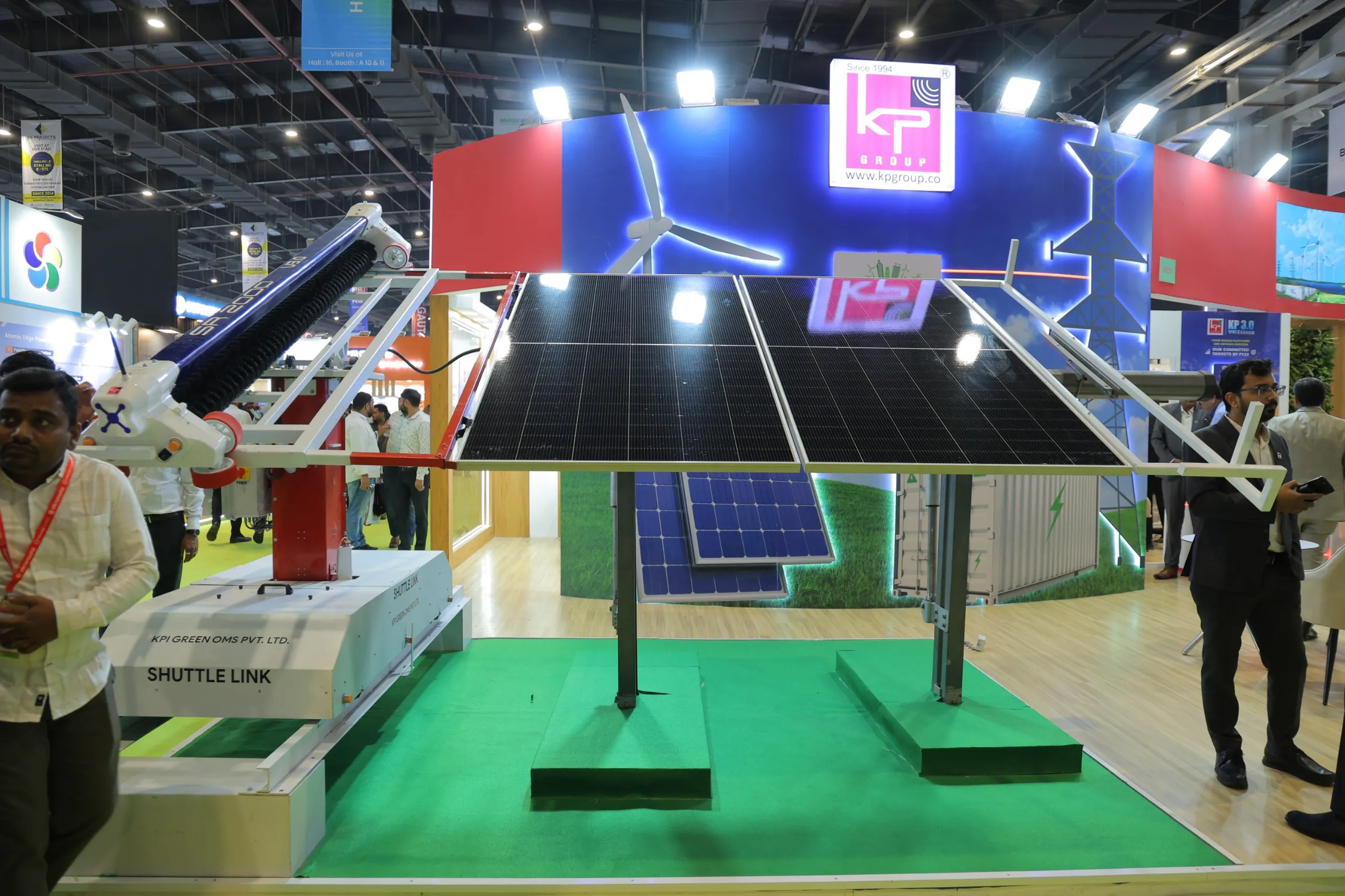
KP Group Launches Waterless Solar Cleaning Robot at REI Expo
KP Group's KPI Green OMS has launched the SR 2000 V3.0, a waterless robotic solar panel cleaning system designed for single-axis tracker and fixed-tilt solar power plants, at the Renewable Energy India (REI) Expo 2026 in Greater Noida. The robot aims to improve solar plant efficiency while reducing water consumption and maintenance requirements.Designed to address dust accumulation on solar modules, particularly in dry and remote locations, the SR 2000 V3.0 uses a UV-resistant polybutylene terephthalate (PBT) brush operating at 130 rpm. According to the company, the system achieves a cleaning ..
Related Articles
Latest Updates