+
Ship Shortage Disrupts India's Auto Exports In August
ECONOMY & POLICY

Ship Shortage Disrupts India's Auto Exports In August

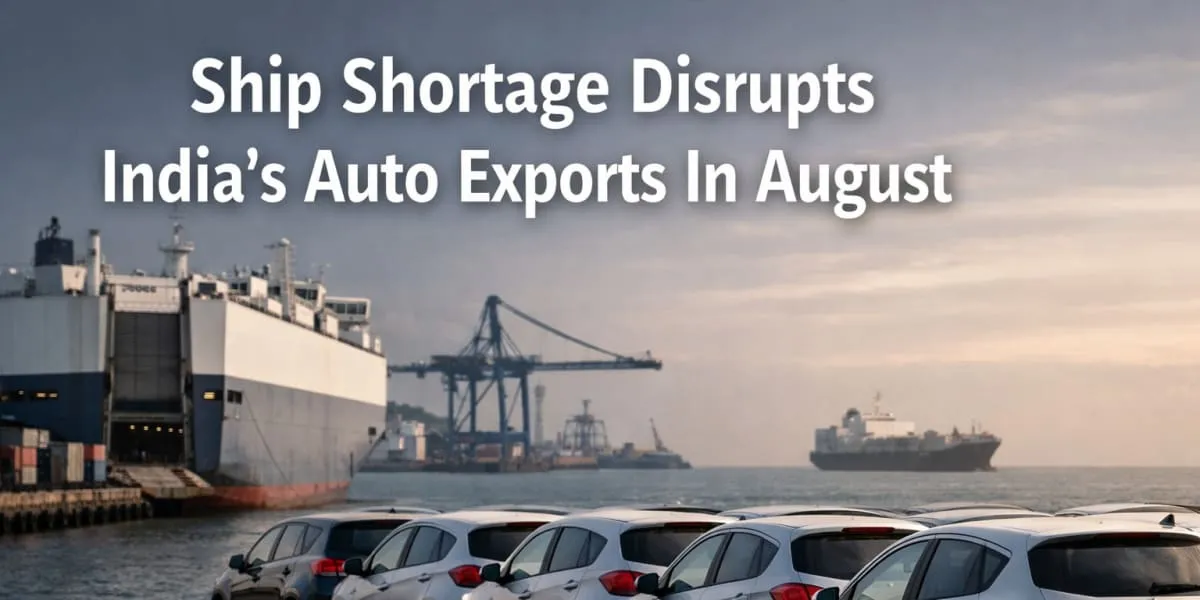
India's automobile exports encountered disruption in August after a shortage of vessels, a problem linked to the ongoing conflict in West Asia which constrained international shipping. The disruption affected major manufacturers including Maruti Suzuki India Ltd and Hyundai Motor India Ltd, reducing the flow of vehicles from Indian ports to overseas destinations. Maruti Suzuki exported 33,844 vehicles in August, marginally lower than 36,538 units in the corresponding month last year.

Maruti's senior executive for corporate affairs reported that demand across markets remained strong and that inventory was available at ports but that liner ships were not available to carry the cars, noting that the problem may continue for a while. The company highlighted diversification across 120 markets, with significant presence in Latin America that necessitates longer voyage times and greater exposure to vessel availability. Management characterised the disruption as temporary and said export momentum was expected to remain resilient.

Despite the logistical constraints, Maruti exported 188,636 vehicles during April to August, registering a 14.1 per cent increase over the corresponding period last year, underscoring continued demand. Between April and July, Maruti exported more vehicles than the other 17 manufacturers from India combined, which gave the company more than 50 per cent of the country's passenger vehicle export market. The firm indicated that shipments to the Middle East continued despite the regional tensions.

The Fronx SUV became the fastest SUV from India to cross 200,000 exports, achieving the milestone in less than 38 months, while the electric SUV e Vitara crossed 46,000 exports in its first 12 months and is being shipped to around 50 countries. These product-specific milestones were cited as evidence of sustained international demand.

Hyundai Motor India acknowledged that total exports in August were impacted by logistical constraints linked to the West Asia conflict and the broader geopolitical environment but remained optimistic about future demand as the situation improved. Industry participants described the vessel shortage as a temporary operational challenge rather than a fundamental shift in overseas demand. Companies are monitoring ship availability while maintaining production and port inventory to ride out the disruption.

India's automobile exports encountered disruption in August after a shortage of vessels, a problem linked to the ongoing conflict in West Asia which constrained international shipping. The disruption affected major manufacturers including Maruti Suzuki India Ltd and Hyundai Motor India Ltd, reducing the flow of vehicles from Indian ports to overseas destinations. Maruti Suzuki exported 33,844 vehicles in August, marginally lower than 36,538 units in the corresponding month last year. Maruti's senior executive for corporate affairs reported that demand across markets remained strong and that inventory was available at ports but that liner ships were not available to carry the cars, noting that the problem may continue for a while. The company highlighted diversification across 120 markets, with significant presence in Latin America that necessitates longer voyage times and greater exposure to vessel availability. Management characterised the disruption as temporary and said export momentum was expected to remain resilient. Despite the logistical constraints, Maruti exported 188,636 vehicles during April to August, registering a 14.1 per cent increase over the corresponding period last year, underscoring continued demand. Between April and July, Maruti exported more vehicles than the other 17 manufacturers from India combined, which gave the company more than 50 per cent of the country's passenger vehicle export market. The firm indicated that shipments to the Middle East continued despite the regional tensions. The Fronx SUV became the fastest SUV from India to cross 200,000 exports, achieving the milestone in less than 38 months, while the electric SUV e Vitara crossed 46,000 exports in its first 12 months and is being shipped to around 50 countries. These product-specific milestones were cited as evidence of sustained international demand. Hyundai Motor India acknowledged that total exports in August were impacted by logistical constraints linked to the West Asia conflict and the broader geopolitical environment but remained optimistic about future demand as the situation improved. Industry participants described the vessel shortage as a temporary operational challenge rather than a fundamental shift in overseas demand. Companies are monitoring ship availability while maintaining production and port inventory to ride out the disruption.

Related Stories

Gold Stories

Next Story
Infrastructure Urban

TransIndia Launches World View Collection at Meridian

TransIndia Group has recently launched ‘The World View Collection’ at TransIndia Meridian, its residential development in Mumbai’s Sion-Matunga Corridor. The campaign introduces residences located on the 22nd floor and above, offering expansive views of the cityscape, Eastern Bay and the sea.The collection positions elevation as an integral part of the living experience, with the higher-floor homes designed around openness, changing skylines and wider city views. Rather than focusing only on floor height, the campaign highlights how elevated residences can offer a different perspective o..

Next Story
Real Estate

Villaro Design Studio Opens on MG Road in Delhi

Furniture designer Yuvraj Vohra has recently launched the new Villaro Design Studio on MG Road, Delhi, introducing a furniture brand built around an architectural approach to design, materiality and craftsmanship.Trained as an architect, Vohra approaches furniture as an integral part of the spatial experience rather than as standalone objects. Villaro's design philosophy focuses on proportion, material expression and the relationship between furniture and its surrounding architecture.The collection explores combinations of stone, marble, wood, metal and upholstery, with materials treated as st..

Next Story
Infrastructure Urban

India-Belgium Trade Shows Signs of Recovery in FY2026

India-Belgium economic relations are gaining renewed momentum following Belgian Prime Minister Bart De Wever’s three-day official visit to India from September 2–4, 2026. The visit, the first by a Belgian Prime Minister to India in two decades, focused on strengthening cooperation across trade, investment, defence, technology, connectivity and logistics.Belgium is an important European investment and trading partner for India, with cumulative foreign direct investment inflows of around $4.25 billion between April 2000 and March 2026. The country is a major European manufacturing, trade and..

Advertisement

Subscribe to Our Newsletter

Get daily newsletters around different themes from Construction world.

STAY CONNECTED

Advertisement

SPECIAL OFFER
QR Code