Study Flags 25 Meghalaya Blocks as Highly Climate Vulnerable
ECONOMY & POLICY

Study Flags 25 Meghalaya Blocks as Highly Climate Vulnerable

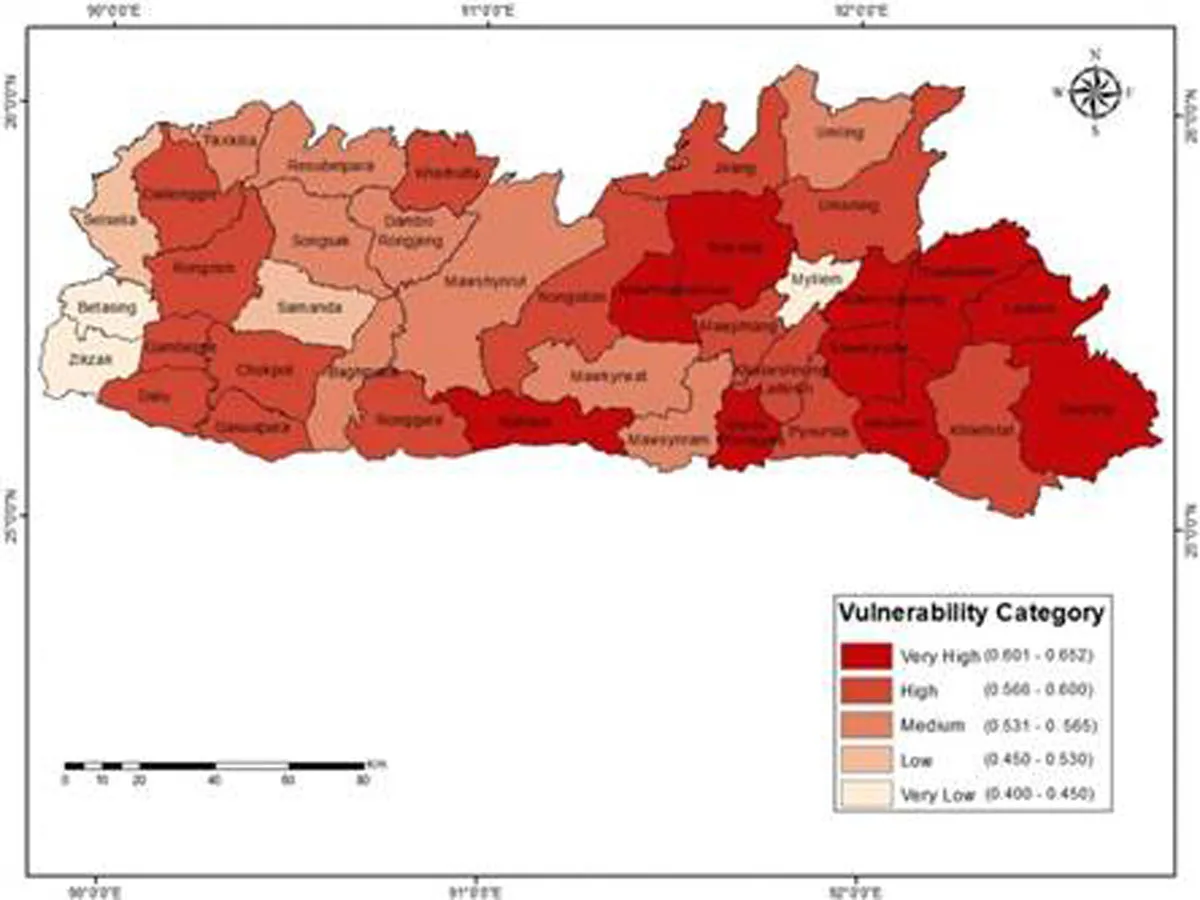
A new climate vulnerability assessment has found that 25 of Meghalaya’s 39 Community and Rural Development (C&RD) Blocks fall under the high or very high risk categories, highlighting the serious pressures climate change is placing on the state’s fragile Himalayan ecosystem. The analysis marks Meghalaya’s first block-level climate vulnerability study and offers a more granular understanding of local risks compared to broader district-level assessments.

The assessment was carried out by the Meghalaya Climate Change Centre (MCCC), established under the National Mission for Sustaining the Himalayan Ecosystem (NMSHE) as part of the National Action Plan for Climate Change. The study aligns with the national climate vulnerability framework promoted through State Climate Change Cells (SCCCs), set up by the Department of Science and Technology in 30 States and Union Territories to strengthen coordination between the Centre and the states.

Using a tiered, top-down methodology, the MCCC evaluated both biophysical and socio-economic indicators to map vulnerability across C&RD Blocks. The findings show that high and very high vulnerability levels are driven by factors such as limited access to institutional credit, low household incomes, poor public health and nutrition services including inadequate Anganwadi Centres, insufficient forest resources, and minimal irrigation coverage. These conditions collectively weaken community resilience and heighten exposure to climate stresses.

The report provides critical insights for policymakers working in climate adaptation, rural development and socio-economic equity. By pinpointing vulnerabilities at the block level, it enables more targeted interventions tailored to specific terrain and community needs. The study reinforces the need for integrated and grassroots-led climate adaptation strategies to build long-term resilience in Meghalaya and contributes to India’s broader goal of safeguarding the Himalayan ecosystem from escalating climate risks.
News source: PIB

A new climate vulnerability assessment has found that 25 of Meghalaya’s 39 Community and Rural Development (C&RD) Blocks fall under the high or very high risk categories, highlighting the serious pressures climate change is placing on the state’s fragile Himalayan ecosystem. The analysis marks Meghalaya’s first block-level climate vulnerability study and offers a more granular understanding of local risks compared to broader district-level assessments.The assessment was carried out by the Meghalaya Climate Change Centre (MCCC), established under the National Mission for Sustaining the Himalayan Ecosystem (NMSHE) as part of the National Action Plan for Climate Change. The study aligns with the national climate vulnerability framework promoted through State Climate Change Cells (SCCCs), set up by the Department of Science and Technology in 30 States and Union Territories to strengthen coordination between the Centre and the states.Using a tiered, top-down methodology, the MCCC evaluated both biophysical and socio-economic indicators to map vulnerability across C&RD Blocks. The findings show that high and very high vulnerability levels are driven by factors such as limited access to institutional credit, low household incomes, poor public health and nutrition services including inadequate Anganwadi Centres, insufficient forest resources, and minimal irrigation coverage. These conditions collectively weaken community resilience and heighten exposure to climate stresses.The report provides critical insights for policymakers working in climate adaptation, rural development and socio-economic equity. By pinpointing vulnerabilities at the block level, it enables more targeted interventions tailored to specific terrain and community needs. The study reinforces the need for integrated and grassroots-led climate adaptation strategies to build long-term resilience in Meghalaya and contributes to India’s broader goal of safeguarding the Himalayan ecosystem from escalating climate risks.News source: PIB

Next Story
Infrastructure Transport

Shimla Halts NHAI Tunnel Work after Road Depression and Home Cracks

The Shimla district administration has ordered an immediate halt to all construction on the twin tube tunnel under National Highway-05 after a large depression surfaced on the Mehli–Dhali Road and structural cracks appeared in several nearby homes. The decision follows growing safety concerns triggered by the recent landslide at Bhattakufar.District Magistrate Anupam Kashyap has written to the Project Director of the National Highways Authority of India (NHAI), instructing that all excavation, blasting and related activities under the Shimla Bypass Package-II be stopped without delay. The bl..

Next Story
Infrastructure Urban

ALIMCO Marks 53 Years with New Logo, EV Scooter and Wheelchair Tech

ALIMCO celebrated its 53rd Foundation Day with the unveiling of a refreshed corporate identity and the launch of next-generation mobility solutions designed to enhance independence for Divyangjan and senior citizens. The event, attended by Union Minister for Social Justice & Empowerment Dr Virendra Kumar and Minister of State B L. Verma, underscored the organisation’s expanding role in India’s inclusion and accessibility landscape.Dr Virendra Kumar highlighted ALIMCO’s evolution from a manufacturing unit into a national institution rooted in innovation and empathy. He noted that more..

Advertisement

Subscribe to Our Newsletter

Get daily newsletters around different themes from Construction world.

STAY CONNECTED

Advertisement

Advertisement

Advertisement

Get CW App