Tribal Ministry and BPCL to Set Up 75 Space Labs in EMR Schools
ECONOMY & POLICY

Tribal Ministry and BPCL to Set Up 75 Space Labs in EMR Schools

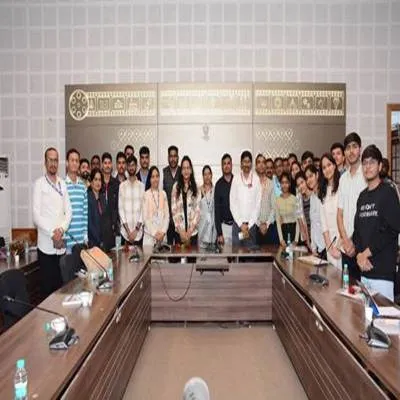
In a historic step Ministry of tribal affairs and Bharat Petroleum Corporation (BPCL) announced the setting up of “Space Labs” in 75 Eklavya Model Residential School (EMRS) across 19 states in the country.

Ministry of Tribal Affairs, Government of India establishes EMRS to impart quality education to ST children thereby enabling them to avail of opportunities in high and professional educational courses and get gainful employment in various sectors. EMRS in addition to imparting high quality education also takes care of their nutrition and overall health and development. As on date there are 470 functional EMRS across the country.

BPCL has announced that it will support the tribal affairs Ministry under its Corporate Social Responsibility (CSR) initiatives to set up the Space Labs and has sanctioned around Rs 120 million towards the same.

Through this initiative, the Ministry seeks to bridge educational gaps and open new avenues for tribal youth in the fields of space science, technology, engineering, and maths (STEM). By providing exposure to space sciences at a young age, the ministry aims to lay the foundation for nurturing future scientists, technologists, and innovators from tribal communities. This project marks a significant step towards mainstreaming tribal students into India's scientific advancement. It reflects the Government's broader efforts under the NEP 2020 framework to create equitable and inclusive educational opportunities for all sections of society.

The initiative will be technically supported by the Space tutor agencies recognized by Indian Space Research Organisation (ISRO).Each such lab will have the advanced scientific equipment including the following components:

• LVM3 Launch Vehicle and EO satellite demo model with all dub system details • Static model launch vehicles (PSLV, HRLV, IRNSS, GSAT) • Table Top demo models of solar System, lunar Eclipse, phases of the moon, day and nights, 4 seasons, globe and time indicator • Star tracker telescope 150/750mm and Cansat working model • Space, Science, and Maths Teaching Learning Material (TLM) kits • ISRO space bookand timelineexhibit

These labs are to be established in EMRS of 19 states in India and includesAndhra Pradesh, Arunachal Pradesh, Chhattisgarh, Dadra and Nagar Haveli, Gujarat, Himachal Pradesh, Jammu & Kashmir, Jharkhand, Karnataka, Madhya Pradesh, Maharashtra, Mizoram, Odisha, Rajasthan, Telangana, Tripura, Uttar Pradesh, Uttarakhand, West Bengal. More than 50,000 tribal students shall benefit through this initiative.

In a historic step Ministry of tribal affairs and Bharat Petroleum Corporation (BPCL) announced the setting up of “Space Labs” in 75 Eklavya Model Residential School (EMRS) across 19 states in the country. Ministry of Tribal Affairs, Government of India establishes EMRS to impart quality education to ST children thereby enabling them to avail of opportunities in high and professional educational courses and get gainful employment in various sectors. EMRS in addition to imparting high quality education also takes care of their nutrition and overall health and development. As on date there are 470 functional EMRS across the country. BPCL has announced that it will support the tribal affairs Ministry under its Corporate Social Responsibility (CSR) initiatives to set up the Space Labs and has sanctioned around Rs 120 million towards the same. Through this initiative, the Ministry seeks to bridge educational gaps and open new avenues for tribal youth in the fields of space science, technology, engineering, and maths (STEM). By providing exposure to space sciences at a young age, the ministry aims to lay the foundation for nurturing future scientists, technologists, and innovators from tribal communities. This project marks a significant step towards mainstreaming tribal students into India's scientific advancement. It reflects the Government's broader efforts under the NEP 2020 framework to create equitable and inclusive educational opportunities for all sections of society. The initiative will be technically supported by the Space tutor agencies recognized by Indian Space Research Organisation (ISRO).Each such lab will have the advanced scientific equipment including the following components: • LVM3 Launch Vehicle and EO satellite demo model with all dub system details • Static model launch vehicles (PSLV, HRLV, IRNSS, GSAT) • Table Top demo models of solar System, lunar Eclipse, phases of the moon, day and nights, 4 seasons, globe and time indicator • Star tracker telescope 150/750mm and Cansat working model • Space, Science, and Maths Teaching Learning Material (TLM) kits • ISRO space bookand timelineexhibit These labs are to be established in EMRS of 19 states in India and includesAndhra Pradesh, Arunachal Pradesh, Chhattisgarh, Dadra and Nagar Haveli, Gujarat, Himachal Pradesh, Jammu & Kashmir, Jharkhand, Karnataka, Madhya Pradesh, Maharashtra, Mizoram, Odisha, Rajasthan, Telangana, Tripura, Uttar Pradesh, Uttarakhand, West Bengal. More than 50,000 tribal students shall benefit through this initiative.

Related Stories

Gold Stories

Next Story
Infrastructure Urban

KONE Opens India's First Digital Experience Centre in Pune

KONE, a global elevator and escalator manufacturer, has inaugurated its first Digital Experience Centre (DEC) in India, located in Pune. The facility aims to showcase how artificial intelligence (AI), connectivity and data-driven technologies can enhance customer experiences and improve building operations.The centre was inaugurated by Jussi Herlin, Executive Vice Chair, KONE Corporation; Philippe Delorme, President and CEO, KONE; and Nandan Nilekani, Co-founder and Chairman of the Board, Infosys.Designed as an interactive customer environment, the facility demonstrates digital solutions cover..

Next Story
Infrastructure Urban

CII GreenCo Launches Circularity Guidelines for Indian Industry

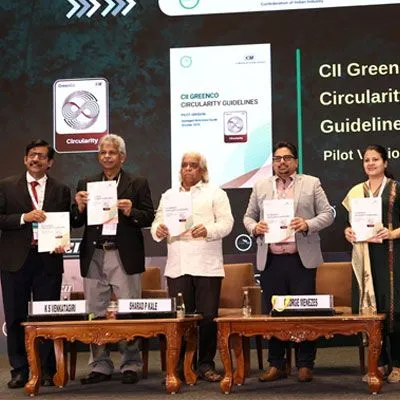
The Confederation of Indian Industry (CII) GreenCo Council has launched the CII GreenCo Circularity Guidelines – Pilot Version at the 17th CII GreenCo Waste & Resource Management Summit 2026 in Chennai. The initiative aims to strengthen resource efficiency, waste reduction and circular economy practices across Indian manufacturing and process industries.The guidelines introduce a structured framework with circularity indices covering raw materials, consumables, packaging and other resource inputs. These indicators will help industries assess existing practices, identify opportunities to ..

Next Story
Infrastructure Energy

Global Electronics Association Launches IPC-1783-CO2E Standard

The Global Electronics Association has introduced IPC-1783-CO2E, a new international standard aimed at improving consistency, transparency and comparability in product carbon footprint reporting across the electronics manufacturing industry.The standard, titled International Standard for Data Collection and Reporting of CO2 Equivalent (CO2e) Emissions for the Electronics Manufacturing Supply Chain, provides industry-specific guidance for collecting, estimating and reporting carbon emissions data.With increasing regulatory requirements and customer expectations, electronics manufacturers face c..

Advertisement

Subscribe to Our Newsletter

Get daily newsletters around different themes from Construction world.

STAY CONNECTED

Advertisement

SPECIAL OFFER
QR Code