Two-Wheelers Lead Work Commutes as Buses, Rail Dominate Overnight Travel
ECONOMY & POLICY

Two-Wheelers Lead Work Commutes as Buses, Rail Dominate Overnight Travel

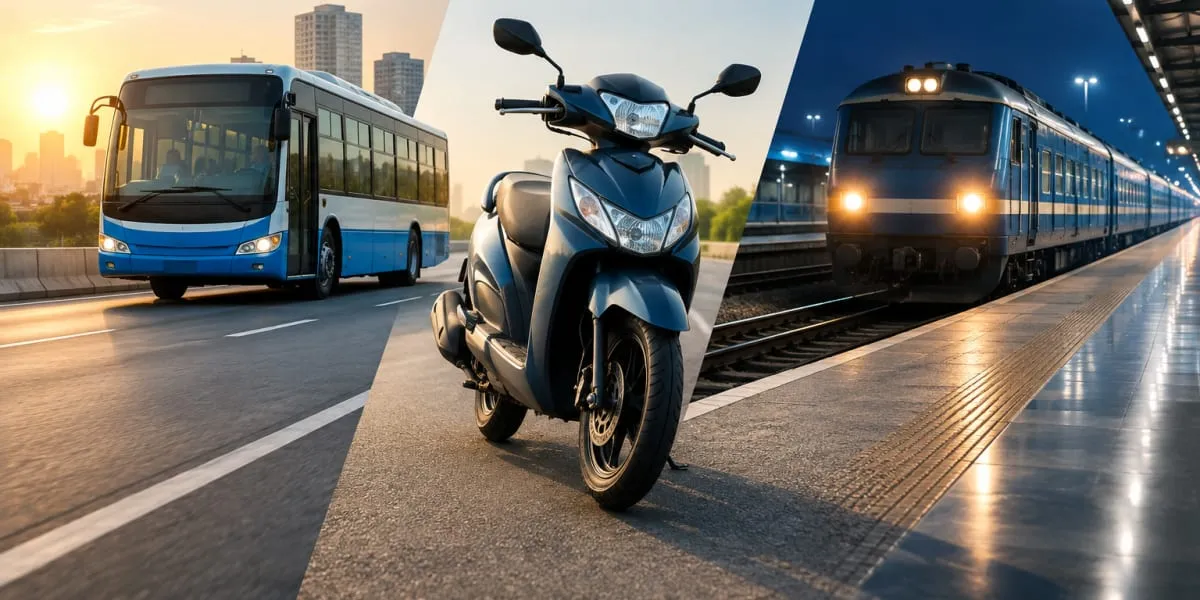
Two-wheelers are the most widely used mode of transport for workers in India, while buses and railways account for most longer overnight journeys, according to the first National Household Travel Survey by the Ministry of Statistics and Programme Implementation (MoSPI). The survey found that 42.6 per cent of workers travelling to fixed or non-fixed workplaces use two-wheelers as their primary mode. The share was 52.3 per cent in urban areas and 37.1 per cent in rural India.

Walking was the second-largest mode nationally, accounting for 28.3 per cent of worker trips. Commute times remained relatively short, with 83.4 per cent of workers travelling to a fixed workplace reaching it within 30 minutes. The proportion was 86.1 per cent in rural areas and 79.3 per cent in urban areas, while another 13.7 per cent took between 30 minutes and one hour.

The average commute lasted 25 minutes nationally, including 27 minutes in urban areas and 23 minutes in rural India. Nearly 95 per cent of workers left for work before 10 am, with 56.5 per cent departing between 8 am and 10 am and 33.7 per cent leaving between 6 am and 8 am.

The average monthly expenditure on commuting to a fixed workplace was Rs. 785 per worker. Urban workers spent Rs. 1,044, compared with Rs. 612 for rural workers. Male workers spent Rs. 835 a month on average, against Rs. 533 for female workers. Overall, 57.6 per cent of workers travelled more than 1 km to their workplace, including 61.9 per cent of male workers and 41.9 per cent of female workers.

Buses accounted for 55.8 per cent of overnight household trips, followed by inter-city railways at 17.7 per cent. Cars accounted for 15.1 per cent and two-wheelers for 8.8 per cent. Social and religious activities made up 70.2 per cent of overnight travel. Among students, walking accounted for 37 per cent of trips to educational institutions, followed by buses at 29.5 per cent and bicycles at 15.8 per cent.

Two-wheelers are the most widely used mode of transport for workers in India, while buses and railways account for most longer overnight journeys, according to the first National Household Travel Survey by the Ministry of Statistics and Programme Implementation (MoSPI). The survey found that 42.6 per cent of workers travelling to fixed or non-fixed workplaces use two-wheelers as their primary mode. The share was 52.3 per cent in urban areas and 37.1 per cent in rural India. Walking was the second-largest mode nationally, accounting for 28.3 per cent of worker trips. Commute times remained relatively short, with 83.4 per cent of workers travelling to a fixed workplace reaching it within 30 minutes. The proportion was 86.1 per cent in rural areas and 79.3 per cent in urban areas, while another 13.7 per cent took between 30 minutes and one hour. The average commute lasted 25 minutes nationally, including 27 minutes in urban areas and 23 minutes in rural India. Nearly 95 per cent of workers left for work before 10 am, with 56.5 per cent departing between 8 am and 10 am and 33.7 per cent leaving between 6 am and 8 am. The average monthly expenditure on commuting to a fixed workplace was Rs. 785 per worker. Urban workers spent Rs. 1,044, compared with Rs. 612 for rural workers. Male workers spent Rs. 835 a month on average, against Rs. 533 for female workers. Overall, 57.6 per cent of workers travelled more than 1 km to their workplace, including 61.9 per cent of male workers and 41.9 per cent of female workers. Buses accounted for 55.8 per cent of overnight household trips, followed by inter-city railways at 17.7 per cent. Cars accounted for 15.1 per cent and two-wheelers for 8.8 per cent. Social and religious activities made up 70.2 per cent of overnight travel. Among students, walking accounted for 37 per cent of trips to educational institutions, followed by buses at 29.5 per cent and bicycles at 15.8 per cent.

Related Stories

Gold Stories

Next Story
Building Material

PureSil Paints Develops Mineral Coatings from Industrial Waste

PureSil Paints, a brand of Relic Coatings LLP, has developed an indigenous mineral-based coating technology aimed at reducing dependence on petrochemical-derived raw materials in the paints and coatings industry. Its proprietary Silicification Technology uses agricultural and industrial by-products to manufacture architectural coatings as an alternative to conventional acrylic paints.Developed in-house by Dr Nikhil Dhote, Founder and Chief Technologist, Relic Coatings LLP, the technology uses silicate binders derived from upcycled rice husk ash and industrial coal fly ash. The formulation is d..

Next Story
Infrastructure Energy

Vedanta Eyes AI to Accelerate Mineral Exploration

Vedanta Group is exploring the use of artificial intelligence (AI) to significantly improve efficiency in mineral exploration, geological analysis and resource modelling. The company aims to reduce exploration processes that traditionally take three to four months to just six to seven days through AI-driven technologies.The proposed approach involves AI-led geological analysis and mineral block modelling to accelerate mineral resource assessment and support faster, more cost-efficient development of domestic mineral reserves. The initiative aligns with India's growing focus on critical mineral..

Next Story
Technology

NXP Launches Unified Robotics Platform for Physical AI

NXP Semiconductors has launched a unified robotics platform designed to accelerate the development and deployment of trusted physical artificial intelligence (AI) systems. Built on the company's neural axis architecture, the platform integrates AI processing, connectivity, motor control, security and energy management within a common hardware and software ecosystem.The platform combines an open-source, modular software development kit (SDK) with pre-validated reference designs, enabling developers to build robotic systems more efficiently. It supports development ranging from individual subsys..

Advertisement

Subscribe to Our Newsletter

Get daily newsletters around different themes from Construction world.

STAY CONNECTED

Advertisement

SPECIAL OFFER
QR Code