
Vedanta Aluminium Patents Eco-Friendly Alloy
ECONOMY & POLICY

Vedanta Aluminium Patents Eco-Friendly Alloy

Vedanta Aluminium, India’s largest producer of aluminium, has secured its first product development patent for a lead- and tin-free bismuth-aluminium alloy, marking a major leap in sustainable metallurgy.

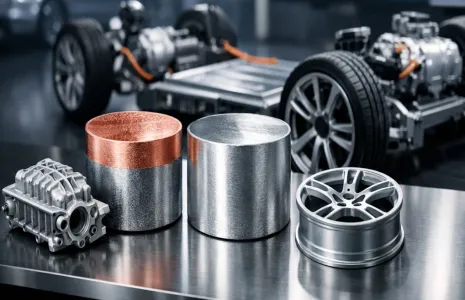
Developed by the company’s in-house R&D team, the innovation replaces hazardous elements like lead and tin—currently being phased out globally—with environmentally safe bismuth. The result is a high-machinability, high-performance alloy designed for automotive, electronics, and textile applications, combining engineering precision with sustainability.

“Innovation and sustainability lie at the core of Vedanta Aluminium’s R&D vision,” said Rajiv Kumar, CEO, Vedanta Aluminium. “This patent validates our pursuit of responsible manufacturing by creating materials that not only meet global environmental standards but also deliver exceptional mechanical strength and machinability.”

The new alloy is tailored for critical components such as hydraulic manifolds, valve blocks, transmission sleeves, steering yokes, and electrical connectors, as well as precision electronic parts like camera housings and mobile components.

The breakthrough responds to increasing demand for eco-friendly alternatives to traditional machinable alloys such as AA6262 and AA6020, which contain restricted elements like lead and tin. Current substitutes such as AA6061 and AA6082 often face limitations like poor surface finish and shorter tool life.

Vedanta Aluminium’s patented bismuth-aluminium alloy overcomes these challenges, offering:
  • Higher strength and durability: 8% greater tensile strength, 21% higher yield strength, and 17% more hardness than conventional grades.
  • Superior machinability: Smaller, easily breakable chips for faster operations.
  • Extended tool life: Up to 30% smoother surface finish and improved efficiency under high-speed machining.

This innovation supports national missions such as ‘Make in India’ and ‘Atmanirbhar Bharat’, reinforcing Vedanta’s commitment to homegrown R&D, import substitution, and industrial sustainability. It also aligns with the company’s goal of achieving Net Zero Carbon Emissions by 2050.

Through such pioneering developments, Vedanta Aluminium continues to lead India’s transition toward sustainable industrial growth, setting new benchmarks in green innovation and responsible manufacturing.

Vedanta Aluminium, India’s largest producer of aluminium, has secured its first product development patent for a lead- and tin-free bismuth-aluminium alloy, marking a major leap in sustainable metallurgy.Developed by the company’s in-house R&D team, the innovation replaces hazardous elements like lead and tin—currently being phased out globally—with environmentally safe bismuth. The result is a high-machinability, high-performance alloy designed for automotive, electronics, and textile applications, combining engineering precision with sustainability.“Innovation and sustainability lie at the core of Vedanta Aluminium’s R&D vision,” said Rajiv Kumar, CEO, Vedanta Aluminium. “This patent validates our pursuit of responsible manufacturing by creating materials that not only meet global environmental standards but also deliver exceptional mechanical strength and machinability.”The new alloy is tailored for critical components such as hydraulic manifolds, valve blocks, transmission sleeves, steering yokes, and electrical connectors, as well as precision electronic parts like camera housings and mobile components.The breakthrough responds to increasing demand for eco-friendly alternatives to traditional machinable alloys such as AA6262 and AA6020, which contain restricted elements like lead and tin. Current substitutes such as AA6061 and AA6082 often face limitations like poor surface finish and shorter tool life.Vedanta Aluminium’s patented bismuth-aluminium alloy overcomes these challenges, offering:Higher strength and durability: 8% greater tensile strength, 21% higher yield strength, and 17% more hardness than conventional grades.Superior machinability: Smaller, easily breakable chips for faster operations.Extended tool life: Up to 30% smoother surface finish and improved efficiency under high-speed machining.This innovation supports national missions such as ‘Make in India’ and ‘Atmanirbhar Bharat’, reinforcing Vedanta’s commitment to homegrown R&D, import substitution, and industrial sustainability. It also aligns with the company’s goal of achieving Net Zero Carbon Emissions by 2050.Through such pioneering developments, Vedanta Aluminium continues to lead India’s transition toward sustainable industrial growth, setting new benchmarks in green innovation and responsible manufacturing.

Related Stories

Gold Stories

Next Story
Infrastructure Urban

KONE Opens India's First Digital Experience Centre in Pune

KONE, a global elevator and escalator manufacturer, has inaugurated its first Digital Experience Centre (DEC) in India, located in Pune. The facility aims to showcase how artificial intelligence (AI), connectivity and data-driven technologies can enhance customer experiences and improve building operations.The centre was inaugurated by Jussi Herlin, Executive Vice Chair, KONE Corporation; Philippe Delorme, President and CEO, KONE; and Nandan Nilekani, Co-founder and Chairman of the Board, Infosys.Designed as an interactive customer environment, the facility demonstrates digital solutions cover..

Next Story
Infrastructure Urban

CII GreenCo Launches Circularity Guidelines for Indian Industry

The Confederation of Indian Industry (CII) GreenCo Council has launched the CII GreenCo Circularity Guidelines – Pilot Version at the 17th CII GreenCo Waste & Resource Management Summit 2026 in Chennai. The initiative aims to strengthen resource efficiency, waste reduction and circular economy practices across Indian manufacturing and process industries.The guidelines introduce a structured framework with circularity indices covering raw materials, consumables, packaging and other resource inputs. These indicators will help industries assess existing practices, identify opportunities to ..

Next Story
Infrastructure Energy

Global Electronics Association Launches IPC-1783-CO2E Standard

The Global Electronics Association has introduced IPC-1783-CO2E, a new international standard aimed at improving consistency, transparency and comparability in product carbon footprint reporting across the electronics manufacturing industry.The standard, titled International Standard for Data Collection and Reporting of CO2 Equivalent (CO2e) Emissions for the Electronics Manufacturing Supply Chain, provides industry-specific guidance for collecting, estimating and reporting carbon emissions data.With increasing regulatory requirements and customer expectations, electronics manufacturers face c..

Advertisement

Subscribe to Our Newsletter

Get daily newsletters around different themes from Construction world.

STAY CONNECTED

Advertisement

SPECIAL OFFER
QR Code