+
WeWork India Expands With New Centres in Pune, Chennai
ECONOMY & POLICY

WeWork India Expands With New Centres in Pune, Chennai

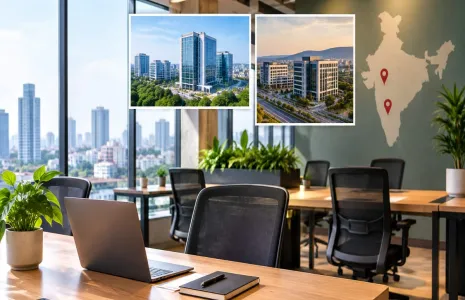
WeWork India Management Limited, a key player in India's premium flexible workspace sector, has announced the signing of leases for two new centres—WeWork EON Free Zone in Pune and WeWork Ramanujan Intellion Park in Chennai. These additions mark a strategic expansion into two of the country’s most dynamic commercial markets, with both locations set to launch in the second half of FY 2025.

Following its entry into Chennai over a year ago, WeWork India is now introducing its third centre in the city. Situated in the Littlewood Tower within Ramanujan Intellion Park, the new space spans approximately 150,000 square feet across three floors and includes around 2,400 desks. The centre is designed as a fully customised managed workspace, combining cutting-edge design with cultural elements inspired by Chennai’s heritage. Its location at the start of Old Mahabalipuram Road—Chennai’s rapidly developing IT corridor—positions it ideally for technology-driven enterprises.

Meanwhile, in Pune, the newly signed WeWork EON Free Zone marks the company’s eighth operational site in the city. Located in the prominent Kharadi business district, the workspace spans about 60,000 square feet over two floors and offers nearly 1,000 desks. With excellent connectivity to Ramwadi Metro Station and Pune International Airport, as well as proximity to key business landmarks like the World Trade Centre and Gera Commerzone, the centre offers a seamless blend of accessibility and modern business convenience.

Arnav S. Gusain, Chief of Supply at WeWork India, commented, “We are excited to expand our presence in Chennai and Pune—two cities that continue to attract innovation, enterprise, and growth. Our spaces are designed to adapt to the evolving demands of today’s workforce, empowering businesses of all sizes with flexible and functional environments.”

Echoing this sentiment, Sagar Chordia, Director at Panchshil Realty, added, “Our continued collaboration with WeWork India at EON Free Zone reinforces our commitment to developing best-in-class workspaces. Kharadi is fast becoming Pune’s commercial epicentre, and this partnership plays a key role in shaping its future.”

The Indian flexible workspace sector is experiencing significant momentum. With a compound annual growth rate of 18 to 19 per cent, the total flexible office stock in Tier 1 cities is projected to reach around 124 to 126 million square feet by the end of calendar year 2027.

WeWork India currently operates across eight major Indian cities and offers over 100,000 desks. Its portfolio caters to a broad spectrum of users, from individual entrepreneurs and startups to global corporations, including Fortune 500 companies. This latest expansion reinforces WeWork India’s mission to provide premium, adaptable workspaces that elevate productivity and foster collaboration in thriving commercial hubs.

WeWork India Management Limited, a key player in India's premium flexible workspace sector, has announced the signing of leases for two new centres—WeWork EON Free Zone in Pune and WeWork Ramanujan Intellion Park in Chennai. These additions mark a strategic expansion into two of the country’s most dynamic commercial markets, with both locations set to launch in the second half of FY 2025.Following its entry into Chennai over a year ago, WeWork India is now introducing its third centre in the city. Situated in the Littlewood Tower within Ramanujan Intellion Park, the new space spans approximately 150,000 square feet across three floors and includes around 2,400 desks. The centre is designed as a fully customised managed workspace, combining cutting-edge design with cultural elements inspired by Chennai’s heritage. Its location at the start of Old Mahabalipuram Road—Chennai’s rapidly developing IT corridor—positions it ideally for technology-driven enterprises.Meanwhile, in Pune, the newly signed WeWork EON Free Zone marks the company’s eighth operational site in the city. Located in the prominent Kharadi business district, the workspace spans about 60,000 square feet over two floors and offers nearly 1,000 desks. With excellent connectivity to Ramwadi Metro Station and Pune International Airport, as well as proximity to key business landmarks like the World Trade Centre and Gera Commerzone, the centre offers a seamless blend of accessibility and modern business convenience.Arnav S. Gusain, Chief of Supply at WeWork India, commented, “We are excited to expand our presence in Chennai and Pune—two cities that continue to attract innovation, enterprise, and growth. Our spaces are designed to adapt to the evolving demands of today’s workforce, empowering businesses of all sizes with flexible and functional environments.”Echoing this sentiment, Sagar Chordia, Director at Panchshil Realty, added, “Our continued collaboration with WeWork India at EON Free Zone reinforces our commitment to developing best-in-class workspaces. Kharadi is fast becoming Pune’s commercial epicentre, and this partnership plays a key role in shaping its future.”The Indian flexible workspace sector is experiencing significant momentum. With a compound annual growth rate of 18 to 19 per cent, the total flexible office stock in Tier 1 cities is projected to reach around 124 to 126 million square feet by the end of calendar year 2027.WeWork India currently operates across eight major Indian cities and offers over 100,000 desks. Its portfolio caters to a broad spectrum of users, from individual entrepreneurs and startups to global corporations, including Fortune 500 companies. This latest expansion reinforces WeWork India’s mission to provide premium, adaptable workspaces that elevate productivity and foster collaboration in thriving commercial hubs.

Related Stories

Gold Stories

Next Story
Infrastructure Transport

Mumbai-Ahmedabad Bullet Train’s Surat-Vapi Section Set for 2027

The first section of the Mumbai-Ahmedabad Bullet Train corridor, linking Surat and Vapi, is targeted to begin services in 2027. Construction is expected to be completed by December 2026, while Railway Minister Ashwini Vaishnaw has indicated that an inauguration could take place around the middle of 2027. The National High Speed Rail Corporation (NHSRCL) said the train being manufactured in India is expected to reach the tracks around April or May 2027. The train will undergo extensive testing before the section is opened for passenger services. The project began construction in 2021 and includ..

Next Story
Infrastructure Transport

Indian Railways Approves Four Projects Worth Rs. 7.36 bn Across Four States

Indian Railways has approved four projects with a combined value of Rs. 7.36 bn across Uttar Pradesh, Maharashtra, Andhra Pradesh and Gujarat. The programme covers train protection, signalling, electric traction supply and a road overbridge, with each project assigned to a different railway zone. In Uttar Pradesh, Rs. 2.52 bn has been approved to extend the Kavach 4.0 automatic train protection system across 607.7 km in the Lucknow Division of North Eastern Railway. The system monitors train movements and can apply the brakes if a driver fails to observe a signal or exceeds a safe speed. The w..

Next Story
Infrastructure Urban

Chandru Raheja Sells 1.49% Stake in Mindspace REIT for Rs. 5 bn

Billionaire Chandru Lachmandas Raheja has sold a 1.49 per cent holding in Mindspace Business Parks REIT for Rs. 5 bn through a bulk deal on the BSE. The transaction involved 9.9 mn units and was executed at an average price of Rs. 505 per unit, according to exchange data. Following the sale, units of Mindspace Business Parks REIT were trading 0.18 per cent lower at Rs. 504.05 on Tuesday. Exchange data did not identify the buyers involved in the transaction. Raheja is the chairman of real estate company K Raheja Corp. The sale involved 99,00,990 units, representing 1.49 per cent of the Mumbai-b..

Advertisement

Subscribe to Our Newsletter

Get daily newsletters around different themes from Construction world.

STAY CONNECTED

Advertisement

SPECIAL OFFER
QR Code