Akasa To Open First MRO Facility At Noida International Airport
AVIATION & AIRPORTS

Akasa To Open First MRO Facility At Noida International Airport

Noida International Airport and Akasa Air have entered a strategic partnership to establish Akasa Air's first maintenance, repair and overhaul facility at the upcoming airport in Jewar, Uttar Pradesh. The agreement provides for Akasa Air to operate a state-of-the-art MRO facility within airport premises. The facility will be positioned to support the airline's fleet requirements and to offer services to third parties.

The MRO facility will provide a range of aircraft maintenance activities designed to ensure operational efficiency and safety, including line and base maintenance capabilities and scheduled checks. The installation is intended to reduce reliance on overseas repair networks and to improve turnaround times for aircraft servicing. It will also support fleet reliability as Akasa expands operations.

Christoph Schnellmann, Chief Executive Officer of Noida International Airport, described the investment as a strong endorsement of the airport vision to build a world-class aviation hub for India and said the partnership will enhance the nation's MRO capabilities and create opportunities for skill development and employment in the region. Vinay Dube, Founder and Chief Executive Officer of Akasa Air, framed the move as part of a disciplined growth strategy to develop domestic MRO capacity and strengthen the airline's operational backbone. He said the investment is intended to contribute to a more self-reliant aviation ecosystem in India.

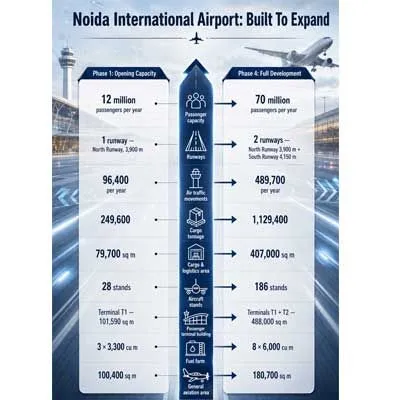
The Directorate General of Civil Aviation recently granted the aerodrome licence for Noida International Airport, clearing the way for domestic passenger and cargo flight operations to begin within the next 45 days as mandated under the airport project plan. The airport is being developed by Yamuna International Airport Private Limited, a wholly owned subsidiary of Zurich Airport International AG, under a public private partnership with the Uttar Pradesh government and the Union government. The facility includes one runway and one passenger terminal with a capacity to serve 12 million (12 mn) passengers annually, and the masterplan allows for further development to serve over 70 million (70 mn) passengers during the concession period.

Noida International Airport and Akasa Air have entered a strategic partnership to establish Akasa Air's first maintenance, repair and overhaul facility at the upcoming airport in Jewar, Uttar Pradesh. The agreement provides for Akasa Air to operate a state-of-the-art MRO facility within airport premises. The facility will be positioned to support the airline's fleet requirements and to offer services to third parties. The MRO facility will provide a range of aircraft maintenance activities designed to ensure operational efficiency and safety, including line and base maintenance capabilities and scheduled checks. The installation is intended to reduce reliance on overseas repair networks and to improve turnaround times for aircraft servicing. It will also support fleet reliability as Akasa expands operations. Christoph Schnellmann, Chief Executive Officer of Noida International Airport, described the investment as a strong endorsement of the airport vision to build a world-class aviation hub for India and said the partnership will enhance the nation's MRO capabilities and create opportunities for skill development and employment in the region. Vinay Dube, Founder and Chief Executive Officer of Akasa Air, framed the move as part of a disciplined growth strategy to develop domestic MRO capacity and strengthen the airline's operational backbone. He said the investment is intended to contribute to a more self-reliant aviation ecosystem in India. The Directorate General of Civil Aviation recently granted the aerodrome licence for Noida International Airport, clearing the way for domestic passenger and cargo flight operations to begin within the next 45 days as mandated under the airport project plan. The airport is being developed by Yamuna International Airport Private Limited, a wholly owned subsidiary of Zurich Airport International AG, under a public private partnership with the Uttar Pradesh government and the Union government. The facility includes one runway and one passenger terminal with a capacity to serve 12 million (12 mn) passengers annually, and the masterplan allows for further development to serve over 70 million (70 mn) passengers during the concession period.

Next Story
Infrastructure Urban

MIDC and Ramky Unit Sign Concession for Life Sciences Park

Maharashtra Industrial Development Corporation has signed a concession agreement with Maha Integrated Life Sciences City Limited (MILeS City), a wholly owned subsidiary of Ramky Infrastructure Limited (RIL), to develop a high-tech pharmaceutical park at Dighi Port Industrial Area in Raigad. The project will follow a public-private partnership under a DBFOT model and has an estimated cost of Rs 30 billion (Rs 30 bn). The concession will run for 95 years, including a five-year construction phase, with MILeS City responsible for development and management. The development will occupy approximatel..

Next Story
Real Estate

BuzzWorks Leases Hyderabad Office to MyComplianceOffice

Brigade Group’s managed workspace provider BuzzWorks has leased 550 seats at Mindspace Business Park in Hyderabad to Dublin based MyComplianceOffice, in what is the company’s largest office in India. With this signing, BuzzWorks' total leased office space in Hyderabad stands at zero point one one million (mn) square feet. The new premises will house core functions including product engineering, product management, customer success and global operations. Artificial intelligence enabled compliance technology initiatives will also be part of the local delivery model. BuzzWorks will provide wo..

Next Story
Infrastructure Transport

Jindal Stainless Flags Operational Strain From Middle East Crisis

Jindal Stainless warned that the Middle East war crisis has affected its operations because of dependence on industrial gases such as propane and LPG and on natural gas. The scrap-based production route used by the stainless steel maker does not generate blast furnace or coke oven gases internally, unlike the conventional steel industry. Several plant processes have been adversely impacted and production is being run at rationalised capacity. Disruptions in global shipping routes have resulted in vessel diversions, longer transit times and cargo delays, adding pressure to supply chains and to ..

Advertisement

Subscribe to Our Newsletter

Get daily newsletters around different themes from Construction world.

STAY CONNECTED

Advertisement

Advertisement

Advertisement