+
Modi Inaugurates Noida International Airport Phase One
AVIATION & AIRPORTS

Modi Inaugurates Noida International Airport Phase One

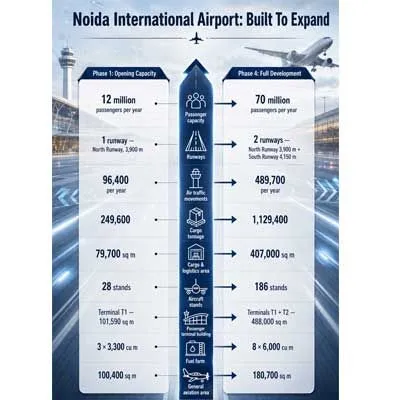
The Prime Minister inaugurated the Noida International Airport at Jewar in Uttar Pradesh, marking the opening of Phase One and describing the event as a milestone in the state's development. The project was delivered with an investment of Rs 112 billion (bn) and is expected to position the airport as a gateway for North India. The Prime Minister observed that Uttar Pradesh has become one of the states with the highest number of international airports and that the new facility will be integrated with regional growth plans.

He said the airport will serve a wide region incorporating Agra, Mathura, Aligarh, Ghaziabad, Meerut, Etawah, Bulandshahr and Faridabad and will create opportunities for farmers, small and medium enterprises and young people in western Uttar Pradesh. The airport will form part of a multi?modal logistics network where two major freight corridors converge at Dadri, enabling agricultural and industrial produce to reach ports and global markets rapidly. The Prime Minister indicated that such connectivity is likely to attract investment and speed up food processing prospects in the region.

The address placed the inauguration in a broader context of global supply challenges and energy security, with the Government acting to shield households and farmers from shocks arising from the conflict in West Asia. He underlined the role of ethanol from sugarcane in reducing crude oil imports and said that increased blending had saved substantial foreign exchange, quantified as about Rs one and a half trillion (tn). He also cited the scale of potential imports avoided as roughly 45 million (mn) barrels and about seven billion litres annually.

The Prime Minister highlighted concurrent projects in western Uttar Pradesh, including semiconductor investment, rail upgrades and metro expansion, and said these developments will create jobs and training opportunities across aviation and in maintenance, repair and overhaul activities where 85 per cent of Indian aircraft still go abroad for servicing. He noted that the Government has approved an expansion of the regional connectivity scheme with about Rs 290 billion (bn) for new airports and helipads, and that an MRO facility foundation stone was laid at Jewar.

The Prime Minister inaugurated the Noida International Airport at Jewar in Uttar Pradesh, marking the opening of Phase One and describing the event as a milestone in the state's development. The project was delivered with an investment of Rs 112 billion (bn) and is expected to position the airport as a gateway for North India. The Prime Minister observed that Uttar Pradesh has become one of the states with the highest number of international airports and that the new facility will be integrated with regional growth plans. He said the airport will serve a wide region incorporating Agra, Mathura, Aligarh, Ghaziabad, Meerut, Etawah, Bulandshahr and Faridabad and will create opportunities for farmers, small and medium enterprises and young people in western Uttar Pradesh. The airport will form part of a multi?modal logistics network where two major freight corridors converge at Dadri, enabling agricultural and industrial produce to reach ports and global markets rapidly. The Prime Minister indicated that such connectivity is likely to attract investment and speed up food processing prospects in the region. The address placed the inauguration in a broader context of global supply challenges and energy security, with the Government acting to shield households and farmers from shocks arising from the conflict in West Asia. He underlined the role of ethanol from sugarcane in reducing crude oil imports and said that increased blending had saved substantial foreign exchange, quantified as about Rs one and a half trillion (tn). He also cited the scale of potential imports avoided as roughly 45 million (mn) barrels and about seven billion litres annually. The Prime Minister highlighted concurrent projects in western Uttar Pradesh, including semiconductor investment, rail upgrades and metro expansion, and said these developments will create jobs and training opportunities across aviation and in maintenance, repair and overhaul activities where 85 per cent of Indian aircraft still go abroad for servicing. He noted that the Government has approved an expansion of the regional connectivity scheme with about Rs 290 billion (bn) for new airports and helipads, and that an MRO facility foundation stone was laid at Jewar.

Related Stories

Gold Stories

Next Story
Infrastructure Urban

KONE Opens India's First Digital Experience Centre in Pune

KONE, a global elevator and escalator manufacturer, has inaugurated its first Digital Experience Centre (DEC) in India, located in Pune. The facility aims to showcase how artificial intelligence (AI), connectivity and data-driven technologies can enhance customer experiences and improve building operations.The centre was inaugurated by Jussi Herlin, Executive Vice Chair, KONE Corporation; Philippe Delorme, President and CEO, KONE; and Nandan Nilekani, Co-founder and Chairman of the Board, Infosys.Designed as an interactive customer environment, the facility demonstrates digital solutions cover..

Next Story
Infrastructure Urban

CII GreenCo Launches Circularity Guidelines for Indian Industry

The Confederation of Indian Industry (CII) GreenCo Council has launched the CII GreenCo Circularity Guidelines – Pilot Version at the 17th CII GreenCo Waste & Resource Management Summit 2026 in Chennai. The initiative aims to strengthen resource efficiency, waste reduction and circular economy practices across Indian manufacturing and process industries.The guidelines introduce a structured framework with circularity indices covering raw materials, consumables, packaging and other resource inputs. These indicators will help industries assess existing practices, identify opportunities to ..

Next Story
Infrastructure Energy

Global Electronics Association Launches IPC-1783-CO2E Standard

The Global Electronics Association has introduced IPC-1783-CO2E, a new international standard aimed at improving consistency, transparency and comparability in product carbon footprint reporting across the electronics manufacturing industry.The standard, titled International Standard for Data Collection and Reporting of CO2 Equivalent (CO2e) Emissions for the Electronics Manufacturing Supply Chain, provides industry-specific guidance for collecting, estimating and reporting carbon emissions data.With increasing regulatory requirements and customer expectations, electronics manufacturers face c..

Advertisement

Subscribe to Our Newsletter

Get daily newsletters around different themes from Construction world.

STAY CONNECTED

Advertisement

SPECIAL OFFER
QR Code