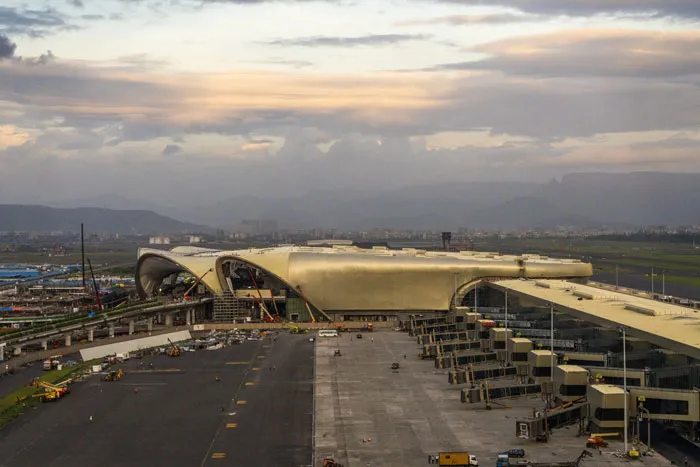
Navi Mumbai property market gains momentum after airport launch
AVIATION & AIRPORTS

Navi Mumbai property market gains momentum after airport launch

The launch of the first commercial flight from the Navi Mumbai International Airport has triggered renewed momentum across the Navi Mumbai property market, with rising buyer interest and accelerated price appreciation, as per news reports.

The airport’s operational debut coincides with progress on key infrastructure projects, including the Atal Setu (Mumbai Trans Harbour Link), the Alibaug–Virar Multimodal Corridor, the Mumbai–Navi Mumbai Metro and improved road connectivity via the Mumbai–Pune Expressway. Together, these developments are improving accessibility and strengthening demand for residential, second-home and luxury housing across Navi Mumbai and adjoining micro-markets.

Industry estimates indicate year-on-year price appreciation of 15–35 per cent over the past 12 months. Ulwe and Panvel have recorded the sharpest gains at 25–35 per cent, followed by Kharghar (20–25 per cent), Taloja (around 20 per cent), and Khopoli and Karjat (15–22 per cent). Locations within a 45-minute radius of the airport are increasingly being viewed as high-potential investment destinations.

Commenting on the trend, Mohit Malhotra, Founder and CEO of NeoLiv, said the airport marks a defining milestone for the extended Mumbai Metropolitan Region, with strategically connected locations such as Khopoli expected to benefit from improved accessibility and expanding economic activity.

Analysts expect further upside by 2026 as airport operations stabilise and supporting metro and road infrastructure is completed.


The launch of the first commercial flight from the Navi Mumbai International Airport has triggered renewed momentum across the Navi Mumbai property market, with rising buyer interest and accelerated price appreciation, as per news reports.The airport’s operational debut coincides with progress on key infrastructure projects, including the Atal Setu (Mumbai Trans Harbour Link), the Alibaug–Virar Multimodal Corridor, the Mumbai–Navi Mumbai Metro and improved road connectivity via the Mumbai–Pune Expressway. Together, these developments are improving accessibility and strengthening demand for residential, second-home and luxury housing across Navi Mumbai and adjoining micro-markets.Industry estimates indicate year-on-year price appreciation of 15–35 per cent over the past 12 months. Ulwe and Panvel have recorded the sharpest gains at 25–35 per cent, followed by Kharghar (20–25 per cent), Taloja (around 20 per cent), and Khopoli and Karjat (15–22 per cent). Locations within a 45-minute radius of the airport are increasingly being viewed as high-potential investment destinations.Commenting on the trend, Mohit Malhotra, Founder and CEO of NeoLiv, said the airport marks a defining milestone for the extended Mumbai Metropolitan Region, with strategically connected locations such as Khopoli expected to benefit from improved accessibility and expanding economic activity.Analysts expect further upside by 2026 as airport operations stabilise and supporting metro and road infrastructure is completed.

Next Story
Infrastructure Transport

MMRDA advances 250 m on Orange Gate–Marine Drive tunnel

The Mumbai Metropolitan Region Development Authority (MMRDA) has completed 250 m of underground tunnelling for the Orange Gate–Marine Drive Urban Road Tunnel using India’s largest slurry shield tunnel boring machine (TBM) deployed for an urban road project.The project involves twin tunnels extending over 7 km beneath critical transport corridors, including Central Railway, Western Railway and Metro Line 3. The work requires high-precision engineering to navigate densely developed urban infrastructure.Once completed, the tunnel is expected to reduce travel time between Orange Gate and Marin..

Next Story
Infrastructure Urban

Hindustan Zinc Pays Rs 188.46 Billion in FY26

Hindustan Zinc contributed Rs 188.46 billion to the public exchequer in FY 2025-26, according to its 9th Tax Transparency Report. The contribution, equivalent to 46 per cent of the company’s revenue, included direct and indirect taxes, government royalties, dividends to the Government of India, withholding taxes and other statutory levies.The company’s five-year cumulative contribution to the exchequer stood at Rs 915.72 billion. In FY26, Hindustan Zinc reported revenue of Rs 408.44 billion, EBITDA of Rs 221.62 billion and profit after tax of Rs 138.32 billion. It also achieved its highest..

Next Story
Infrastructure Urban

World of Concrete India 2026 Opens in Mumbai

Informa Markets in India will host the 12th edition of World of Concrete India 2026 from 3–5 June 2026 at the Bombay Exhibition Centre, Mumbai. The specialised B2B exhibition will bring together manufacturers, suppliers, contractors, developers, architects, consultants, infrastructure companies, project leaders and government stakeholders.The event is expected to feature over 350 brands and more than 18,000 trade professionals. It will cover concrete and cement, dry mortar, precast technologies, formwork, construction chemicals, industrial and commercial flooring, scaffolding, safety solutio..

Advertisement

Subscribe to Our Newsletter

Get daily newsletters around different themes from Construction world.

STAY CONNECTED

Advertisement

Advertisement

Advertisement