



AFCONS & Navayuga set world records with Missing Link Expressway
Maharashtra’s most ambitious greenfield bypass — a 13.3-km alignment carrying twin record-setting tunnels and India’s tallest cable-stayed road bridge — was thrown open to traffic on Maharashtra Day, finally completing the Mumbai–Pune Expressway after a 23-year wait. CW reports…

The 650-m cable-stayed bridge over Tiger Valley at sunset — the package executed by Afcons Infrastructure Ltd carries 182-m pylons, the tallest on any Indian road bridge.
On 1 May 2026, Chief Minister Devendra Fadnavis, flanked by Deputy Chief Ministers Eknath Shinde and Sunetra Pawar (representing the late Ajit Pawar), inaugurated the long-pending Missing Link of the Yashwantrao Chavan (Mumbai–Pune) Expressway at Khalapur in Raigad district. The 13.3-km bypass, which cleaves through the Sahyadris between Khopoli and Kusgaon near Lonavala, eliminates the notorious Khandala Ghat section that had remained the single largest bottleneck on India’s first access-controlled expressway since its commissioning in 2002.
The CM, who proposed renaming the alignment the “Connecting Link,” accepted a Guinness World Records certificate at the ceremony recognising the project’s 22.33-m-wide twin tunnel as the widest underground road tunnel in the world.
Project Fact Sheet
Project | Missing Link, Mumbai–Pune Expressway (Yashwantrao Chavan Expressway Capacity Augmentation) |
Location | Khopoli Exit (Raigad) to Kusgaon (Pune district), Maharashtra |
Length | 13.3 km greenfield bypass + 6.5 km capacity augmentation |
Configuration | 8-lane, access-controlled |
Project Cost | Rs 7,181 crore (revised; originally sanctioned at Rs 4,797.57 crore on 2015-16 SoR) |
Client / Developer | Maharashtra State Road Development Corporation (MSRDC) |
Mode | EPC |
General Consultant | Geodata–LB Consortium |
EPC – Package I (Tunnels) | Navayuga Engineering Company Ltd (NECL) |
EPC – Package II (Viaducts & Capacity Augmentation) | Afcons Infrastructure Ltd |
Letter of Acceptance | 30 August 2018 |
Civil Works Commenced | February–March 2019 |
Inauguration | 1 May 2026 (Maharashtra Day) |
Distance Saved | Approximately 6 km |
Travel Time Saved | 20–30 minutes |
Design Speed | 120 km/h |
The route and what it replaces

Aerial wide showing the new 8-lane Missing Link bypass (left) cutting across the Sahyadris while the legacy ghat alignment with its hairpin bends remains visible on the right.
The new route — Khopoli Exit → Twin Tunnels → Tiger Valley Cable-Stayed Bridge → Kusgaon — is fully access-controlled and bypasses the ghat altogether. MSRDC estimates that up to 70 per cent of traffic will migrate to the bypass, leaving the legacy ghat to lighter vehicles.
Package I: The Guinness-record tunnels

The Khopoli-end tunnel portal, treated in a heritage stone facade rather than the utilitarian concrete typical of Indian expressway tunnels.
Navayuga Engineering executed the project’s headline structures: twin 8-lane tunnels measuring 1.75 km and 8.92 km respectively. The longer bore — driven 182 m beneath Lonavala Lake — is among Asia’s longest road tunnels. Both are 22.33 m wide internally, a span that earned the project its Guinness recognition for the widest underground tunnel anywhere in the world.

The Kusgaon-end portal is dressed with sculptural reliefs evocative of Ellora and Ajanta, surmounted by a Marathi LED variable-message board reading "Welcome to the Missing Link Tunnel."
Tunnelling was executed by NATM with controlled blasting to protect the live expressway and Lonavala Lake above. NECL provided cross passages every 300 m and a network of adits to manage logistics inside the bores. Over the project’s life, the contractor excavated 8.5 million tonne of rock, placed 7,600 tonne of structural steel, 1.1 lakh cubic metre of shotcrete and 2.2 lakh cubic metre of pavement quality concrete, clocking close to 9 million manhours.

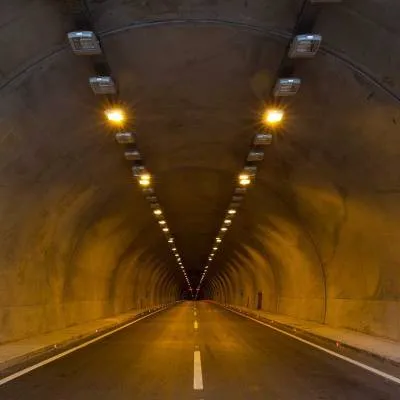
Tunnel interior showing variable speed-limit gantries (80 km/h and 100 km/h zones), incident-detection cameras and full-length LED lighting — broadly characteristic of category-A road tunnels under IRC: SP: 91.
Safety and operational systems include SCADA-based monitoring, jet-fan ventilation, full-length LED lighting, fire detection and emergency egress at regulated intervals.
“This is more than a world record. It is a statement of what India can build.”
— Chinta Sridhar, Managing Director, Navayuga Engineering Company Ltd
“The project presented formidable execution challenges, particularly due to complex land constraints and the steep gradients of the hilly and valley terrain. These were addressed through meticulous planning and advanced engineering — adits, cross passages every 300 metres, and NATM with controlled blasting to safeguard the adjacent expressway.”
— Ramesh Singooru, Sr. Vice President & Regional Head, NECL
Package II: India’s tallest cable-stayed road bridge

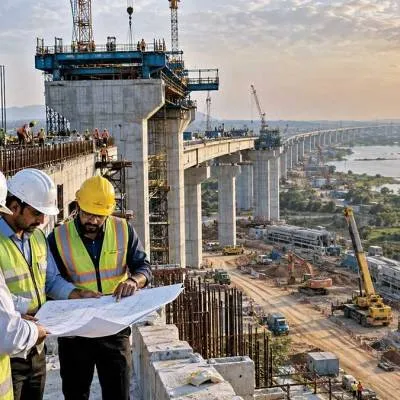
The 182-m pylon of the Tiger Valley cable-stayed bridge — raised using a self-climbing shuttering system to counter the strong cross-winds of the Sahyadris.
Afcons Infrastructure delivered the package that turned the Missing Link into a marquee structural project: two 8-lane viaducts of 850 m and 650 m, the latter a cable-stayed bridge over Tiger Valley with a 305-m main span and 182-m-tall pylons — making it the tallest cable-stayed road bridge in India and one of the tallest in Asia. The deck is engineered to remain stable in wind speeds up to 240–252 km/h, well in excess of the 130–155 km/h gusts recorded during Cyclone Nisarga in 2020.
Pylon shafts were raised using a self-climbing shuttering system to counter the strong cross-winds of the Sahyadris. Four tower cranes, mounted at 182 m, worked in coordination with eight 350-tonne cantilever form travellers (CFTs) to construct the deck segments cantilevering progressively from each pylon — a methodology Afcons has previously deployed on its long-span river crossings.

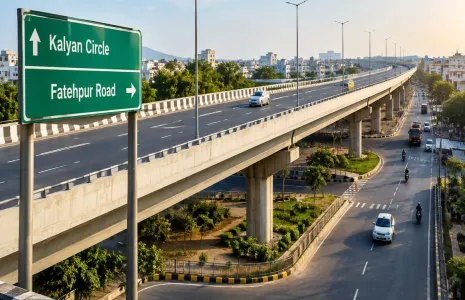
The approach viaduct on the Khopoli side, photographed at sunrise alongside the legacy expressway alignment.
The package also includes more than 10 km of approach and slip roads and the capacity augmentation from 6 to 8 lanes of the existing expressway between Khalapur Toll Plaza and Khopoli Exit (5.86–6.5 km), tying the new alignment into the legacy corridor.
“The bridge, located in the Sahyadri region, presented extreme challenges: narrow ridges left little room for heavy machinery, wind speeds could shift from a gentle breeze to violent blasts of 100 km/h within minutes, and monsoon rains turned cliffs into cascading sheets of water, halting work instantly. Fog often rolled in without warning, reducing visibility to just a few metres. Despite such formidable challenges, we are proud to deliver this engineering marvel,".”
— Krishnamurthy Subramanian, Executive Chairman, Afcons Infrastructure Ltd
“Working at such heights, construction activities such as welding and segment lifting demand extraordinary precision, courage, and patience. Engineers and workers, often positioned on narrow ledges above deep valleys, operate under world-class safety and quality standards.”
— Ranjan Kumar Mishra, Project Director, Afcons Infrastructure Ltd
Why the project took eight years
The project was scoped as a 36-month build at LoA in August 2018 with a target completion of March 2024. Three factors pushed completion to 2026: the COVID-19 lockdowns of 2020–22, which paused work at peak excavation; tunnelling beneath Lonavala Lake, which required ground-treatment protocols and slower advance rates than originally programmed; and the Sahyadri terrain and monsoon windows, which compressed the working calendar each year.The original Detailed Project Report had been cleared by an MSRDC Technical Advisory Committee following a feasibility study by RITES dating back to 1995, but the alignment was only revived under the Cabinet Sub-Committee on Infrastructure approval of 13 June 2017.
Strategic and economic significance
CM Fadnavis pegged the economic activity catalysed by the project at Rs 70,000 crore over its life — driven by faster freight turnarounds on what is one of India’s densest interurban corridors, a near-elimination of ghat-section accident risk, and the unlocking of second-home and warehousing markets along Karjat, Neral, Khopoli and Lonavala. For MSRDC, which builds, owns and operates the Yashwantrao Chavan Expressway on a 30-year BOT mandate, the Missing Link represents the most consequential capacity intervention since the original commissioning in 2002. Combined with the upcoming Mumbai–Nagpur Samruddhi Mahamarg connectivity at Igatpuri and the Virar–Alibaug Multi-Modal Corridor at the Mumbai end, the agency is steadily rebuilding Maharashtra’s western corridor as a fully access-controlled grid.The opening day — marked by gridlocks on the legacy carriageways as commuters and curious onlookers descended on the new alignment, prompting a public apology from the Chief Minister — was a reminder that the Missing Link arrives into a corridor whose traffic has long since outgrown its original 1990s design assumptions. With the connector now live, the original promise of the Yashwantrao Chavan Expressway — a fully access-controlled, sub-two-hour run between Maharashtra’s capital and its cultural counterpart — is, at last, complete.
Project intelligence and construction tracking by IMPACCT | impacct.info | Photo credits: MSRDC
Related Stories

Gold Stories



Interio by Godrej launches modular workplace solutions
Interio by Godrej has launched Workscapes, a modular workplace solutions category designed to help organisations configure and adapt workspaces to changing requirements. The portfolio combines mobile and compatible furniture and support elements that can be rearranged across different work modes without changes to fixed layouts.Workscapes includes Collaboration Tables, Privacy Solutions, Mobile Markerboards and Space Dividers, Power Solutions, Storage and Support Elements, Meeting and Presentation Tools, and Seating Elements. The range is designed for focused work, collaboration, informal disc..

CAFE-III Gives Auto Industry Investment Clarity
The government’s new Corporate Average Fuel Economy (CAFE-III) norms have provided the automobile industry with a clearer framework for technology investments, according to industry representatives. The framework seeks to balance environmental objectives with flexibility for manufacturers while encouraging the adoption of flex-fuel vehicles and biofuels. Society of Indian Automobile Manufacturers (SIAM) President Shenu Agarwal said the five-year framework would give automakers greater predictability to plan investments and accelerate innovation. He said the regulation established annual targ..

Mines Ministry to Auction Two Offshore Mineral Blocks in Andaman Sea
The Ministry of Mines will launch an auction of two offshore mineral blocks in the Andaman Sea on Thursday, seeking to unlock India’s offshore mineral potential and strengthen long-term mineral resource security. The blocks will be offered under a composite licence, which permits exploration and development activities in accordance with the applicable regulatory framework. The ministry said the auction was intended to encourage systematic exploration, attract investment and promote the use of advanced technologies for offshore mineral exploration and development. The initiative is also aimed..
Related Articles
Latest Updates













