Cabinet Extends PMGSY-III Till 2028 Raises Outlay To Rs 839.77 bn
ROADS & HIGHWAYS

Cabinet Extends PMGSY-III Till 2028 Raises Outlay To Rs 839.77 bn

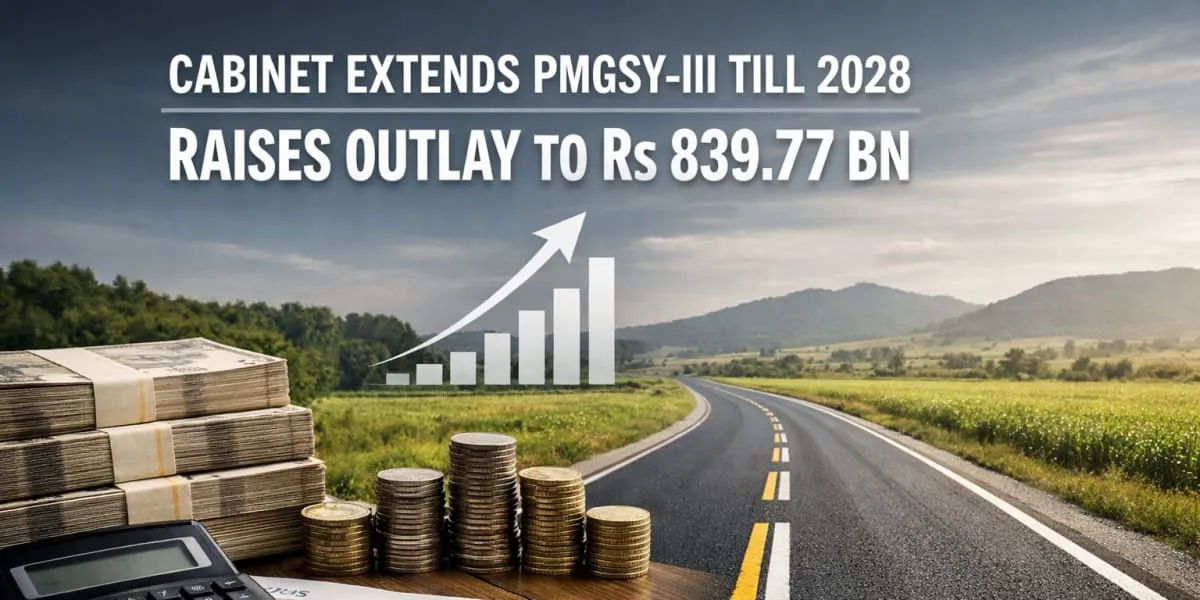
The Union Cabinet, chaired by the prime minister, approved an extension of the Pradhan Mantri Gram Sadak Yojana-III (PMGSY-III) until March 2028 and revised the scheme's financial outlay to Rs 83,977 crore (Rs 839.77 bn). The programme had been scheduled to end in March 2025. The decision was notified in an official release.

The scheme will continue to concentrate on upgrading rural road networks, including through routes and major links that connect villages to Gramin Agricultural Markets, higher secondary schools and hospitals. Timelines for project execution have been extended so that roads and bridges in plain areas, and roads in hilly regions, are to be completed by March 2028. Bridges in hilly areas have been assigned a later completion date of March 2029.

Projects that were sanctioned before March 31, 2025 but not yet awarded will be eligible for tendering and execution under the extended framework. The Cabinet also approved taking up 161 long-span bridges, estimated at Rs 961 crore (Rs 9.61 bn), where those structures fall along already sanctioned road alignments. The extended window is intended to allow these pending works to proceed to award and construction.

The financial allocation for the scheme has been increased from an earlier Rs 80,250 crore (Rs 802.5 bn) to the revised figure. Officials indicated that the extension and the higher outlay are designed to ensure completion of targeted upgrades and to unlock the scheme's socio-economic benefits. Improved connectivity is expected to enhance access to markets, reduce transportation time and costs and support higher rural incomes.

The government noted that better road infrastructure will improve access to education and healthcare services in remote areas while also generating employment through construction and allied rural economic activities. The extended deadlines are intended to provide implementing agencies with greater certainty to complete complex works in challenging terrain. Administrative guidelines and tendering processes will be adjusted to reflect the new timelines.

The Union Cabinet, chaired by the prime minister, approved an extension of the Pradhan Mantri Gram Sadak Yojana-III (PMGSY-III) until March 2028 and revised the scheme's financial outlay to Rs 83,977 crore (Rs 839.77 bn). The programme had been scheduled to end in March 2025. The decision was notified in an official release. The scheme will continue to concentrate on upgrading rural road networks, including through routes and major links that connect villages to Gramin Agricultural Markets, higher secondary schools and hospitals. Timelines for project execution have been extended so that roads and bridges in plain areas, and roads in hilly regions, are to be completed by March 2028. Bridges in hilly areas have been assigned a later completion date of March 2029. Projects that were sanctioned before March 31, 2025 but not yet awarded will be eligible for tendering and execution under the extended framework. The Cabinet also approved taking up 161 long-span bridges, estimated at Rs 961 crore (Rs 9.61 bn), where those structures fall along already sanctioned road alignments. The extended window is intended to allow these pending works to proceed to award and construction. The financial allocation for the scheme has been increased from an earlier Rs 80,250 crore (Rs 802.5 bn) to the revised figure. Officials indicated that the extension and the higher outlay are designed to ensure completion of targeted upgrades and to unlock the scheme's socio-economic benefits. Improved connectivity is expected to enhance access to markets, reduce transportation time and costs and support higher rural incomes. The government noted that better road infrastructure will improve access to education and healthcare services in remote areas while also generating employment through construction and allied rural economic activities. The extended deadlines are intended to provide implementing agencies with greater certainty to complete complex works in challenging terrain. Administrative guidelines and tendering processes will be adjusted to reflect the new timelines.

Related Stories

Gold Stories

Next Story
Infrastructure Urban

KONE Opens India's First Digital Experience Centre in Pune

KONE, a global elevator and escalator manufacturer, has inaugurated its first Digital Experience Centre (DEC) in India, located in Pune. The facility aims to showcase how artificial intelligence (AI), connectivity and data-driven technologies can enhance customer experiences and improve building operations.The centre was inaugurated by Jussi Herlin, Executive Vice Chair, KONE Corporation; Philippe Delorme, President and CEO, KONE; and Nandan Nilekani, Co-founder and Chairman of the Board, Infosys.Designed as an interactive customer environment, the facility demonstrates digital solutions cover..

Next Story
Infrastructure Urban

CII GreenCo Launches Circularity Guidelines for Indian Industry

The Confederation of Indian Industry (CII) GreenCo Council has launched the CII GreenCo Circularity Guidelines – Pilot Version at the 17th CII GreenCo Waste & Resource Management Summit 2026 in Chennai. The initiative aims to strengthen resource efficiency, waste reduction and circular economy practices across Indian manufacturing and process industries.The guidelines introduce a structured framework with circularity indices covering raw materials, consumables, packaging and other resource inputs. These indicators will help industries assess existing practices, identify opportunities to ..

Next Story
Infrastructure Energy

Global Electronics Association Launches IPC-1783-CO2E Standard

The Global Electronics Association has introduced IPC-1783-CO2E, a new international standard aimed at improving consistency, transparency and comparability in product carbon footprint reporting across the electronics manufacturing industry.The standard, titled International Standard for Data Collection and Reporting of CO2 Equivalent (CO2e) Emissions for the Electronics Manufacturing Supply Chain, provides industry-specific guidance for collecting, estimating and reporting carbon emissions data.With increasing regulatory requirements and customer expectations, electronics manufacturers face c..

Advertisement

Subscribe to Our Newsletter

Get daily newsletters around different themes from Construction world.

STAY CONNECTED

Advertisement

SPECIAL OFFER
QR Code