MMRDA Approves Rs 67.48 Billion Elevated Highway Linking Samruddhi
ROADS & HIGHWAYS

MMRDA Approves Rs 67.48 Billion Elevated Highway Linking Samruddhi

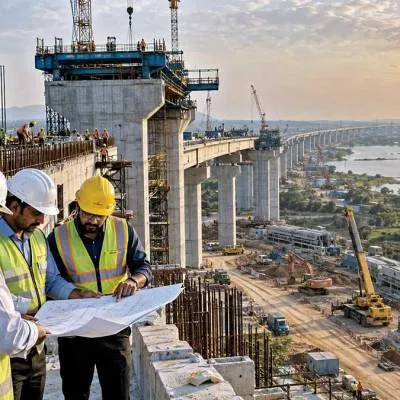
The Mumbai Metropolitan Region Development Authority has approved a Rs 67.48 billion (bn) elevated highway to ease congestion between Thane and Mumbai by linking the Samruddhi Expressway to the city outskirts. The project, which the authority said will cover construction, land acquisition and environmental mitigation, is intended to provide a seamless transition for commuters exiting the high-speed Samruddhi route into the Mumbai metropolitan area. Approval follows a detailed project report completed in September 2025 and strategic revisions recommended by senior state officials.

The six-lane, high-speed corridor will extend for 21.35 kilometres with an elevated section of 12.55 kilometres and a greenfield stretch of eight point eight kilometres. The alignment will link the Anandnagar-Saket elevated road in Thane to the Rajnoli Junction and will veer from Sonale village into the median of the Mumbai-Nashik Highway before reaching Karvali and Aamne. The design is intended to bypass congested local roads and to segregate long-distance freight from local traffic.

Infrastructure provisions include one major bridge, three minor bridges, a dedicated railway overbridge, two flyovers and six vehicular underpasses to ensure uninterrupted flow. The authority requires 127 hectares of land, of which 116.38 hectares is private, eight point five nine hectares is government land and two point nine hectares is forest area. A tiered tolling proposal for the stretch between the Kharegaon Toll Plaza and the Samruddhi Mahamarg sets charges at Rs 100 for light motor vehicles, Rs 160 for small buses, Rs 340 for standard buses and trucks and Rs 645 for large multi-axle vehicles, with a five per cent annual hike proposed.

Planners expect the corridor to act as the missing link that will extend the benefits of the Samruddhi Mahamarg into the heart of the Mumbai metropolitan region by bypassing warehouse-clogged roads in Bhiwandi and Anjur. The authority has framed the project as a permanent engineering solution to persistent freight congestion that has persisted despite round-the-clock traffic management. The scheme is projected to reduce commute times for thousands of daily travellers and to improve regional connectivity once construction and land acquisition proceed.

The Mumbai Metropolitan Region Development Authority has approved a Rs 67.48 billion (bn) elevated highway to ease congestion between Thane and Mumbai by linking the Samruddhi Expressway to the city outskirts. The project, which the authority said will cover construction, land acquisition and environmental mitigation, is intended to provide a seamless transition for commuters exiting the high-speed Samruddhi route into the Mumbai metropolitan area. Approval follows a detailed project report completed in September 2025 and strategic revisions recommended by senior state officials. The six-lane, high-speed corridor will extend for 21.35 kilometres with an elevated section of 12.55 kilometres and a greenfield stretch of eight point eight kilometres. The alignment will link the Anandnagar-Saket elevated road in Thane to the Rajnoli Junction and will veer from Sonale village into the median of the Mumbai-Nashik Highway before reaching Karvali and Aamne. The design is intended to bypass congested local roads and to segregate long-distance freight from local traffic. Infrastructure provisions include one major bridge, three minor bridges, a dedicated railway overbridge, two flyovers and six vehicular underpasses to ensure uninterrupted flow. The authority requires 127 hectares of land, of which 116.38 hectares is private, eight point five nine hectares is government land and two point nine hectares is forest area. A tiered tolling proposal for the stretch between the Kharegaon Toll Plaza and the Samruddhi Mahamarg sets charges at Rs 100 for light motor vehicles, Rs 160 for small buses, Rs 340 for standard buses and trucks and Rs 645 for large multi-axle vehicles, with a five per cent annual hike proposed. Planners expect the corridor to act as the missing link that will extend the benefits of the Samruddhi Mahamarg into the heart of the Mumbai metropolitan region by bypassing warehouse-clogged roads in Bhiwandi and Anjur. The authority has framed the project as a permanent engineering solution to persistent freight congestion that has persisted despite round-the-clock traffic management. The scheme is projected to reduce commute times for thousands of daily travellers and to improve regional connectivity once construction and land acquisition proceed.

Related Stories

Gold Stories
Next Story
Infrastructure Urban

KONE Opens India's First Digital Experience Centre in Pune

KONE, a global elevator and escalator manufacturer, has inaugurated its first Digital Experience Centre (DEC) in India, located in Pune. The facility aims to showcase how artificial intelligence (AI), connectivity and data-driven technologies can enhance customer experiences and improve building operations.The centre was inaugurated by Jussi Herlin, Executive Vice Chair, KONE Corporation; Philippe Delorme, President and CEO, KONE; and Nandan Nilekani, Co-founder and Chairman of the Board, Infosys.Designed as an interactive customer environment, the facility demonstrates digital solutions cover..

Next Story
Infrastructure Urban

CII GreenCo Launches Circularity Guidelines for Indian Industry

The Confederation of Indian Industry (CII) GreenCo Council has launched the CII GreenCo Circularity Guidelines – Pilot Version at the 17th CII GreenCo Waste & Resource Management Summit 2026 in Chennai. The initiative aims to strengthen resource efficiency, waste reduction and circular economy practices across Indian manufacturing and process industries.The guidelines introduce a structured framework with circularity indices covering raw materials, consumables, packaging and other resource inputs. These indicators will help industries assess existing practices, identify opportunities to ..

Next Story
Infrastructure Energy

Global Electronics Association Launches IPC-1783-CO2E Standard

The Global Electronics Association has introduced IPC-1783-CO2E, a new international standard aimed at improving consistency, transparency and comparability in product carbon footprint reporting across the electronics manufacturing industry.The standard, titled International Standard for Data Collection and Reporting of CO2 Equivalent (CO2e) Emissions for the Electronics Manufacturing Supply Chain, provides industry-specific guidance for collecting, estimating and reporting carbon emissions data.With increasing regulatory requirements and customer expectations, electronics manufacturers face c..

Advertisement

Subscribe to Our Newsletter

Get daily newsletters around different themes from Construction world.

STAY CONNECTED

Advertisement

SPECIAL OFFER
QR Code