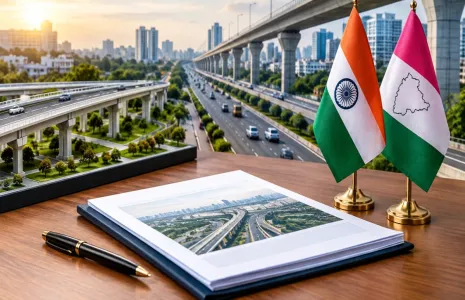
NHAI Begins Work On Rs 50 Billion Delhi–Gurugram Expressway
ROADS & HIGHWAYS

NHAI Begins Work On Rs 50 Billion Delhi–Gurugram Expressway

In a major infrastructure push to ease commuting between Delhi and Gurugram, the National Highways Authority of India (NHAI) has begun preparatory work on a 20 km expressway corridor linking AIIMS to Gurugram via Mahipalpur.

The direct elevated corridor will connect AIIMS to the Mahipalpur Bypass and extend to the Gurugram–Faridabad Road, significantly reducing congestion and travel time on the Delhi–Gurugram Expressway.

According to officials, work on the Detailed Project Report (DPR) is already in progress. The DPR will determine which sections of the expressway will be elevated or underground, along with cost estimates and environmental feasibility. The Ministry of Road Transport and Highways (MoRTH) has already floated tenders for DPR preparation, with the bid submission deadline set for 15 October 2025.

The project is expected to cost around Rs 50 billion, though final figures will be confirmed once the DPR is completed. Designed to enhance intercity connectivity, the new expressway aims to cut the current 1.5-hour journey from AIIMS to Sirhaul Border in Gurugram to just 20–25 minutes once operational.

The decongestion plan envisions the elevated corridor beginning from AIIMS/INA, passing through Nadira Marg, and linking Mehrauli–Gurgaon Road with the Gurgaon–Faridabad Road, running parallel to NH-48. Each section — elevated and underground — will feature six lanes to ensure seamless traffic flow.

In addition to improving Delhi–Gurugram travel, the project is expected to divert traffic towards Ghaziabad, Noida, and Greater Noida via NH-48, thereby reducing congestion on MG Road, as well as Delhi’s inner and outer ring roads.

Officials said the new expressway forms part of a broader Delhi–NCR traffic decongestion strategy, promising a signal-free, high-speed route for daily commuters and long-distance travellers alike.

In a major infrastructure push to ease commuting between Delhi and Gurugram, the National Highways Authority of India (NHAI) has begun preparatory work on a 20 km expressway corridor linking AIIMS to Gurugram via Mahipalpur. The direct elevated corridor will connect AIIMS to the Mahipalpur Bypass and extend to the Gurugram–Faridabad Road, significantly reducing congestion and travel time on the Delhi–Gurugram Expressway. According to officials, work on the Detailed Project Report (DPR) is already in progress. The DPR will determine which sections of the expressway will be elevated or underground, along with cost estimates and environmental feasibility. The Ministry of Road Transport and Highways (MoRTH) has already floated tenders for DPR preparation, with the bid submission deadline set for 15 October 2025. The project is expected to cost around Rs 50 billion, though final figures will be confirmed once the DPR is completed. Designed to enhance intercity connectivity, the new expressway aims to cut the current 1.5-hour journey from AIIMS to Sirhaul Border in Gurugram to just 20–25 minutes once operational. The decongestion plan envisions the elevated corridor beginning from AIIMS/INA, passing through Nadira Marg, and linking Mehrauli–Gurgaon Road with the Gurgaon–Faridabad Road, running parallel to NH-48. Each section — elevated and underground — will feature six lanes to ensure seamless traffic flow. In addition to improving Delhi–Gurugram travel, the project is expected to divert traffic towards Ghaziabad, Noida, and Greater Noida via NH-48, thereby reducing congestion on MG Road, as well as Delhi’s inner and outer ring roads. Officials said the new expressway forms part of a broader Delhi–NCR traffic decongestion strategy, promising a signal-free, high-speed route for daily commuters and long-distance travellers alike.

Related Stories

Gold Stories
Next Story
Infrastructure Urban

KONE Opens India's First Digital Experience Centre in Pune

KONE, a global elevator and escalator manufacturer, has inaugurated its first Digital Experience Centre (DEC) in India, located in Pune. The facility aims to showcase how artificial intelligence (AI), connectivity and data-driven technologies can enhance customer experiences and improve building operations.The centre was inaugurated by Jussi Herlin, Executive Vice Chair, KONE Corporation; Philippe Delorme, President and CEO, KONE; and Nandan Nilekani, Co-founder and Chairman of the Board, Infosys.Designed as an interactive customer environment, the facility demonstrates digital solutions cover..

Next Story
Infrastructure Urban

CII GreenCo Launches Circularity Guidelines for Indian Industry

The Confederation of Indian Industry (CII) GreenCo Council has launched the CII GreenCo Circularity Guidelines – Pilot Version at the 17th CII GreenCo Waste & Resource Management Summit 2026 in Chennai. The initiative aims to strengthen resource efficiency, waste reduction and circular economy practices across Indian manufacturing and process industries.The guidelines introduce a structured framework with circularity indices covering raw materials, consumables, packaging and other resource inputs. These indicators will help industries assess existing practices, identify opportunities to ..

Next Story
Infrastructure Energy

Global Electronics Association Launches IPC-1783-CO2E Standard

The Global Electronics Association has introduced IPC-1783-CO2E, a new international standard aimed at improving consistency, transparency and comparability in product carbon footprint reporting across the electronics manufacturing industry.The standard, titled International Standard for Data Collection and Reporting of CO2 Equivalent (CO2e) Emissions for the Electronics Manufacturing Supply Chain, provides industry-specific guidance for collecting, estimating and reporting carbon emissions data.With increasing regulatory requirements and customer expectations, electronics manufacturers face c..

Advertisement

Subscribe to Our Newsletter

Get daily newsletters around different themes from Construction world.

STAY CONNECTED

Advertisement

SPECIAL OFFER
QR Code