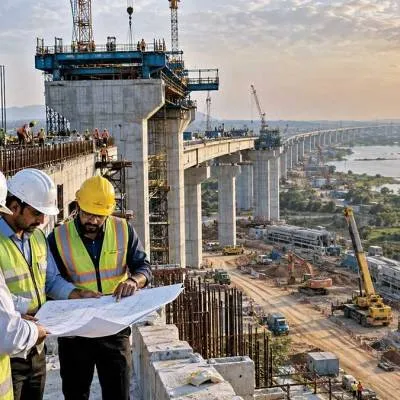
NHAI Empanels IITs For Independent Proof Checking Of Major Bridge Designs
ROADS & HIGHWAYS

NHAI Empanels IITs For Independent Proof Checking Of Major Bridge Designs

The National Highways Authority of India (NHAI) has moved to empanel Indian Institutes of Technology (IITs) and other reputed technical institutions to provide independent proof checking of hydraulic studies and the design of major bridge structures on National Highway projects. The measure is intended to strengthen safety, quality and the long term durability of the highway network by ensuring rigorous independent technical review before construction. Around 12 IITs, including IIT Delhi, IIT Bombay, IIT Roorkee and IIT Kharagpur, and several other premier institutions have expressed willingness to collaborate with NHAI.

The empanelment will enable NHAI to establish a nationwide institutional framework for design vetting of critical bridge projects and to standardise quality assurance practices across regions. The scope of reviews will include structural design calculations, engineering drawings, construction methodologies, geotechnical investigations and hydraulic studies to verify suitability and safety for service lives of 100 years or more. The reviews will be applied uniformly across projects implemented under different delivery modes to create consistency in technical oversight and reduce variation in design standards.

NHAI expects the framework to strengthen engineering governance and to foster improved design and execution of bridge works through independent scrutiny by academic institutions with recognised expertise. The arrangement is intended to supplement in-house review mechanisms and to provide an external layer of assurance that can identify hidden risks and recommend remedial design measures early in the project cycle. Institutions will be asked to examine calculations, drawings and site investigation reports and to advise on construction sequencing and risk mitigation measures.

The initiative is aligned with NHAI's broader objective of adopting best in class engineering practices and institutional mechanisms to support the development of a high quality and future ready National Highway network. It is expected to minimise long term operational risks and to improve reliability of major bridge assets, thereby enhancing safety for road users and longevity of infrastructure investments. NHAI will draw upon the technical credentials of participating institutes to create a consistent and transparent process for independent validation across projects nationwide.

The National Highways Authority of India (NHAI) has moved to empanel Indian Institutes of Technology (IITs) and other reputed technical institutions to provide independent proof checking of hydraulic studies and the design of major bridge structures on National Highway projects. The measure is intended to strengthen safety, quality and the long term durability of the highway network by ensuring rigorous independent technical review before construction. Around 12 IITs, including IIT Delhi, IIT Bombay, IIT Roorkee and IIT Kharagpur, and several other premier institutions have expressed willingness to collaborate with NHAI. The empanelment will enable NHAI to establish a nationwide institutional framework for design vetting of critical bridge projects and to standardise quality assurance practices across regions. The scope of reviews will include structural design calculations, engineering drawings, construction methodologies, geotechnical investigations and hydraulic studies to verify suitability and safety for service lives of 100 years or more. The reviews will be applied uniformly across projects implemented under different delivery modes to create consistency in technical oversight and reduce variation in design standards. NHAI expects the framework to strengthen engineering governance and to foster improved design and execution of bridge works through independent scrutiny by academic institutions with recognised expertise. The arrangement is intended to supplement in-house review mechanisms and to provide an external layer of assurance that can identify hidden risks and recommend remedial design measures early in the project cycle. Institutions will be asked to examine calculations, drawings and site investigation reports and to advise on construction sequencing and risk mitigation measures. The initiative is aligned with NHAI's broader objective of adopting best in class engineering practices and institutional mechanisms to support the development of a high quality and future ready National Highway network. It is expected to minimise long term operational risks and to improve reliability of major bridge assets, thereby enhancing safety for road users and longevity of infrastructure investments. NHAI will draw upon the technical credentials of participating institutes to create a consistent and transparent process for independent validation across projects nationwide.

Next Story
Building Material

Saint-Gobain, CEPT partner on sustainable construction

Saint-Gobain and CEPT University have entered into a strategic partnership to establish a Tech Commons Centre aimed at advancing research, innovation and skill development in sustainable and energy-efficient construction.The centre will serve as a platform for building science research, prototyping, industry collaboration and knowledge exchange, bringing together Saint-Gobain's expertise in sustainable construction and CEPT's capabilities in education and research. The collaboration will focus on sustainability, energy efficiency, climate resilience and wellbeing in the built environment.Accor..

Next Story
Building Material

Aludecor launches Stonic ACP surface series

Aludecor Lamination has launched its Stonic aluminium composite panel (ACP) surface series and the second phase of its 'Test Nahi Toh Trust Nahi' campaign as part of its 24th Foundation Day celebrations.Inspired by the natural craquelure patterns found in aged stone, the Stonic series is available in seven finishes and has been developed using the company's Spray Fusion technology. The ACP range is designed for use in façades, feature walls, entranceways, soffits, balcony fascia, ceilings and other commercial, residential and hospitality applications.The company also introduced 'The Fikar-Fre..

Next Story
Real Estate

NABARD, MAHAPREIT partner on rural green infrastructure

NABARD has signed a memorandum of understanding (MoU) with Mahatma Phule Renewable Energy and Infrastructure Technology (MAHAPREIT) to finance and promote green, climate-resilient infrastructure in rural India, with an initial focus on Maharashtra.The partnership will combine NABARD's expertise in rural development and climate finance with MAHAPREIT's experience in renewable energy and sustainable infrastructure. The collaboration will identify, develop and finance projects aimed at strengthening village infrastructure, Panchayati Raj Institutions and other community assets.Priority areas incl..

Advertisement

Subscribe to Our Newsletter

Get daily newsletters around different themes from Construction world.

STAY CONNECTED

Advertisement

Advertisement

Advertisement