NHAI Empanels IITs For Independent Proof Checking Of Major Bridges
ROADS & HIGHWAYS

NHAI Empanels IITs For Independent Proof Checking Of Major Bridges

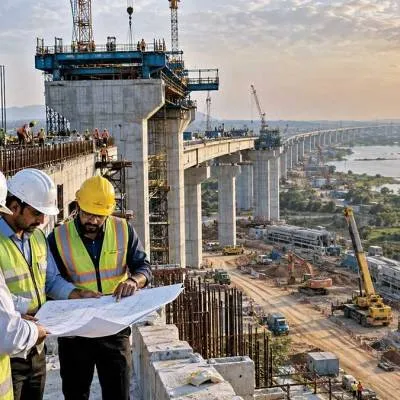
The National Highways Authority of India (NHAI) has moved to empanel Indian Institutes of Technology (IITs) and other reputed technical institutions for independent proof checking of hydraulic studies and design of major bridge structures across national highway projects in all new projects. The measure aims to strengthen safety, quality and long-term durability of the National Highway network by ensuring major bridges designed for a service life of 100 years or more undergo rigorous independent technical review prior to construction. The initiative is intended to add an additional layer of assurance to engineering decisions on critical structures.

Around 12 IITs, including Indian Institute of Technology Delhi, Indian Institute of Technology Bombay, Indian Institute of Technology Roorkee and Indian Institute of Technology Kharagpur, along with several premier technical schools, have indicated willingness to collaborate with NHAI. The empanelment is expected to create a pool of external experts capable of scrutinising structural proposals and hydraulic assessments prepared by project consultants. Institutions on the panel will be required to apply standardised vetting protocols and document their findings for inclusion in project records.

The framework will mandate independent review of structural design calculations, engineering drawings, construction methodologies, geotechnical investigations and hydraulic studies for major bridge schemes. Reviews will cover both conceptual and detailed design stages and will assess assumptions, loadings and design life parameters to reduce the risk of design defects being carried into construction. The process seeks to harmonise design practices across contracts and delivery modes so that similar standards apply whether projects are delivered through public funding, public-private partnerships or other formats.

Authorities anticipate that institutional proof checking will significantly enhance structural safety, improve design reliability and minimise long-term operational risks across the highway network. The move aligns with NHAI's broader objective of adopting best-in-class engineering practices and institutional mechanisms to support development of a future-ready National Highway network. Officials expect the framework to strengthen quality assurance and promote better execution of critical bridge projects nationwide.

"Join industry leaders at RAHSTA Expo, India's premier platform for roads, highways and traffic infrastructure. Register now to explore innovations, network with experts and shape the future of mobility."

The National Highways Authority of India (NHAI) has moved to empanel Indian Institutes of Technology (IITs) and other reputed technical institutions for independent proof checking of hydraulic studies and design of major bridge structures across national highway projects in all new projects. The measure aims to strengthen safety, quality and long-term durability of the National Highway network by ensuring major bridges designed for a service life of 100 years or more undergo rigorous independent technical review prior to construction. The initiative is intended to add an additional layer of assurance to engineering decisions on critical structures. Around 12 IITs, including Indian Institute of Technology Delhi, Indian Institute of Technology Bombay, Indian Institute of Technology Roorkee and Indian Institute of Technology Kharagpur, along with several premier technical schools, have indicated willingness to collaborate with NHAI. The empanelment is expected to create a pool of external experts capable of scrutinising structural proposals and hydraulic assessments prepared by project consultants. Institutions on the panel will be required to apply standardised vetting protocols and document their findings for inclusion in project records. The framework will mandate independent review of structural design calculations, engineering drawings, construction methodologies, geotechnical investigations and hydraulic studies for major bridge schemes. Reviews will cover both conceptual and detailed design stages and will assess assumptions, loadings and design life parameters to reduce the risk of design defects being carried into construction. The process seeks to harmonise design practices across contracts and delivery modes so that similar standards apply whether projects are delivered through public funding, public-private partnerships or other formats. Authorities anticipate that institutional proof checking will significantly enhance structural safety, improve design reliability and minimise long-term operational risks across the highway network. The move aligns with NHAI's broader objective of adopting best-in-class engineering practices and institutional mechanisms to support development of a future-ready National Highway network. Officials expect the framework to strengthen quality assurance and promote better execution of critical bridge projects nationwide.

Next Story
Real Estate

SNN Estates Expands North Bengaluru Housing Project

SNN Estates has announced an expansion of its SNN Estates Felicity residential project in North Bengaluru following strong buyer demand, with 75 per cent of the first-phase inventory sold within three days of launch.The developer will add 76 apartments in the new phase, taking the project's estimated revenue potential to around Rs 1,000 crore upon completion of Phase 2.Spread across 6.5 acres in Rachenahalli, near Manyata Tech Park, the project comprises 604 apartments in 1.5, 2, 2.5, 3 and 4 BHK configurations. The development includes a 50,000-sq-ft clubhouse with amenities such as sports co..

Next Story
Infrastructure Urban

SCG Drives ASEAN Industrial Transformation Strategy

SCG is strengthening its focus on ASEAN as a key growth region by advancing industrial transformation, enhancing competitiveness and building resilient regional value chains. Thammasak Sethaudom, President and Chief Executive Officer, SCG, highlighted the need for industries to continuously develop capabilities, strengthen resilience and deepen regional cooperation to achieve sustainable long-term growth.SCG views ASEAN as an important growth engine alongside China, supported by favourable demographics, trade connectivity and investment flows. With ASEAN’s GDP projected to grow by around 4.7..

Next Story
Products

EUROBOND Expands NABL Accreditation to 51 Testing Parameters

EUROBOND, the flagship brand of Euro Panel Products, has expanded the National Accreditation Board for Testing and Calibration Laboratories (NABL) accreditation of its in-house laboratory from 16 to 51 mechanical and chemical testing parameters, making it the only Indian aluminium composite panel (ACP) manufacturer with accreditation covering such an extensive testing scope.The expanded accreditation enables the company to independently test coils, coatings, cores, aluminium composite panels (ACP) and metal composite panels (MCP) in accordance with international standards, including IS, ASTM, ..

Advertisement

Subscribe to Our Newsletter

Get daily newsletters around different themes from Construction world.

STAY CONNECTED

Advertisement

Advertisement

Advertisement