NHAI Greenlights Six Lane Upgrade on NH-52 to Cut Logistics Costs
ROADS & HIGHWAYS

NHAI Greenlights Six Lane Upgrade on NH-52 to Cut Logistics Costs

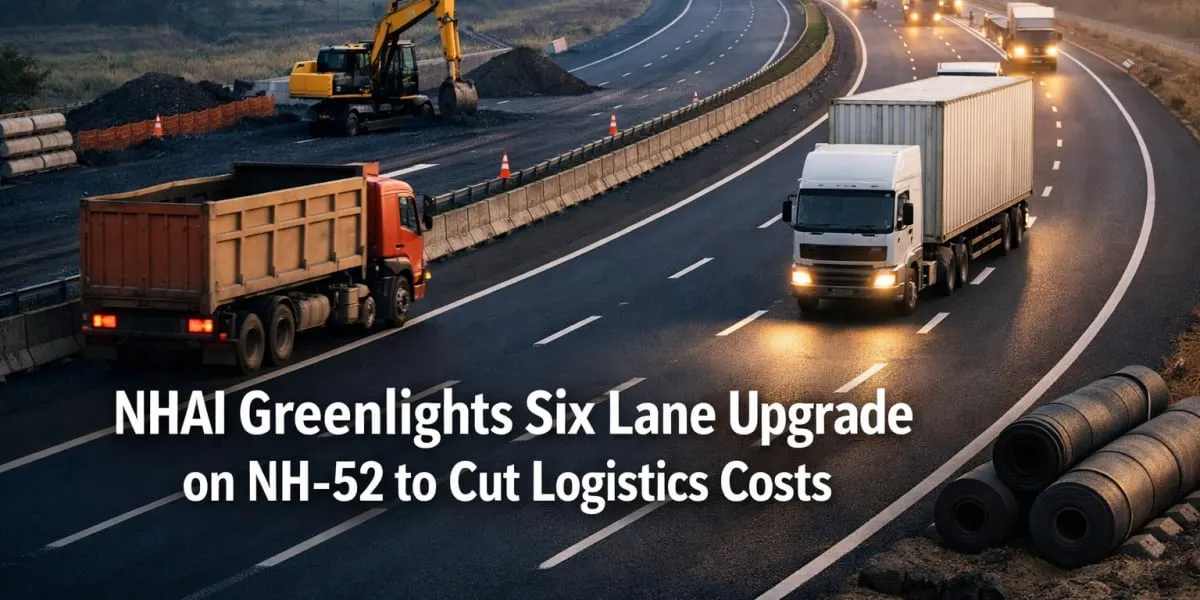
The National Highways Authority of India (NHAI) has begun work on a detailed project report to widen a 160-kilometre stretch of National Highway 52 (NH-52) from Indore to the Maharashtra border via Khalghat and Sendhwa, upgrading the route from four lanes to six. The move responds to steady growth in traffic on the Agra–Mumbai corridor, which carries heavy freight between central and western India. Around 40,000 vehicles use this corridor daily, many of them commercial trucks and container vehicles serving Indore and the Pithampur industrial belt. The DPR is being prepared and construction is expected to be taken up in phases once the report is finalised.

Beyond lane addition, the project targets the three ghat sections Bheru, Bakaner and Bijasan for six-lane upgrades with road realignment and slope work to tackle gradients and heavy vehicle movement. A parallel bridge over the Narmada near Khalghat is proposed to ease the load on the existing crossing and preserve lane continuity. In built up towns bypasses and service roads are planned to separate local and highway traffic, with flyovers and underpasses at major junctions.

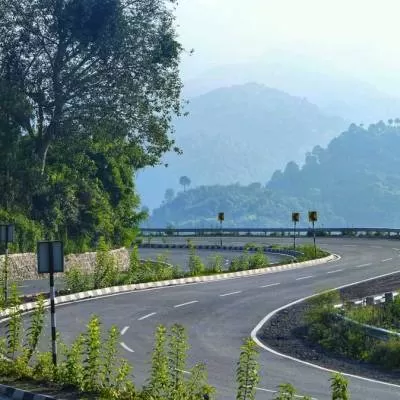
The design gives particular attention to safety in accident prone stretches, notably around Bijasan Ghat, with proposals to redesign sharp curves, improve drainage to prevent water accumulation, upgrade signage and crash barriers, and install modern traffic management systems. These interventions are intended to reduce delays and the risk of collisions on steep or constrained sections. NHAI has not disclosed a construction start date or an overall project cost in the public domain. Priority sections are likely to include the ghat areas and the Narmada bridge, with remaining work following over subsequent years.

For commuters the upgrade should mean reduced travel time between Indore and the Maharashtra border and more predictable journey schedules through ghat sections and junctions. For businesses, particularly in Pithampur, smoother traffic flow is expected to lower logistics costs and improve supply chain planning. The project timeline will depend on final DPR approvals and phased implementation.

The National Highways Authority of India (NHAI) has begun work on a detailed project report to widen a 160-kilometre stretch of National Highway 52 (NH-52) from Indore to the Maharashtra border via Khalghat and Sendhwa, upgrading the route from four lanes to six. The move responds to steady growth in traffic on the Agra–Mumbai corridor, which carries heavy freight between central and western India. Around 40,000 vehicles use this corridor daily, many of them commercial trucks and container vehicles serving Indore and the Pithampur industrial belt. The DPR is being prepared and construction is expected to be taken up in phases once the report is finalised. Beyond lane addition, the project targets the three ghat sections Bheru, Bakaner and Bijasan for six-lane upgrades with road realignment and slope work to tackle gradients and heavy vehicle movement. A parallel bridge over the Narmada near Khalghat is proposed to ease the load on the existing crossing and preserve lane continuity. In built up towns bypasses and service roads are planned to separate local and highway traffic, with flyovers and underpasses at major junctions. The design gives particular attention to safety in accident prone stretches, notably around Bijasan Ghat, with proposals to redesign sharp curves, improve drainage to prevent water accumulation, upgrade signage and crash barriers, and install modern traffic management systems. These interventions are intended to reduce delays and the risk of collisions on steep or constrained sections. NHAI has not disclosed a construction start date or an overall project cost in the public domain. Priority sections are likely to include the ghat areas and the Narmada bridge, with remaining work following over subsequent years. For commuters the upgrade should mean reduced travel time between Indore and the Maharashtra border and more predictable journey schedules through ghat sections and junctions. For businesses, particularly in Pithampur, smoother traffic flow is expected to lower logistics costs and improve supply chain planning. The project timeline will depend on final DPR approvals and phased implementation.

Related Stories

Gold Stories

Next Story
Infrastructure Urban

KONE Opens India's First Digital Experience Centre in Pune

KONE, a global elevator and escalator manufacturer, has inaugurated its first Digital Experience Centre (DEC) in India, located in Pune. The facility aims to showcase how artificial intelligence (AI), connectivity and data-driven technologies can enhance customer experiences and improve building operations.The centre was inaugurated by Jussi Herlin, Executive Vice Chair, KONE Corporation; Philippe Delorme, President and CEO, KONE; and Nandan Nilekani, Co-founder and Chairman of the Board, Infosys.Designed as an interactive customer environment, the facility demonstrates digital solutions cover..

Next Story
Infrastructure Urban

CII GreenCo Launches Circularity Guidelines for Indian Industry

The Confederation of Indian Industry (CII) GreenCo Council has launched the CII GreenCo Circularity Guidelines – Pilot Version at the 17th CII GreenCo Waste & Resource Management Summit 2026 in Chennai. The initiative aims to strengthen resource efficiency, waste reduction and circular economy practices across Indian manufacturing and process industries.The guidelines introduce a structured framework with circularity indices covering raw materials, consumables, packaging and other resource inputs. These indicators will help industries assess existing practices, identify opportunities to ..

Next Story
Infrastructure Energy

Global Electronics Association Launches IPC-1783-CO2E Standard

The Global Electronics Association has introduced IPC-1783-CO2E, a new international standard aimed at improving consistency, transparency and comparability in product carbon footprint reporting across the electronics manufacturing industry.The standard, titled International Standard for Data Collection and Reporting of CO2 Equivalent (CO2e) Emissions for the Electronics Manufacturing Supply Chain, provides industry-specific guidance for collecting, estimating and reporting carbon emissions data.With increasing regulatory requirements and customer expectations, electronics manufacturers face c..

Advertisement

Subscribe to Our Newsletter

Get daily newsletters around different themes from Construction world.

STAY CONNECTED

Advertisement

SPECIAL OFFER
QR Code