NHAI Orders Banks To Validate FASTag Vehicle Numbers
ROADS & HIGHWAYS

NHAI Orders Banks To Validate FASTag Vehicle Numbers

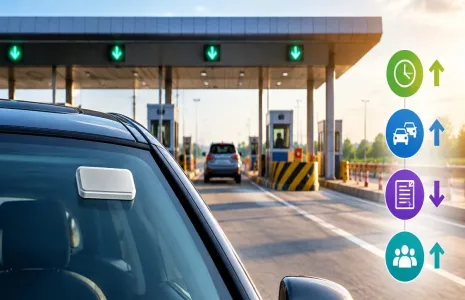
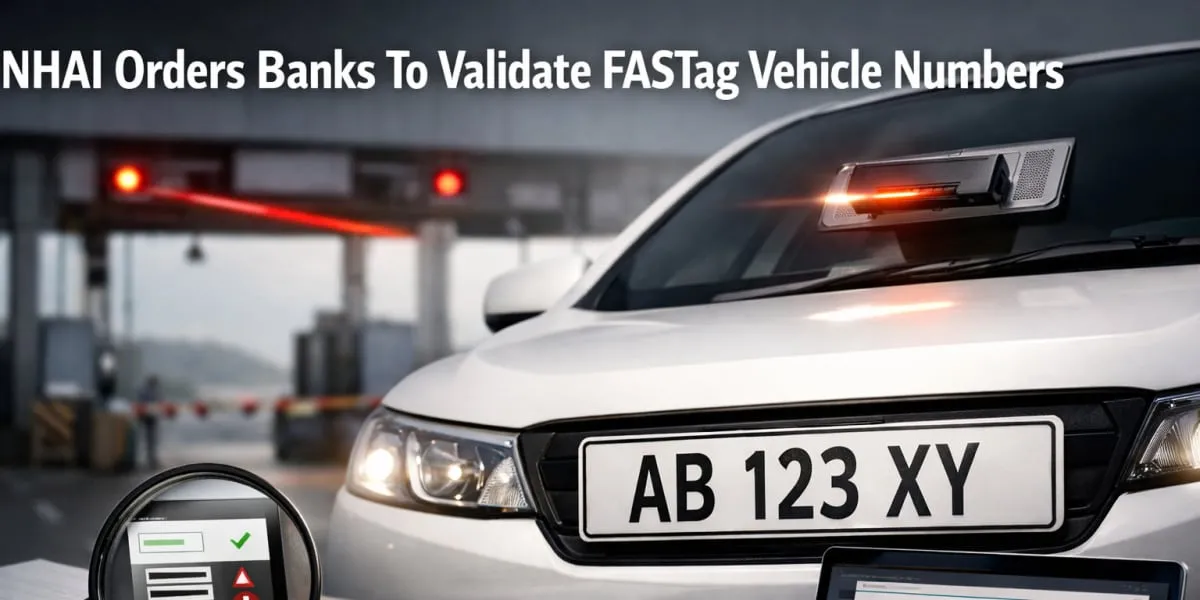
The National Highway Authority of India (NHAI) has directed all FASTag issuer banks to undertake immediate validation of Vehicle Registration Numbers (VRNs) linked to FASTags after receiving complaints that the VRN captured by FASTag readers did not match the registration number displayed on vehicle number plates. The Ministry of Road Transport and Highways warned that such discrepancies had the potential to undermine enforcement mechanisms, lead to evasion of Government revenue and attract penal provisions under the Motor Vehicles Act, 1988.

The instruction is intended to enhance the accuracy and reliability of data in the Electronic Toll Collection (ETC) system and to strengthen transparency, compliance and operational efficiency. The NHAI stressed the critical importance of correct VRN mapping with FASTag in view of upcoming technology driven initiatives such as Multi-Lane Free Flow (MLFF) tolling. Under the MLFF framework, enforcement actions including issuance of electronic notices to non compliant vehicles will rely on accurate and verified vehicle identification data.

NHAI officials said that a considerable number of mismatches had been associated with FASTags issued prior to integration with the VAHAN database, when validation mechanisms were relatively limited and manual processes increased the risk of inconsistencies in vehicle identification records. In response, all FASTag issuer banks have been instructed to undertake urgent verification of FASTags issued by them and to blacklist those FASTags found to be linked with incorrect or invalid VRNs, in accordance with established Government guidelines.

The NHAI has also noted that it issues over 0.5 million (mn) FASTag annual toll passes and collects Rs 1.5 billion (bn) in toll revenue, figures that underline the financial scale at stake. The agency indicated that tighter VRN validation and coordination between issuer banks and the VAHAN system are expected to protect revenue streams and support smoother deployment of technology driven tolling reforms. The measure is part of broader efforts to modernise toll operations and reduce evasion.

The National Highway Authority of India (NHAI) has directed all FASTag issuer banks to undertake immediate validation of Vehicle Registration Numbers (VRNs) linked to FASTags after receiving complaints that the VRN captured by FASTag readers did not match the registration number displayed on vehicle number plates. The Ministry of Road Transport and Highways warned that such discrepancies had the potential to undermine enforcement mechanisms, lead to evasion of Government revenue and attract penal provisions under the Motor Vehicles Act, 1988. The instruction is intended to enhance the accuracy and reliability of data in the Electronic Toll Collection (ETC) system and to strengthen transparency, compliance and operational efficiency. The NHAI stressed the critical importance of correct VRN mapping with FASTag in view of upcoming technology driven initiatives such as Multi-Lane Free Flow (MLFF) tolling. Under the MLFF framework, enforcement actions including issuance of electronic notices to non compliant vehicles will rely on accurate and verified vehicle identification data. NHAI officials said that a considerable number of mismatches had been associated with FASTags issued prior to integration with the VAHAN database, when validation mechanisms were relatively limited and manual processes increased the risk of inconsistencies in vehicle identification records. In response, all FASTag issuer banks have been instructed to undertake urgent verification of FASTags issued by them and to blacklist those FASTags found to be linked with incorrect or invalid VRNs, in accordance with established Government guidelines. The NHAI has also noted that it issues over 0.5 million (mn) FASTag annual toll passes and collects Rs 1.5 billion (bn) in toll revenue, figures that underline the financial scale at stake. The agency indicated that tighter VRN validation and coordination between issuer banks and the VAHAN system are expected to protect revenue streams and support smoother deployment of technology driven tolling reforms. The measure is part of broader efforts to modernise toll operations and reduce evasion.

Next Story
Equipment

India CE Industry Ends FY26 on a Steady Recovery Path

India’s construction equipment industry closed FY26 on a stable note, reflecting measured resilience and gradually improving momentum. Total sales in Q4 FY26 rose 4 per cent year on year to 42,906 units, extending the recovery seen over the past two years.Domestic demand for the full year remained under pressure, declining 7 per cent, but exports provided strong support. Overall exports grew 31 per cent, while non-OEM exports increased 13 per cent, highlighting sustained demand from overseas markets.March 2026 further underlined the recovery, with sales rising 6 per cent year on year and 13 ..

Next Story
Infrastructure Urban

Leaders Question FIR Against Anil Agarwal

Several industry and public figures have questioned the FIR filed against Anil Agarwal following the boiler accident in Chhattisgarh, while also expressing condolences over the loss of lives and calling for a thorough investigation.Naveen Jindal said the tragedy was deeply painful and stressed that compensation, livelihood support for affected families and a fair probe were essential. He also questioned naming Agarwal in the FIR before completion of the investigation.Kiran Bedi urged restraint, saying investigations should focus on learning lessons and strengthening systems rather than prematu..

Next Story
Infrastructure Urban

Tier 2, 3 Cities Drive 66% of New D2C Orders

Tier 2 and Tier 3 cities accounted for 66 per cent of new direct-to-consumer (D2C) orders in FY 2026, according to a new analysis by Unicommerce.The report said buyers from smaller cities also contributed 60 per cent of incremental gross merchandise value (GMV) in FY 2026 compared with FY 2025, highlighting rising demand beyond metro markets.Overall, India’s D2C segment recorded strong growth, with order volumes rising 33 per cent and GMV increasing 32 per cent year-on-year. The findings are based on more than 400 million order items processed through brand websites on Unicommerce’s Uniwar..

Advertisement

Subscribe to Our Newsletter

Get daily newsletters around different themes from Construction world.

STAY CONNECTED

Advertisement

Advertisement

Advertisement