+
NIT-Calicut Inspects Kochi Metro Corridor After Road Bumps Reappear
ROADS & HIGHWAYS

NIT-Calicut Inspects Kochi Metro Corridor After Road Bumps Reappear

A four-member engineering team from the National Institute of Technology-Calicut (NIT-Calicut) inspected the Kochi Metro corridor along Sahodaran Ayyappan Road on Friday after dangerous bumps reappeared, creating a safety hazard for motorists and two-wheeler riders. The inspection covered the 3.10-km stretch between Vyttila Metro station and Manorama Junction.

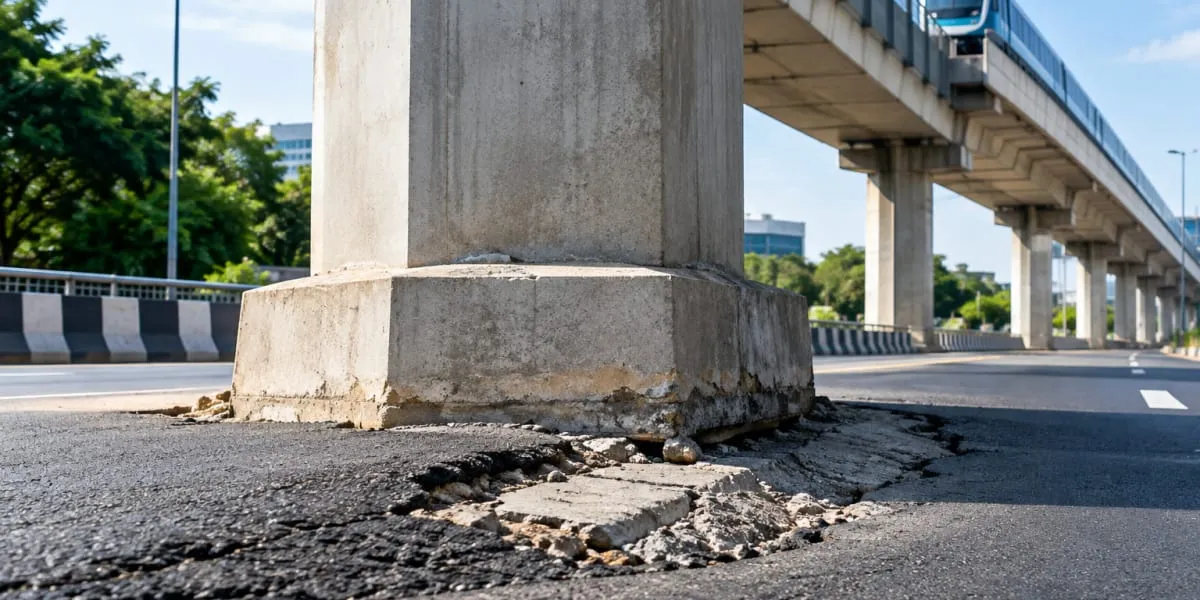
Sections of the bitumen road have settled around rigid pile caps supporting Metro pillars. The uneven settlement has exposed hard concrete bases and produced bumps measuring about 3 to 4 inches in height. The hazards are difficult for riders to identify at night, while sudden changes in road level can affect vehicle control on the busy urban corridor.

The NIT-Calicut team, led by MVLR Anjaneyulu from the civil engineering department, collected soil samples during the inspection. A detailed study is to be conducted, with a report scheduled for submission to the Kochi corporation within 15 days. The assessment will examine the recurring sinkage and identify a permanent approach to repairing the road surface.

The problem involves the different behaviour of the road surface and the Metro structures beneath it. The pile caps are rigid concrete elements, while the surrounding road formation can settle if soil or supporting layers lose stability. The precise technical cause and recommended repair design have not yet been established. Earlier tarring by the Kochi corporation did not prevent the road around the pile caps from sinking again.

The Kerala High Court has directed the corporation to carry out rectification measures along the affected stretch within four months. The available report does not provide the date of the direction or explain how the deadline will be assessed, but the order places responsibility for the road condition on the civic authority. The corporation is expected to use the NIT-Calicut report to plan longer-term work rather than continue with surface-level repairs. Until the assessment is completed, the extent of intervention and final repair method remain undetermined.

A four-member engineering team from the National Institute of Technology-Calicut (NIT-Calicut) inspected the Kochi Metro corridor along Sahodaran Ayyappan Road on Friday after dangerous bumps reappeared, creating a safety hazard for motorists and two-wheeler riders. The inspection covered the 3.10-km stretch between Vyttila Metro station and Manorama Junction. Sections of the bitumen road have settled around rigid pile caps supporting Metro pillars. The uneven settlement has exposed hard concrete bases and produced bumps measuring about 3 to 4 inches in height. The hazards are difficult for riders to identify at night, while sudden changes in road level can affect vehicle control on the busy urban corridor. The NIT-Calicut team, led by MVLR Anjaneyulu from the civil engineering department, collected soil samples during the inspection. A detailed study is to be conducted, with a report scheduled for submission to the Kochi corporation within 15 days. The assessment will examine the recurring sinkage and identify a permanent approach to repairing the road surface. The problem involves the different behaviour of the road surface and the Metro structures beneath it. The pile caps are rigid concrete elements, while the surrounding road formation can settle if soil or supporting layers lose stability. The precise technical cause and recommended repair design have not yet been established. Earlier tarring by the Kochi corporation did not prevent the road around the pile caps from sinking again. The Kerala High Court has directed the corporation to carry out rectification measures along the affected stretch within four months. The available report does not provide the date of the direction or explain how the deadline will be assessed, but the order places responsibility for the road condition on the civic authority. The corporation is expected to use the NIT-Calicut report to plan longer-term work rather than continue with surface-level repairs. Until the assessment is completed, the extent of intervention and final repair method remain undetermined.

Related Stories

Gold Stories

Next Story
Infrastructure Energy

Perkins Begins Production of 5016 Power Generation Engine

Perkins has commenced production of its new 5016 full-authority electronic engine, completing its 5000 Series range of 6-, 8-, 12- and 16-cylinder engines. Manufactured in Stafford, UK, and Aurangabad, India, the range delivers up to 2,500 kVA of standby power and 2,250 kVA of prime power.The 61-litre V16 engine delivers 1,400–2,500 kVA at 50 Hz for base load, prime and standby applications. Designed for power generation, it supports critical infrastructure, including data centres, hospitals, airports and remote worksites.Engineered to meet ISO G3 and NFPA110 standards, the 5016 incorporates..

Next Story
Real Estate

JAPAN BUILD Tokyo 2026 Expects 35,000 Visitors

RX Japan GK will organise the 11th edition of JAPAN BUILD Tokyo at Tokyo Big Sight from 2–4 December 2026, with approximately 35,000 visitors expected from the building, construction and real estate sectors.The exhibition will bring together manufacturers, developers, contractors, architects, distributors and property owners. According to the organiser, 51.2 per cent of visitors hold managerial positions or above, providing exhibitors with opportunities to engage with procurement decision-makers. The previous edition attracted 33,618 visitors and 548 exhibitors.JAPAN BUILD Tokyo will feature..

Next Story
Infrastructure Urban

Magma Signs LOIs Worth Over Rs 8 Bn Across Industrial Businesses

Magma has signed Letters of Intent (LOIs) worth more than Rs 8 bn across its advanced materials, waste management, precision engineering and digital industrial solutions businesses.The company expects to execute around 70 per cent of the current LOI pipeline during FY27, providing visibility for the remainder of the financial year. The pipeline reflects rising demand from enterprise manufacturers and deeper engagement across Magma’s customer relationships.India’s industrial B2B trade is estimated at around USD 2 trillion. In precision engineering, imports account for 60-65 per cent of high..

Advertisement

Subscribe to Our Newsletter

Get daily newsletters around different themes from Construction world.

STAY CONNECTED

Advertisement

SPECIAL OFFER
QR Code