96km Rail Line to Link Rajasthan's Sirohi to Network
RAILWAYS & METRO RAIL

96km Rail Line to Link Rajasthan's Sirohi to Network

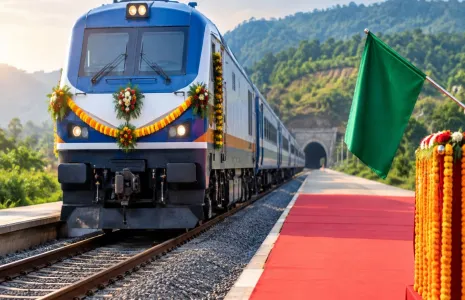
In a major step towards improving infrastructure in Rajasthan, the central government has approved the final location survey for a 96-kilometre railway line connecting Marwar Bagra (Jalore)–Sirohi–Swarupganj, thereby integrating Sirohi district into the national railway network for the first time.

The approval, announced on Monday, marks a long-awaited development for tribal-dominated western Rajasthan. Sirohi, currently without a rail link, lies near the important Delhi–Ajmer–Abu Road–Ahmedabad corridor, while Jalore is already on the Samdari–Bhildi–Gandhidham route.

Railway Minister Ashwini Vaishnaw confirmed that this project fulfils a longstanding demand to connect Sirohi with the national rail grid. The line is expected to bring transformative benefits including increased trade, employment generation, and enhanced social inclusion.

By connecting the district, the rail line will support economic growth, improve living standards, and provide rail access to major cities such as Ahmedabad, Mumbai, and Delhi. Additionally, it will serve as a strategic transport corridor, especially for border areas and key freight routes.

The new route will facilitate the movement of marble, granite, cement, food grains, and fertilisers, improving connectivity to Samdari and Munabao, and linking efficiently with the Western Dedicated Freight Corridor (DFC), thereby strengthening Rajasthan’s logistics framework.

The rail connection is set to benefit over 1 million residents, particularly in nearby towns and villages like Shivganj, Pindwara, Rewadar, Mandar, Kalandri, and those in the Jawal region. This move is expected to usher in a new era of development for the western part of the state.

In a major step towards improving infrastructure in Rajasthan, the central government has approved the final location survey for a 96-kilometre railway line connecting Marwar Bagra (Jalore)–Sirohi–Swarupganj, thereby integrating Sirohi district into the national railway network for the first time.The approval, announced on Monday, marks a long-awaited development for tribal-dominated western Rajasthan. Sirohi, currently without a rail link, lies near the important Delhi–Ajmer–Abu Road–Ahmedabad corridor, while Jalore is already on the Samdari–Bhildi–Gandhidham route.Railway Minister Ashwini Vaishnaw confirmed that this project fulfils a longstanding demand to connect Sirohi with the national rail grid. The line is expected to bring transformative benefits including increased trade, employment generation, and enhanced social inclusion.By connecting the district, the rail line will support economic growth, improve living standards, and provide rail access to major cities such as Ahmedabad, Mumbai, and Delhi. Additionally, it will serve as a strategic transport corridor, especially for border areas and key freight routes.The new route will facilitate the movement of marble, granite, cement, food grains, and fertilisers, improving connectivity to Samdari and Munabao, and linking efficiently with the Western Dedicated Freight Corridor (DFC), thereby strengthening Rajasthan’s logistics framework.The rail connection is set to benefit over 1 million residents, particularly in nearby towns and villages like Shivganj, Pindwara, Rewadar, Mandar, Kalandri, and those in the Jawal region. This move is expected to usher in a new era of development for the western part of the state.

Next Story
Infrastructure Transport

India Becomes First to Produce Bio-Bitumen for Roads

India has become the first country in the world to commercially produce bio-bitumen for use in road construction, according to Road, Transport and Highways Minister Nitin Gadkari. Bitumen, a black and viscous hydrocarbon derived from crude oil, is a key binding material in road building, and the bio-based alternative is expected to significantly improve the sector’s environmental footprint.Addressing the CSIR Technology Transfer Ceremony in New Delhi, Mr Gadkari congratulated Council of Scientific and Industrial Research on achieving the milestone, noting that the initiative would help curb ..

Next Story
Infrastructure Urban

HILT Policy Seen Boosting Telangana Revenue Sharply

The Hyderabad Industrial Land Transformation (HILT) Policy is expected to generate around Rs 1.08 billion in revenue for the Telangana state exchequer, according to Deputy Chief Minister Bhatti Vikramarka Mallu. Speaking in the Telangana Legislative Assembly, he said the policy would be implemented within a six-month timeframe in a transparent manner, with uniform rules applicable to all stakeholders. Mr Vikramarka noted that without the HILT Policy, the state would have earned only about Rs 1.2 million per acre. Under the new framework, however, revenue is projected to rise sharply to Rs 70 ..

Next Story
Infrastructure Urban

India Post, MoRD Tie Up to Boost Rural Inclusion

The Department of Posts and the Ministry of Rural Development have signed a Memorandum of Understanding to accelerate rural transformation and expand financial, digital and logistics services for Self-Help Groups (SHGs) and rural households across India. The agreement was signed in the presence of Union Minister of Communications and Development of North Eastern Region Jyotiraditya M. Scindia and Union Minister of Rural Development and Agriculture and Farmers’ Welfare Shivraj Singh Chouhan. The collaboration aligns with the government’s “Dak Sewa, Jan Sewa” vision and seeks to repositi..

Advertisement

Subscribe to Our Newsletter

Get daily newsletters around different themes from Construction world.

STAY CONNECTED

Advertisement

Advertisement

Advertisement

Advertisement

Open In App