DFCCIL Installs Longest Rail Flyover Girder at Kalamboli in Key Feat
RAILWAYS & METRO RAIL

DFCCIL Installs Longest Rail Flyover Girder at Kalamboli in Key Feat

Demonstrating India's advancing engineering capabilities and its dedication to modernizing freight mobility, the Dedicated Freight Corridor Corporation of India Limited (DFCCIL) has successfully completed the installation of its longest rail flyover girder at Kalamboli. This milestone, situated on the Jawaharlal Nehru Port Trust (JNPT)–Nilje section of the Western Dedicated Freight Corridor (WDFC), represents a significant achievement in the nation’s infrastructure development.

The open web steel girder, measuring an impressive 110.5 meters in length and weighing approximately 1,500 tons, is the largest ever installed by DFCCIL. The precision-focused installation involved a remarkable engineering feat: a 34-meter radial shift of the girder over active Indian Railways tracks, achieved without interrupting train operations. This complex procedure required the use of advanced heavy-lifting technology and careful coordination, highlighting the increasing technical expertise within India’s freight rail sector.

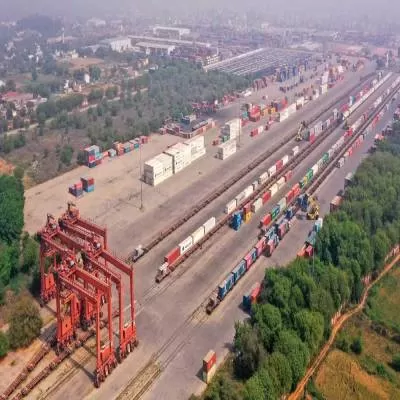
This engineering accomplishment reflects DFCCIL’s broader objective of transforming India’s freight transport system with an emphasis on safety, sustainability, and efficiency. Upon completion, the Kalamboli Rail Flyover is expected to enhance connectivity between JNPT—India’s busiest container port—and industrial centers in Maharashtra and beyond, resulting in faster cargo movement, reduced transit times, and better logistics performance.

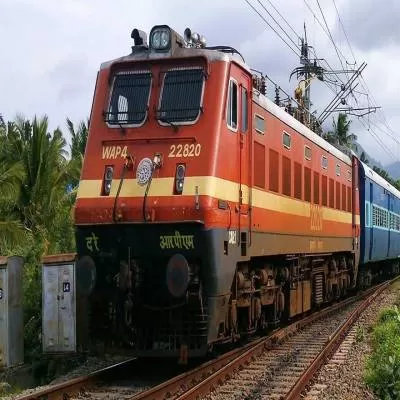
The Kalamboli project forms part of the 1,500+ kilometer Western Dedicated Freight Corridor, which, along with its eastern counterpart, aims to ease congestion on India’s overburdened rail network. Together, these corridors are designed to support high-speed, high-capacity freight operations and encourage a shift away from carbon-intensive road transport, in alignment with the country’s climate objectives.

Experts have observed that milestones such as the Kalamboli girder installation represent more than just engineering achievements; they signify a strategic shift in India’s freight transport approach. Open web steel girders are engineered for durability and high load efficiency, enabling the support of heavier freight with lower maintenance requirements and a reduced environmental impact. With the expansion of India’s urban and industrial areas, the demand for climate-resilient, digitally integrated freight corridors is increasing, and the Kalamboli project is seen as a critical step towards this future.

Beyond the success of DFCCIL, this accomplishment also underscores India’s growing ability to deliver world-class infrastructure projects under challenging conditions. Each such milestone brings the country closer to establishing a modern, efficient, and sustainable logistics ecosystem.

News source: Logistics Insider

Demonstrating India's advancing engineering capabilities and its dedication to modernizing freight mobility, the Dedicated Freight Corridor Corporation of India Limited (DFCCIL) has successfully completed the installation of its longest rail flyover girder at Kalamboli. This milestone, situated on the Jawaharlal Nehru Port Trust (JNPT)–Nilje section of the Western Dedicated Freight Corridor (WDFC), represents a significant achievement in the nation’s infrastructure development.The open web steel girder, measuring an impressive 110.5 meters in length and weighing approximately 1,500 tons, is the largest ever installed by DFCCIL. The precision-focused installation involved a remarkable engineering feat: a 34-meter radial shift of the girder over active Indian Railways tracks, achieved without interrupting train operations. This complex procedure required the use of advanced heavy-lifting technology and careful coordination, highlighting the increasing technical expertise within India’s freight rail sector.This engineering accomplishment reflects DFCCIL’s broader objective of transforming India’s freight transport system with an emphasis on safety, sustainability, and efficiency. Upon completion, the Kalamboli Rail Flyover is expected to enhance connectivity between JNPT—India’s busiest container port—and industrial centers in Maharashtra and beyond, resulting in faster cargo movement, reduced transit times, and better logistics performance.The Kalamboli project forms part of the 1,500+ kilometer Western Dedicated Freight Corridor, which, along with its eastern counterpart, aims to ease congestion on India’s overburdened rail network. Together, these corridors are designed to support high-speed, high-capacity freight operations and encourage a shift away from carbon-intensive road transport, in alignment with the country’s climate objectives.Experts have observed that milestones such as the Kalamboli girder installation represent more than just engineering achievements; they signify a strategic shift in India’s freight transport approach. Open web steel girders are engineered for durability and high load efficiency, enabling the support of heavier freight with lower maintenance requirements and a reduced environmental impact. With the expansion of India’s urban and industrial areas, the demand for climate-resilient, digitally integrated freight corridors is increasing, and the Kalamboli project is seen as a critical step towards this future.Beyond the success of DFCCIL, this accomplishment also underscores India’s growing ability to deliver world-class infrastructure projects under challenging conditions. Each such milestone brings the country closer to establishing a modern, efficient, and sustainable logistics ecosystem.News source: Logistics Insider

Next Story
Infrastructure Transport

MMRDA advances 250 m on Orange Gate–Marine Drive tunnel

The Mumbai Metropolitan Region Development Authority (MMRDA) has completed 250 m of underground tunnelling for the Orange Gate–Marine Drive Urban Road Tunnel using India’s largest slurry shield tunnel boring machine (TBM) deployed for an urban road project.The project involves twin tunnels extending over 7 km beneath critical transport corridors, including Central Railway, Western Railway and Metro Line 3. The work requires high-precision engineering to navigate densely developed urban infrastructure.Once completed, the tunnel is expected to reduce travel time between Orange Gate and Marin..

Next Story
Infrastructure Urban

Hindustan Zinc Pays Rs 188.46 Billion in FY26

Hindustan Zinc contributed Rs 188.46 billion to the public exchequer in FY 2025-26, according to its 9th Tax Transparency Report. The contribution, equivalent to 46 per cent of the company’s revenue, included direct and indirect taxes, government royalties, dividends to the Government of India, withholding taxes and other statutory levies.The company’s five-year cumulative contribution to the exchequer stood at Rs 915.72 billion. In FY26, Hindustan Zinc reported revenue of Rs 408.44 billion, EBITDA of Rs 221.62 billion and profit after tax of Rs 138.32 billion. It also achieved its highest..

Next Story
Infrastructure Urban

World of Concrete India 2026 Opens in Mumbai

Informa Markets in India will host the 12th edition of World of Concrete India 2026 from 3–5 June 2026 at the Bombay Exhibition Centre, Mumbai. The specialised B2B exhibition will bring together manufacturers, suppliers, contractors, developers, architects, consultants, infrastructure companies, project leaders and government stakeholders.The event is expected to feature over 350 brands and more than 18,000 trade professionals. It will cover concrete and cement, dry mortar, precast technologies, formwork, construction chemicals, industrial and commercial flooring, scaffolding, safety solutio..

Advertisement

Subscribe to Our Newsletter

Get daily newsletters around different themes from Construction world.

STAY CONNECTED

Advertisement

Advertisement

Advertisement