+
Indian Railways Sanctions Rs8.71 bn Projects Across Three States
RAILWAYS & METRO RAIL

Indian Railways Sanctions Rs8.71 bn Projects Across Three States

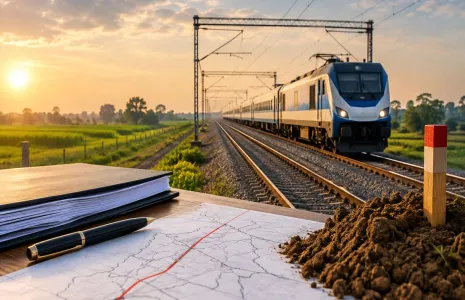
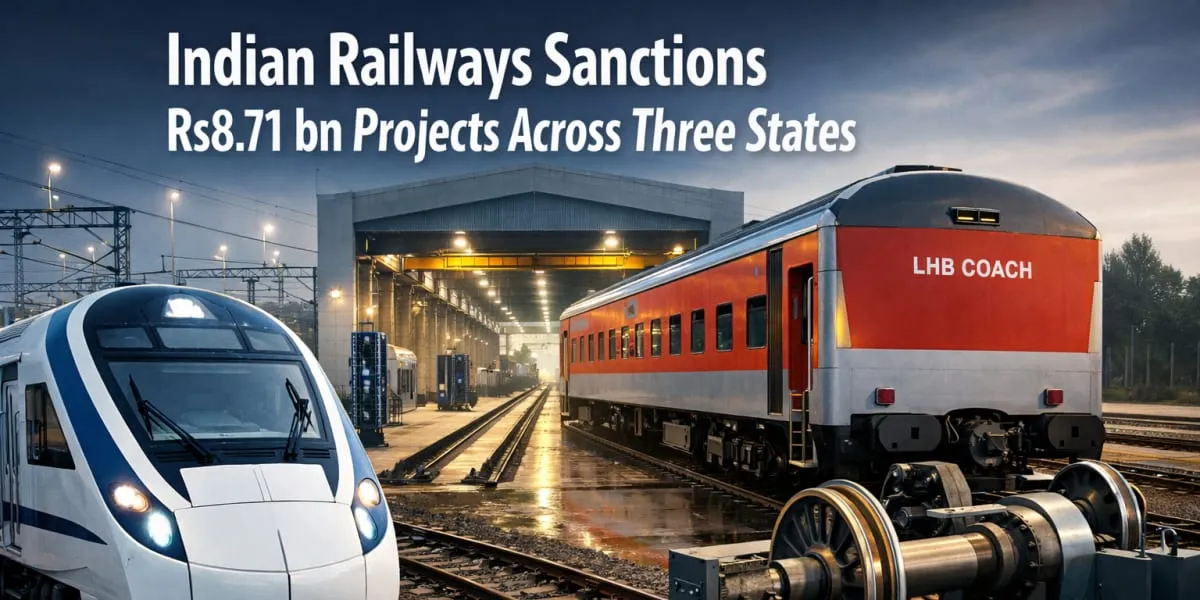
Indian Railways has sanctioned a Rs8.71 billion (bn) infrastructure package covering projects in Rajasthan, Kerala and West Bengal to modernise maintenance facilities and expand capacity. The package will upgrade coach and engine maintenance with new washing lines, stabling lines, pit lines and a wheel lathe line to support modern rolling stock including Linke Hofmann Busch (LHB) coaches and Vande Bharat trains, increasing maintenance capacity by six additional rakes per day. The investments are intended to reduce turnaround times and improve reliability across key depots.

Phase II augmentation at Lalgarh in the Bikaner region will be executed at a cost of Rs1.40 bn and will include a 600-metre washing line, a covered shed over four washing lines and a sick line extension of 120m by 16m. The works also comprise a 1,000 square metre service building, two automatic coach washing plants, two synchronized coach lifting systems and two 25-tonne (t) EOT cranes. The expansion is expected to enhance preparedness for additional Vande Bharat sets and advanced LHB coaches while improving maintenance throughput.

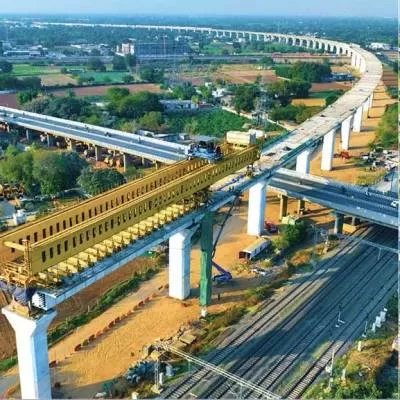
A Rs4.51 bn doubling scheme will add a second track over the 21.10 km Turavur–Mararikulam section on the Ernakulam–Alappuzha–Kayankulam corridor. The capacity enhancement is expected to permit operation of nine additional passenger trains per day in each direction and to raise freight throughput by two point eight eight million (mn) tonnes (t) per annum while reducing freight train detention by 17–19 minutes and saving 12–15 minutes on passenger services. The project aims to ease congestion and strengthen connectivity to Cochin Port, supporting regional logistics.

A Rs1.07 bn Kalipahari bypass of 4.75 km near Asansol will eliminate engine reversal at Asansol yard, saving about 90 minutes for nine freight trains daily and about 30 minutes for eight coaching trains daily and reducing congestion on one of eastern India’s busiest corridors. Together these targeted investments are presented as a strategic push to modernise infrastructure for next generation trains, speed passenger services, boost freight efficiency and support economic growth.

Indian Railways has sanctioned a Rs8.71 billion (bn) infrastructure package covering projects in Rajasthan, Kerala and West Bengal to modernise maintenance facilities and expand capacity. The package will upgrade coach and engine maintenance with new washing lines, stabling lines, pit lines and a wheel lathe line to support modern rolling stock including Linke Hofmann Busch (LHB) coaches and Vande Bharat trains, increasing maintenance capacity by six additional rakes per day. The investments are intended to reduce turnaround times and improve reliability across key depots. Phase II augmentation at Lalgarh in the Bikaner region will be executed at a cost of Rs1.40 bn and will include a 600-metre washing line, a covered shed over four washing lines and a sick line extension of 120m by 16m. The works also comprise a 1,000 square metre service building, two automatic coach washing plants, two synchronized coach lifting systems and two 25-tonne (t) EOT cranes. The expansion is expected to enhance preparedness for additional Vande Bharat sets and advanced LHB coaches while improving maintenance throughput. A Rs4.51 bn doubling scheme will add a second track over the 21.10 km Turavur–Mararikulam section on the Ernakulam–Alappuzha–Kayankulam corridor. The capacity enhancement is expected to permit operation of nine additional passenger trains per day in each direction and to raise freight throughput by two point eight eight million (mn) tonnes (t) per annum while reducing freight train detention by 17–19 minutes and saving 12–15 minutes on passenger services. The project aims to ease congestion and strengthen connectivity to Cochin Port, supporting regional logistics. A Rs1.07 bn Kalipahari bypass of 4.75 km near Asansol will eliminate engine reversal at Asansol yard, saving about 90 minutes for nine freight trains daily and about 30 minutes for eight coaching trains daily and reducing congestion on one of eastern India’s busiest corridors. Together these targeted investments are presented as a strategic push to modernise infrastructure for next generation trains, speed passenger services, boost freight efficiency and support economic growth.

Next Story
Infrastructure Urban

Implementation Status of Jal Jeevan Mission

Since August 2019 the Government has implemented Jal Jeevan Mission to provide assured potable water through household tap connections in rural India. At the start of the mission only 32.3 million (mn) rural households, representing 16.7 per cent, were reported to have tap water connections. States and union territories have reported that 125.8 mn additional rural households have since been provided with tap connections. As a result, of about 193.6 mn rural households roughly 158.2 mn, or 81.71 per cent, are reported to have tap water supply at home.\n\nThe State, district and village level st..

Next Story
Infrastructure Urban

Jal Jeevan Mission Reaches Eighty One Per Cent Rural Coverage

The Government reported substantial progress under the Jal Jeevan Mission, launched in August 2019 to provide tap water to every rural household. At launch only 32.3 million (mn) rural households had tap connections and states and Union territories reported provision of 125.8 mn additional households by March 2026. Consequently, out of about 193.6 mn rural households around 158.2 mn, or 81.71 per cent, are reported to have tap water at home. The Finance Minister announced extension of the mission until 2028 in the 2025-26 budget speech. The Swachh Bharat Mission Grameen, launched in October 20..

Next Story
Infrastructure Urban

Empowering Local Governance for Sustainable Rural Water Supply

The Ministry of Jal Shakti has aligned the Jal Jeevan Mission (JJM) with the 73rd Amendment to strengthen village level planning and community ownership of water supply. Gram Panchayats, village water and sanitation committees and Pani Samitis are to plan, implement, manage and maintain piped water systems, with gram sabha processes formalising handover and oversight. Implementation support agencies including non government organisations, community based organisations and self help groups have been empanelled to train local committees and promote women participation. Under JJM, the department ..

Advertisement

Subscribe to Our Newsletter

Get daily newsletters around different themes from Construction world.

STAY CONNECTED

Advertisement

Advertisement

Advertisement