New Panvel-Karjat rail corridor completes 19% civil work
RAILWAYS & METRO RAIL

New Panvel-Karjat rail corridor completes 19% civil work

Civil work on the Central Railway zone's under-construction suburban railway corridor between Panvel and Karjat has begun. On February 22, the Mumbai Railway Vikas Corporation (MRVC) announced the completion of the longest tunnel on the Panvel-Karjat suburban route. When completed, the tunnel will be the longest on the suburban rail corridor. The Parsik tunnel at Mumbra is currently the only tunnel on the Central Railway suburban route.

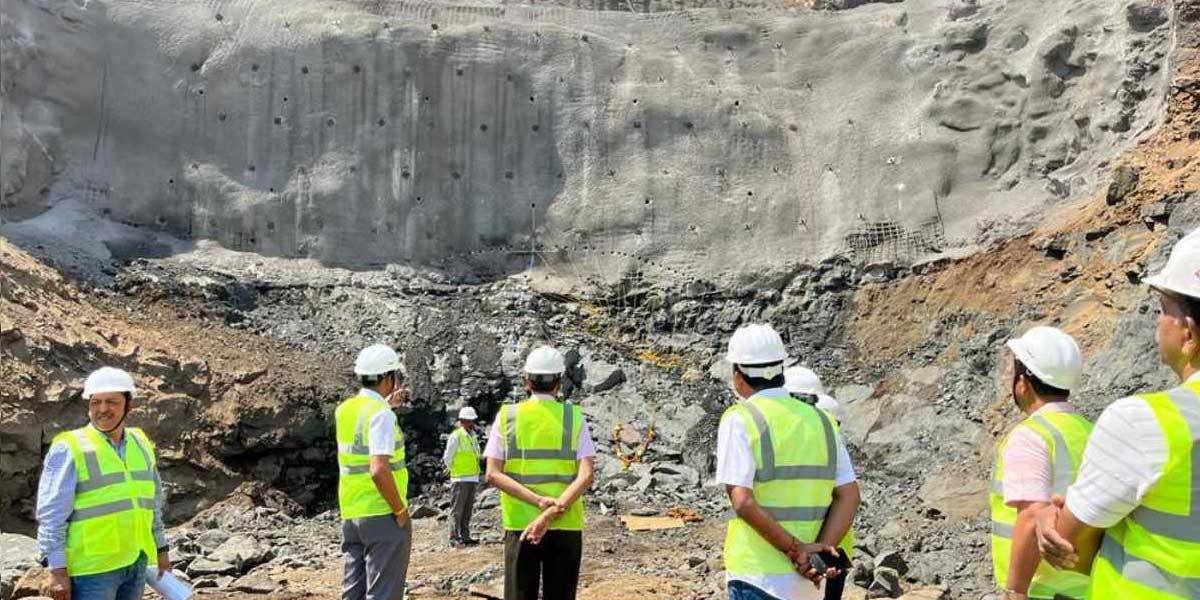
The approach cutting and controlled blasting work for tunnels (T1 & T2) has begun, according to the MRVC. In contrast, the underground excavation for tunnel T1 (92 metres) is complete. T2 and T3 portal (tunnel entrance) excavation is currently underway.

Subhash Chand Gupta, chairman of the MRVC, stated that the double line corridor will allow suburban services to run, providing an alternate route from Mumbai's main island city to Karjat via Panvel. “This additional suburban corridor will not only provide an alternate route between CSMT and Karjat but will also work as a catalyst for the further economic development of fast-developing Panvel, Karjat, and NAINA areas. With the Ministry of Railways and the Government of Maharashtra focusing towards infrastructure development of the suburban rail network of Mumbai, my dedicated team of MRVC is working as planned to deliver on time,” Gupta said, adding that the new corridor will also provide a shorter commute between the CSMT and Karjat.

The Panvel-Karjat suburban corridor has been approved for five stations. The project is scheduled to be completed in December 2025.

The project requires 57.18 ha of private land spread across 24 villages in the Panvel, Khalapur, and Karjat talukas. According to the MRVC, a total of 56.28 ha of private land has been acquired, and compensation has been paid to all 24 villages. The project also includes public and forest land. A total of 4.4 ha of government land has been acquired in its entirety. The forest department also required clearance for a total of 9.13 ha of land (4.96 ha government forest land and 4.22 ha private forest land) for the corridor's construction.

The permission to work on forest land was issued by CCF (Chief Conservator of Forest) Thane in August last year.

See also:
Railway line doubling to reduce travelling time between CSMT-Karjat
Thane-Kalyan-Bhiwandi viaduct across Kasheli Creek completed


Civil work on the Central Railway zone's under-construction suburban railway corridor between Panvel and Karjat has begun. On February 22, the Mumbai Railway Vikas Corporation (MRVC) announced the completion of the longest tunnel on the Panvel-Karjat suburban route. When completed, the tunnel will be the longest on the suburban rail corridor. The Parsik tunnel at Mumbra is currently the only tunnel on the Central Railway suburban route. The approach cutting and controlled blasting work for tunnels (T1 & T2) has begun, according to the MRVC. In contrast, the underground excavation for tunnel T1 (92 metres) is complete. T2 and T3 portal (tunnel entrance) excavation is currently underway. Subhash Chand Gupta, chairman of the MRVC, stated that the double line corridor will allow suburban services to run, providing an alternate route from Mumbai's main island city to Karjat via Panvel. “This additional suburban corridor will not only provide an alternate route between CSMT and Karjat but will also work as a catalyst for the further economic development of fast-developing Panvel, Karjat, and NAINA areas. With the Ministry of Railways and the Government of Maharashtra focusing towards infrastructure development of the suburban rail network of Mumbai, my dedicated team of MRVC is working as planned to deliver on time,” Gupta said, adding that the new corridor will also provide a shorter commute between the CSMT and Karjat. The Panvel-Karjat suburban corridor has been approved for five stations. The project is scheduled to be completed in December 2025. The project requires 57.18 ha of private land spread across 24 villages in the Panvel, Khalapur, and Karjat talukas. According to the MRVC, a total of 56.28 ha of private land has been acquired, and compensation has been paid to all 24 villages. The project also includes public and forest land. A total of 4.4 ha of government land has been acquired in its entirety. The forest department also required clearance for a total of 9.13 ha of land (4.96 ha government forest land and 4.22 ha private forest land) for the corridor's construction. The permission to work on forest land was issued by CCF (Chief Conservator of Forest) Thane in August last year. See also: Railway line doubling to reduce travelling time between CSMT-KarjatThane-Kalyan-Bhiwandi viaduct across Kasheli Creek completed

Related Stories

Gold Stories

Next Story
Infrastructure Urban

KONE Opens India's First Digital Experience Centre in Pune

KONE, a global elevator and escalator manufacturer, has inaugurated its first Digital Experience Centre (DEC) in India, located in Pune. The facility aims to showcase how artificial intelligence (AI), connectivity and data-driven technologies can enhance customer experiences and improve building operations.The centre was inaugurated by Jussi Herlin, Executive Vice Chair, KONE Corporation; Philippe Delorme, President and CEO, KONE; and Nandan Nilekani, Co-founder and Chairman of the Board, Infosys.Designed as an interactive customer environment, the facility demonstrates digital solutions cover..

Next Story
Infrastructure Urban

CII GreenCo Launches Circularity Guidelines for Indian Industry

The Confederation of Indian Industry (CII) GreenCo Council has launched the CII GreenCo Circularity Guidelines – Pilot Version at the 17th CII GreenCo Waste & Resource Management Summit 2026 in Chennai. The initiative aims to strengthen resource efficiency, waste reduction and circular economy practices across Indian manufacturing and process industries.The guidelines introduce a structured framework with circularity indices covering raw materials, consumables, packaging and other resource inputs. These indicators will help industries assess existing practices, identify opportunities to ..

Next Story
Infrastructure Energy

Global Electronics Association Launches IPC-1783-CO2E Standard

The Global Electronics Association has introduced IPC-1783-CO2E, a new international standard aimed at improving consistency, transparency and comparability in product carbon footprint reporting across the electronics manufacturing industry.The standard, titled International Standard for Data Collection and Reporting of CO2 Equivalent (CO2e) Emissions for the Electronics Manufacturing Supply Chain, provides industry-specific guidance for collecting, estimating and reporting carbon emissions data.With increasing regulatory requirements and customer expectations, electronics manufacturers face c..

Advertisement

Subscribe to Our Newsletter

Get daily newsletters around different themes from Construction world.

STAY CONNECTED

Advertisement

SPECIAL OFFER
QR Code