NFR Deploys Underwater Robots to Inspect 34 Bridges
RAILWAYS & METRO RAIL

NFR Deploys Underwater Robots to Inspect 34 Bridges

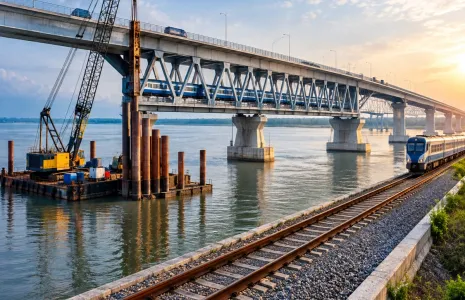
The Northeast Frontier Railway (NFR) has carried out extensive inspections of major railway bridges using underwater robotic vehicles, including the iconic Saraighat Bridge over the Brahmaputra in Guwahati. The initiative uses advanced Remotely Operated Robotic Vehicle (RORV) technology to assess submerged structures that require year-round monitoring.

The Saraighat Bridge — India’s first rail-cum-road bridge linking Pandu and Amingaon — underwent a comprehensive evaluation using a combination of RORV surveys, LiDAR, thermal imaging, Ground Penetrating Radar (GPR) and Ultrasonic Pulse Velocity (UPV) testing. The review covered pier caps, well foundations, underwater scour zones, superstructure stress points and deck elements.

NFR also conducted similar inspections on 18 additional bridges, capturing high-resolution visuals of riverbeds, submerged piers and potential defects. Across the structures surveyed, no major underwater issues were found.

In 2024–25, NFR completed underwater inspections of 13 bridges using RORV. In 2025–26, the tally has risen sharply, with 34 bridges already examined. The railway said the technology, combined with modern digital tools, is significantly enhancing structural-health monitoring and aiding timely preventive-maintenance planning.
News source: The Assam Tribune

The Northeast Frontier Railway (NFR) has carried out extensive inspections of major railway bridges using underwater robotic vehicles, including the iconic Saraighat Bridge over the Brahmaputra in Guwahati. The initiative uses advanced Remotely Operated Robotic Vehicle (RORV) technology to assess submerged structures that require year-round monitoring.The Saraighat Bridge — India’s first rail-cum-road bridge linking Pandu and Amingaon — underwent a comprehensive evaluation using a combination of RORV surveys, LiDAR, thermal imaging, Ground Penetrating Radar (GPR) and Ultrasonic Pulse Velocity (UPV) testing. The review covered pier caps, well foundations, underwater scour zones, superstructure stress points and deck elements.NFR also conducted similar inspections on 18 additional bridges, capturing high-resolution visuals of riverbeds, submerged piers and potential defects. Across the structures surveyed, no major underwater issues were found.In 2024–25, NFR completed underwater inspections of 13 bridges using RORV. In 2025–26, the tally has risen sharply, with 34 bridges already examined. The railway said the technology, combined with modern digital tools, is significantly enhancing structural-health monitoring and aiding timely preventive-maintenance planning.News source: The Assam Tribune

Next Story
Real Estate

CREDAI-MCHI to Host 10th Design & Construction Conference

CREDAI-MCHI will host the 10th anniversary edition of its Design & Construction Conference on August 19, 2026, at the Jio World Convention Centre in Mumbai.The event is expected to bring together more than 500 procurement leaders, construction heads, architects, consultants and senior real estate decision-makers, alongside over 50 construction and ancillary brands.The conference will feature product launches, technology showcases, knowledge sessions, strategic business-to-business networking and recognition of procurement professionals contributing to the transformation of the construction..

Next Story
Infrastructure Energy

BorgWarner Wins Extension for High-Voltage Inverter Programmes

BorgWarner has secured a major extension of several high-volume high-voltage inverter programmes from a leading European automotive manufacturer.The contracts cover updated inverter designs for plug-in hybrid and 800V battery-electric vehicle applications. Production is scheduled to begin in 2029.Isabelle McKenzie, President and General Manager, BorgWarner PowerDrive Systems, said the programme extensions demonstrate the company’s position in power electronics and reflect the strength of its technology, in-house expertise and customer relationships.For plug-in hybrid vehicles, BorgWarner wil..

Next Story
Infrastructure Urban

Castrol India Q2 Profit Rises 43% to Rs 3.48 bn

Castrol India reported a 43 per cent year-on-year increase in profit after tax to Rs 3.48 billion for the quarter ended June 30, 2026, supported by growth across its consumer, industrial and institutional businesses.Revenue from operations increased 25 per cent to Rs 18.71 billion during the second quarter of 2026, compared with Rs 14.97 billion in the corresponding period of 2025. EBITDA rose 41 per cent to Rs 4.94 billion from Rs 3.50 billion.Sequentially, revenue increased from Rs 15.45 billion in the first quarter of 2026, while EBITDA rose from Rs 3.29 billion. Profit after tax increased ..

Advertisement

Subscribe to Our Newsletter

Get daily newsletters around different themes from Construction world.

STAY CONNECTED

Advertisement

Advertisement

Advertisement