Deendayal Port To Begin Site Work For India's First 150 TPD Plant
PORTS & SHIPPING

Deendayal Port To Begin Site Work For India's First 150 TPD Plant

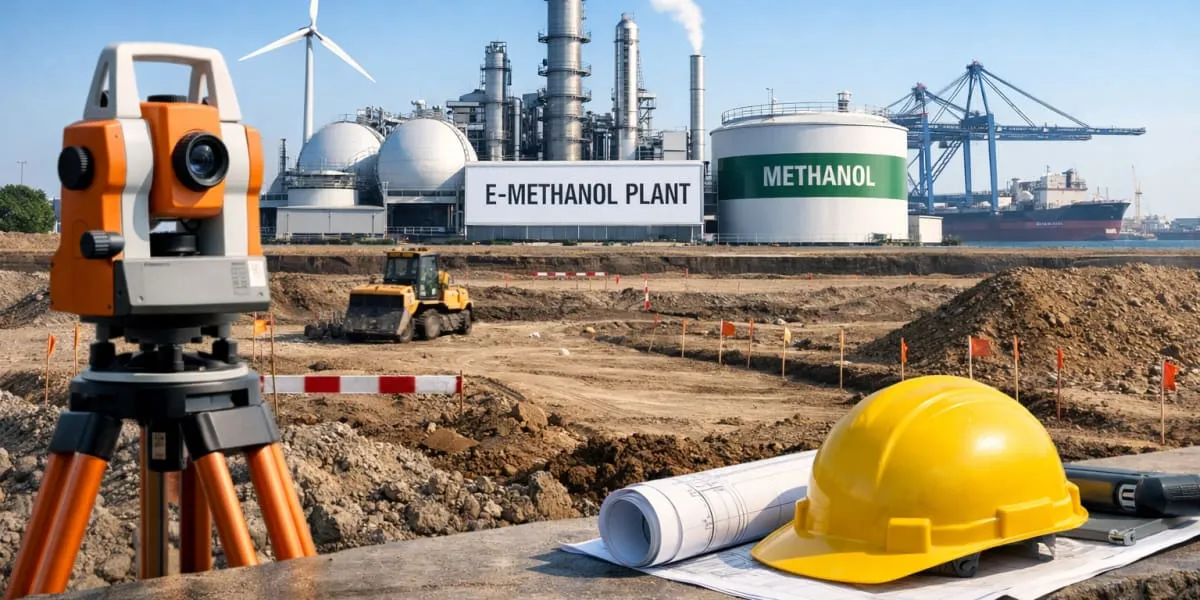
Deendayal Port Authority will commence site work for India’s first 150 tonne (t) per day e-methanol plant at its Kandla facility, the authority announced. The project was described as a landmark for port-led industrial development and for the country’s clean fuel agenda. The plant capacity of 150 t per day positions it as a small-scale demonstration facility intended to validate technologies and operational models. Preparatory surveys and ground clearance are expected to be the immediate focus.

The release associated the initiative with broader efforts to promote alternative fuels and listed Assam Petrochemicals among topical references, indicating industrial interest. The plant will link to existing port logistics and may leverage maritime infrastructure for feedstock and product movement. Site selection at Kandla is expected to benefit from established connectivity and storage facilities, which could reduce initial handling complexity. Environmental permits and safety assessments will form part of the preliminary approvals.

The development was framed as a strategic step for decarbonisation in hard-to-abate sectors and as part of pilot projects that demonstrate e-fuel viability at scale. E-methanol is anticipated to serve as a lower-emission fuel option for shipping and industry, supporting long-term energy transition planning. The demonstration will provide data on production costs, logistics and integration with renewable feedstock, which will inform potential scale-up decisions. Stakeholders are expected to monitor performance metrics closely.

Deendayal Port Authority will oversee the site works and coordinate with regulatory bodies and commercial partners to advance the project to detailed engineering stages. The announcement indicated that further technical and commercial details will be released as the preparatory phase concludes. Observers noted that successful demonstration could catalyse further investments in e-fuels and support India’s clean energy objectives. The port envisages the facility as a step towards integrating novel fuel technologies into its industrial ecosystem.

Deendayal Port Authority will commence site work for India’s first 150 tonne (t) per day e-methanol plant at its Kandla facility, the authority announced. The project was described as a landmark for port-led industrial development and for the country’s clean fuel agenda. The plant capacity of 150 t per day positions it as a small-scale demonstration facility intended to validate technologies and operational models. Preparatory surveys and ground clearance are expected to be the immediate focus. The release associated the initiative with broader efforts to promote alternative fuels and listed Assam Petrochemicals among topical references, indicating industrial interest. The plant will link to existing port logistics and may leverage maritime infrastructure for feedstock and product movement. Site selection at Kandla is expected to benefit from established connectivity and storage facilities, which could reduce initial handling complexity. Environmental permits and safety assessments will form part of the preliminary approvals. The development was framed as a strategic step for decarbonisation in hard-to-abate sectors and as part of pilot projects that demonstrate e-fuel viability at scale. E-methanol is anticipated to serve as a lower-emission fuel option for shipping and industry, supporting long-term energy transition planning. The demonstration will provide data on production costs, logistics and integration with renewable feedstock, which will inform potential scale-up decisions. Stakeholders are expected to monitor performance metrics closely. Deendayal Port Authority will oversee the site works and coordinate with regulatory bodies and commercial partners to advance the project to detailed engineering stages. The announcement indicated that further technical and commercial details will be released as the preparatory phase concludes. Observers noted that successful demonstration could catalyse further investments in e-fuels and support India’s clean energy objectives. The port envisages the facility as a step towards integrating novel fuel technologies into its industrial ecosystem.

Next Story
Infrastructure Transport

Sector 51-52 Metro skywalk in Noida remains shut despite being ready for over a year

Thousands of commuters travelling between Delhi Metro Rail Corporation’s (DMRC) Sector 52 station and Noida Metro Rail Corporation’s (NMRC) Sector 51 station continue to face daily inconvenience as the 300-metre air-conditioned skywalk connecting the two stations remains closed, despite being completed over a year ago, according to a report.The Noida Metro Rail Corporation built the foot overbridge to enable a seamless interchange between the Delhi Metro and Noida Metro networks. However, pending finishing work and a structural obstruction have delayed its opening.Krishna Karunesh, Chief E..

Next Story
Infrastructure Transport

Maharashtra clears Metro Line 5A, expansion of Mumbai Metro Line 5

The Maharashtra government has approved the expansion of Mumbai Metro Line 5 along with a new integrated corridor, Metro Line 5A, forming a combined 34.2-km metro network across the Thane-Bhiwandi-Kalyan-Ulhasnagar belt. The integrated project has been cleared at an estimated cost of ₹18,130.55 crore, according to a government resolution (GR).Metro Line 5 was originally approved in October 2017 as a 24.9-km fully elevated corridor with 17 stations connecting Thane, Bhiwandi and Kalyan, with an initial project cost of ₹8,416.51 crore. The corridor is being developed in two phases.The first ..

Next Story
Infrastructure Transport

Bengaluru Metro expansion seen driving office demand

Bengaluru’s expanding metro network is expected to emerge as a major catalyst for real estate growth, with the Yellow and Pink Lines likely to boost both office demand and residential prices across key micro-markets, according to a report by Colliers India.The report estimates that over the next two years, Bengaluru could witness an additional 5–7 million sq ft of Grade A office space demand across the Central Business District (CBD), Secondary Business District (SBD) and Electronic City. Improved metro connectivity and reduced commute times are expected to drive higher occupier interest a..

Advertisement

Subscribe to Our Newsletter

Get daily newsletters around different themes from Construction world.

STAY CONNECTED

Advertisement

Advertisement

Advertisement