Dugarajapatnam Cleared For Rs 292.53 bn Shipbuilding Cluster
PORTS & SHIPPING

Dugarajapatnam Cleared For Rs 292.53 bn Shipbuilding Cluster

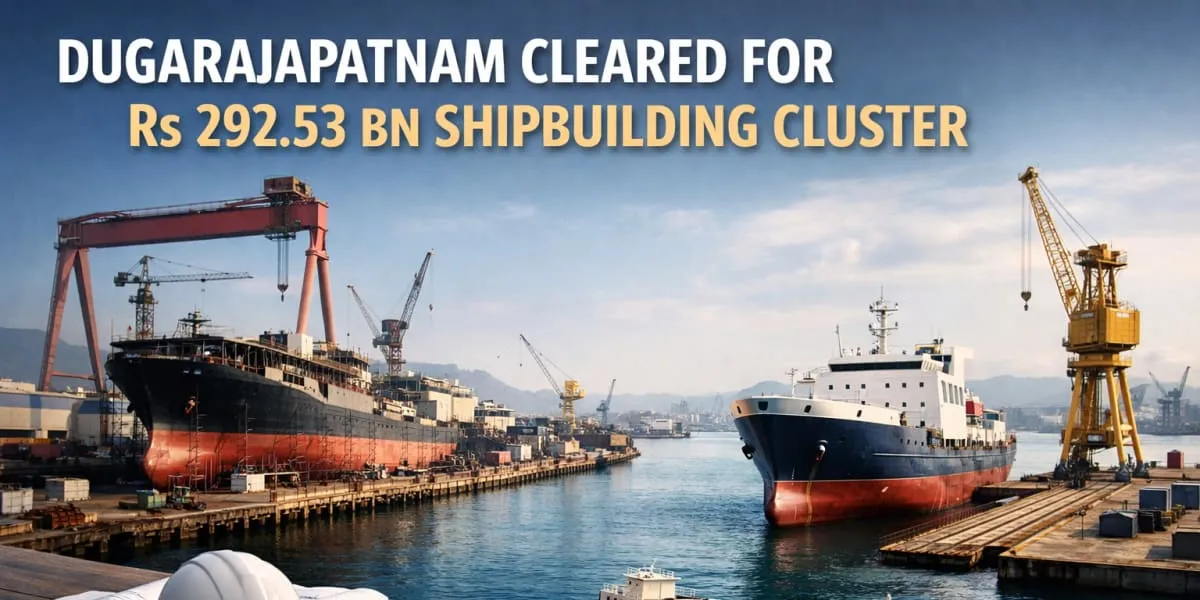
The Andhra Pradesh government and the Visakhapatnam Port Authority (VPA) have cleared Dugarajapatnam for development as a mega shipbuilding cluster through a newly formed special purpose vehicle (SPV). The project has been authorised at an estimated cost of Rs 292.53 bn and is intended to create a concentrated industrial hub for ship construction and repair. The SPV will coordinate land assembly, infrastructure delivery and investment promotion on behalf of the partners.

Dugarajapatnam is positioned to leverage coastal access and existing port connectivity to support large scale dry docks, fabrication yards and ancillary services. Observers expect the cluster model to encourage shipbuilders, equipment suppliers and logistics providers to co locate, creating economies of scale. Planning documents indicate a focus on integrated utilities, road and rail links and environmental safeguards to support maritime industrial activity.

Proponents argue the initiative could strengthen domestic shipbuilding capacity, reduce dependence on foreign yards and integrate with broader port led industrialisation ambitions. The SPV structure is intended to streamline decision making, attract long term capital and enable phased development aligned with market demand. Authorities are expected to engage with private partners and offer incentives to accelerate the establishment of manufacturing clusters.

Environmental assessments and detailed master planning will determine the precise footprint and staging of construction, with regulatory clearances required before major works commence. The project is likely to be positioned within national manufacturing and maritime growth strategies to leverage policy support. Stakeholders said the development aims to create a coastal manufacturing node that supports shipbuilding competitiveness and regional economic growth.

Implementation will require collaboration between government agencies, port authorities and industry to build skilled labour pipelines and local supplier networks. Training programmes and technical institutions may be linked to the cluster to ensure availability of specialised skills and support long term productivity gains. Over time the cluster is expected to enhance export potential for built and repaired vessels while anchoring related maritime services.

The Andhra Pradesh government and the Visakhapatnam Port Authority (VPA) have cleared Dugarajapatnam for development as a mega shipbuilding cluster through a newly formed special purpose vehicle (SPV). The project has been authorised at an estimated cost of Rs 292.53 bn and is intended to create a concentrated industrial hub for ship construction and repair. The SPV will coordinate land assembly, infrastructure delivery and investment promotion on behalf of the partners. Dugarajapatnam is positioned to leverage coastal access and existing port connectivity to support large scale dry docks, fabrication yards and ancillary services. Observers expect the cluster model to encourage shipbuilders, equipment suppliers and logistics providers to co locate, creating economies of scale. Planning documents indicate a focus on integrated utilities, road and rail links and environmental safeguards to support maritime industrial activity. Proponents argue the initiative could strengthen domestic shipbuilding capacity, reduce dependence on foreign yards and integrate with broader port led industrialisation ambitions. The SPV structure is intended to streamline decision making, attract long term capital and enable phased development aligned with market demand. Authorities are expected to engage with private partners and offer incentives to accelerate the establishment of manufacturing clusters. Environmental assessments and detailed master planning will determine the precise footprint and staging of construction, with regulatory clearances required before major works commence. The project is likely to be positioned within national manufacturing and maritime growth strategies to leverage policy support. Stakeholders said the development aims to create a coastal manufacturing node that supports shipbuilding competitiveness and regional economic growth. Implementation will require collaboration between government agencies, port authorities and industry to build skilled labour pipelines and local supplier networks. Training programmes and technical institutions may be linked to the cluster to ensure availability of specialised skills and support long term productivity gains. Over time the cluster is expected to enhance export potential for built and repaired vessels while anchoring related maritime services.

Next Story
Infrastructure Urban

UniAcoustic, Vicoustic Form UniVicoustic Alliance

UniAcoustic, part of United Group, has acquired a strategic stake in Portugal-based Vicoustic, forming a new alliance branded as UniVicoustic. The agreement, signed in Mumbai, marks a significant cross-border partnership aligned with evolving India–EU trade dynamics.The collaboration brings together Vicoustic’s global expertise in architectural acoustic products with UniAcoustic’s manufacturing scale and distribution capabilities. The combined platform aims to expand market reach, integrate technology and optimise supply chains across key regions.The development comes amid progress in th..

Next Story
Infrastructure Urban

Dalmia Bharat, Delhi PWD Revamp Under-Flyover Spaces

Dalmia Bharat has partnered with the Public Works Department (PWD), Government of Delhi, to redevelop select under-flyover spaces and a road stretch into sustainable urban hubs. The agreement covers key locations including Lodhi Flyover, Oberoi Flyover, Mangi Bridge and Hanuman Setu.Under the initiative, the company will undertake design, landscaping, plantation and long-term maintenance of the sites, with a defined upkeep period of three years after completion. The project aims to improve urban aesthetics while promoting environmental sustainability and biodiversity restoration in high-densit..

Next Story
Infrastructure Urban

Versigent Debuts as Independent NYSE-Listed Company

Versigent has launched as an independent publicly traded company following its separation from Aptiv, with shares commencing trading on the New York Stock Exchange under the ticker “VGNT”. The move marks a significant milestone in the company’s transition into a standalone global player in power distribution systems.The company specialises in the design, manufacturing and delivery of low- and high-voltage electrical architectures, supported by engineering centres across four continents and manufacturing operations in over 25 countries.Versigent reported revenues of $8.8 billion, net inco..

Advertisement

Subscribe to Our Newsletter

Get daily newsletters around different themes from Construction world.

STAY CONNECTED

Advertisement

Advertisement

Advertisement