Chief of Integrated Defence Staff Addresses 81st Staff Course
DEFENSE

Chief of Integrated Defence Staff Addresses 81st Staff Course

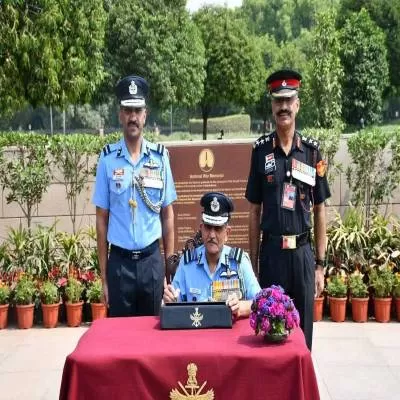
Chief of Integrated Defence Staff (CISC) Air Marshal Ashutosh Dixit visited the Defence Services Staff College (DSSC) Wellington between 22nd and 24th March 2026 and engaged with faculty and participants. He addressed student officers of the Indian Defence Forces and officers from friendly foreign countries attending the 81st Staff Course, outlining the purpose of his visit and the college's role in professional development. The visit included interaction with the permanent staff and observation of ongoing academic and practical training activities across departments.

In his address, the CISC explained the evolving character of warfare and the imperative for military leaders to adapt to technological, doctrinal and strategic shifts, urging a mindset oriented to flexibility and learning. He emphasised the strategic challenges confronting India and set out the need for enhanced jointness and inter service synergy to respond effectively to complex security dynamics. The remarks highlighted the interplay of doctrine, capability development and institutional reform as essential to meet future contingencies.

The CISC elaborated on transformative reforms undertaken across the Indian military in response to emerging threats and operational requirements, noting that change must be sustained through rigorous training and education. He received a detailed briefing from the Commandant of the DSSC on the ongoing training activities, curricula updates and the integration of multinational perspectives into course modules. The account of training practices and institutional priorities underlined the college's adaptation to contemporary requirements and its contribution to cultivating staff competence.

He commended the DSSC for its pivotal role in shaping future military leaders and underlined the significance of sustained professional military education in enhancing operational preparedness and informed decision making. The visit was presented as reinforcing the bonds between the Integrated Defence Staff and the staff college while signalling continued emphasis on jointness, interoperability and institutional excellence. The engagement concluded with acknowledgement of the collaborative effort required to translate strategic intent into capability and readiness.

Chief of Integrated Defence Staff (CISC) Air Marshal Ashutosh Dixit visited the Defence Services Staff College (DSSC) Wellington between 22nd and 24th March 2026 and engaged with faculty and participants. He addressed student officers of the Indian Defence Forces and officers from friendly foreign countries attending the 81st Staff Course, outlining the purpose of his visit and the college's role in professional development. The visit included interaction with the permanent staff and observation of ongoing academic and practical training activities across departments. In his address, the CISC explained the evolving character of warfare and the imperative for military leaders to adapt to technological, doctrinal and strategic shifts, urging a mindset oriented to flexibility and learning. He emphasised the strategic challenges confronting India and set out the need for enhanced jointness and inter service synergy to respond effectively to complex security dynamics. The remarks highlighted the interplay of doctrine, capability development and institutional reform as essential to meet future contingencies. The CISC elaborated on transformative reforms undertaken across the Indian military in response to emerging threats and operational requirements, noting that change must be sustained through rigorous training and education. He received a detailed briefing from the Commandant of the DSSC on the ongoing training activities, curricula updates and the integration of multinational perspectives into course modules. The account of training practices and institutional priorities underlined the college's adaptation to contemporary requirements and its contribution to cultivating staff competence. He commended the DSSC for its pivotal role in shaping future military leaders and underlined the significance of sustained professional military education in enhancing operational preparedness and informed decision making. The visit was presented as reinforcing the bonds between the Integrated Defence Staff and the staff college while signalling continued emphasis on jointness, interoperability and institutional excellence. The engagement concluded with acknowledgement of the collaborative effort required to translate strategic intent into capability and readiness.

Next Story
Technology

AI-Enabled Workflows Lift Profitability and Productivity

Organisations modernising frontline workflows with artificial intelligence, automation and real-time data are reporting stronger financial performance, higher productivity and improved employee engagement, according to a global study by Zebra Technologies and Oxford Economics.The research covered 1,000 senior leaders across retail, manufacturing, transportation and logistics in the US, Mexico, the UK, Germany, India, Japan, Australia and New Zealand.In transportation and logistics, 54 per cent of companies that improved picking and packing operations reported faster operational performance, wh..

Next Story
Real Estate

India Leads Global AI Readiness but Implementation Lags

Indian companies lead global averages across all eight artificial intelligence readiness indicators tracked by JLL, but only 19 per cent have started making changes to their workplaces, according to the JLL 2026 Future of Work Survey.The study found that 77 per cent of Indian business leaders expect AI to change their office requirements, creating a 58-percentage-point gap between awareness and implementation. The survey covered more than 2,200 CEOs, CFOs and real estate leaders across 21 countries during the first quarter of 2026.Despite concerns over automation, 58 per cent of Indian leaders..

Next Story
Equipment

Three WOLFF Cranes Build Riyadh Cable-Stayed Bridges

Three WOLFF 180 B luffing jib cranes are supporting the construction of two cable-stayed bridges alongside the existing Wadi Laban Bridge in Riyadh, Saudi Arabia. The project is being developed for the Royal Commission for Riyadh City and executed by the ICRC joint venture comprising IC Ictas and Al Rashid Trading & Contracting Company.The cranes are handling lifting operations including formwork, reinforcement, concrete placement, work platforms, surveying equipment and other construction materials. Each crane is fitted with a 40 m jib, reaches a hook height of 157 m and offers a maximum ..

Advertisement

Subscribe to Our Newsletter

Get daily newsletters around different themes from Construction world.

STAY CONNECTED

Advertisement

Advertisement

Advertisement