+
PM Modi asks gram panchayats to have local revenue model
SMART CITIES

PM Modi asks gram panchayats to have local revenue model

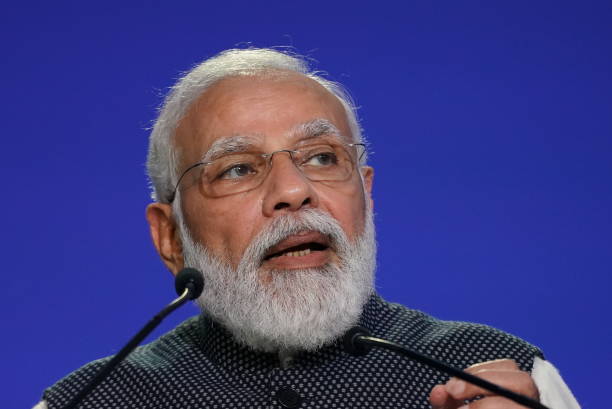
Prime Minister Narendra Modi urges gram panchayats of Indian villages to have a local revenue model and also stresses the waste management system.

On Sunday, PM during his visit to India's first carbon-neutral village Palli in Jammu & Kashmir highlighted the significance of developing villages of the nation by providing them with various ways of generating income via local resources. He further threw light on different measures like waste management that could help develop a village.

PM Modi said that unique initiatives and methods should be developed to financially use the resources of the villages to develop ways of getting funds and income.

Every Indian village can equip itself with indigenous methods to generate income using natural resources and raw materials with adequate innovation and determination, said PM Modi.

PM mentioned measures and schemes like Kachre se Kanchan (Waste to Wealth), building Biogas plants, Gobar Dhan Yojana, doing Organic Farming, and making organic pesticides and fertilisers.

He said that with the administration's support if Panchayats could set up small plants and units for the previous schemes, it would help them increase their revenue multifold.

The Prime Minister also highlighted that waste management is very critical and encouraged villagers to partner with NGOs and other non-profit organisations to formulate ways to create such channels to make the best out of waste. He also propagated the practice of separating dry and wet waste at homes.

During his Jammu and Kashmir visit, PM Modi also flagged off several developmental projects worth over Rs 20,000 crores.

He laid the foundation stone of the Delhi-Amritsar-Katra Expressway and inaugurated the Solar Power Plant of 500 KW at Palli village along with 108 Jan Aushadhi Kendras, in Samba district.

With the inauguration of a 500 KW solar power plant at Palli, the Samba District is moving towards becoming India’s first panchayat to become carbon neutral.

The Prime Minister was accompanied by top business leaders from the UAE on his visit to the Union Territory, highlighting the backing of industrialists and investors as the BJP government strives to pitch a new phase for J&K, after the revocation of Article 370. UAE firms are likely to propose investments of over Rs 3,000 crore.

Image Source

Also read: Palli in J&K becomes India's first carbon-neutral solar panchayat

Prime Minister Narendra Modi urges gram panchayats of Indian villages to have a local revenue model and also stresses the waste management system. On Sunday, PM during his visit to India's first carbon-neutral village Palli in Jammu & Kashmir highlighted the significance of developing villages of the nation by providing them with various ways of generating income via local resources. He further threw light on different measures like waste management that could help develop a village. PM Modi said that unique initiatives and methods should be developed to financially use the resources of the villages to develop ways of getting funds and income. Every Indian village can equip itself with indigenous methods to generate income using natural resources and raw materials with adequate innovation and determination, said PM Modi. PM mentioned measures and schemes like Kachre se Kanchan (Waste to Wealth), building Biogas plants, Gobar Dhan Yojana, doing Organic Farming, and making organic pesticides and fertilisers. He said that with the administration's support if Panchayats could set up small plants and units for the previous schemes, it would help them increase their revenue multifold. The Prime Minister also highlighted that waste management is very critical and encouraged villagers to partner with NGOs and other non-profit organisations to formulate ways to create such channels to make the best out of waste. He also propagated the practice of separating dry and wet waste at homes. During his Jammu and Kashmir visit, PM Modi also flagged off several developmental projects worth over Rs 20,000 crores. He laid the foundation stone of the Delhi-Amritsar-Katra Expressway and inaugurated the Solar Power Plant of 500 KW at Palli village along with 108 Jan Aushadhi Kendras, in Samba district. With the inauguration of a 500 KW solar power plant at Palli, the Samba District is moving towards becoming India’s first panchayat to become carbon neutral. The Prime Minister was accompanied by top business leaders from the UAE on his visit to the Union Territory, highlighting the backing of industrialists and investors as the BJP government strives to pitch a new phase for J&K, after the revocation of Article 370. UAE firms are likely to propose investments of over Rs 3,000 crore. Image Source Also read: Palli in J&K becomes India's first carbon-neutral solar panchayat

Related Stories

Gold Stories

Next Story
Infrastructure Urban

KONE Opens India's First Digital Experience Centre in Pune

KONE, a global elevator and escalator manufacturer, has inaugurated its first Digital Experience Centre (DEC) in India, located in Pune. The facility aims to showcase how artificial intelligence (AI), connectivity and data-driven technologies can enhance customer experiences and improve building operations.The centre was inaugurated by Jussi Herlin, Executive Vice Chair, KONE Corporation; Philippe Delorme, President and CEO, KONE; and Nandan Nilekani, Co-founder and Chairman of the Board, Infosys.Designed as an interactive customer environment, the facility demonstrates digital solutions cover..

Next Story
Infrastructure Urban

CII GreenCo Launches Circularity Guidelines for Indian Industry

The Confederation of Indian Industry (CII) GreenCo Council has launched the CII GreenCo Circularity Guidelines – Pilot Version at the 17th CII GreenCo Waste & Resource Management Summit 2026 in Chennai. The initiative aims to strengthen resource efficiency, waste reduction and circular economy practices across Indian manufacturing and process industries.The guidelines introduce a structured framework with circularity indices covering raw materials, consumables, packaging and other resource inputs. These indicators will help industries assess existing practices, identify opportunities to ..

Next Story
Infrastructure Energy

Global Electronics Association Launches IPC-1783-CO2E Standard

The Global Electronics Association has introduced IPC-1783-CO2E, a new international standard aimed at improving consistency, transparency and comparability in product carbon footprint reporting across the electronics manufacturing industry.The standard, titled International Standard for Data Collection and Reporting of CO2 Equivalent (CO2e) Emissions for the Electronics Manufacturing Supply Chain, provides industry-specific guidance for collecting, estimating and reporting carbon emissions data.With increasing regulatory requirements and customer expectations, electronics manufacturers face c..

Advertisement

Subscribe to Our Newsletter

Get daily newsletters around different themes from Construction world.

STAY CONNECTED

Advertisement

SPECIAL OFFER
QR Code