GST Reforms Make Waste Management And Green Mobility Affordable
WATER & WASTE

GST Reforms Make Waste Management And Green Mobility Affordable

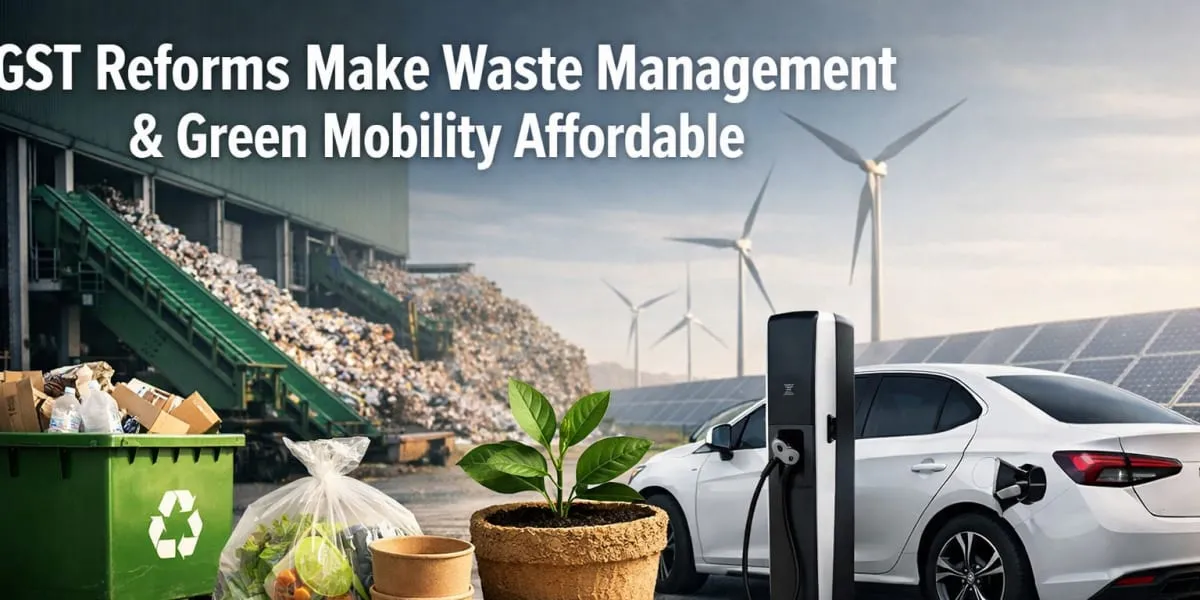
The government has enacted goods and services tax reforms to make waste management, biodegradable products and green mobility more affordable across India. The changes are intended to accelerate eco friendly manufacturing, strengthen waste treatment infrastructure and promote sustainable mobility in alignment with Viksit Bharat 2047, the LiFE movement and India’s Net Zero 2070 commitments. The measures aim to lower upfront costs for industry and urban operators while encouraging circular economy practices.

The reduction in GST from 12 per cent to five per cent for services to common effluent treatment plants (CETPs) is aimed at making collective industrial wastewater treatment more attractive to small and medium enterprises. There are 222 operational CETPs treating 2,212 million litres per day across 21 states and the tax change is estimated to save industry about Rs132.7 mn per day. 53 plants are implementing zero liquid discharge systems, supporting reuse of treated wastewater and reduced freshwater dependency.

GST on biodegradable carry bags has been cut from 18 per cent to five per cent to reinforce the ban on identified single use plastics and make compostable alternatives more affordable. The sale price of compostable bags is expected to fall from Rs200/kg to Rs178/kg, a drop of approximately 11 per cent, which should help over 200 certified manufacturers scale production of starch based materials. Lower prices are expected to support coastal and riverine clean up efforts by reducing plastic leakage into marine ecosystems.

The cut in GST from 28 per cent to 18 per cent for buses and commercial goods vehicles is intended to encourage fleet modernisation and replacement of older vehicles with Bharat Stage VI compliant models that are up to 10 times cleaner. Reduced acquisition costs are expected to enable deployment of more buses by public and private operators, improve last mile and intercity connectivity and lower logistics costs for businesses. Collectively, the reforms are presented as reinforcing India’s role in the global response to climate change by lowering barriers to sustainable industry practices and cleaner urban transport.

The government has enacted goods and services tax reforms to make waste management, biodegradable products and green mobility more affordable across India. The changes are intended to accelerate eco friendly manufacturing, strengthen waste treatment infrastructure and promote sustainable mobility in alignment with Viksit Bharat 2047, the LiFE movement and India’s Net Zero 2070 commitments. The measures aim to lower upfront costs for industry and urban operators while encouraging circular economy practices. The reduction in GST from 12 per cent to five per cent for services to common effluent treatment plants (CETPs) is aimed at making collective industrial wastewater treatment more attractive to small and medium enterprises. There are 222 operational CETPs treating 2,212 million litres per day across 21 states and the tax change is estimated to save industry about Rs132.7 mn per day. 53 plants are implementing zero liquid discharge systems, supporting reuse of treated wastewater and reduced freshwater dependency. GST on biodegradable carry bags has been cut from 18 per cent to five per cent to reinforce the ban on identified single use plastics and make compostable alternatives more affordable. The sale price of compostable bags is expected to fall from Rs200/kg to Rs178/kg, a drop of approximately 11 per cent, which should help over 200 certified manufacturers scale production of starch based materials. Lower prices are expected to support coastal and riverine clean up efforts by reducing plastic leakage into marine ecosystems. The cut in GST from 28 per cent to 18 per cent for buses and commercial goods vehicles is intended to encourage fleet modernisation and replacement of older vehicles with Bharat Stage VI compliant models that are up to 10 times cleaner. Reduced acquisition costs are expected to enable deployment of more buses by public and private operators, improve last mile and intercity connectivity and lower logistics costs for businesses. Collectively, the reforms are presented as reinforcing India’s role in the global response to climate change by lowering barriers to sustainable industry practices and cleaner urban transport.

Next Story
Building Material

Haver & Boecker Niagara to showcase solutions at Hillhead

Haver & Boecker Niagara will showcase its mineral processing technologies at Hillhead 2026, scheduled from June 23–25 in Buxton, UK.At Stand PA3, the company will present its end-to-end solutions including screeners, screen media and advanced diagnostics, with a focus on improving efficiency, uptime and throughput for aggregates producers.Highlighting its screen media portfolio, the company will feature Ty-Wire media with hybrid design offering up to 80 per cent more open area, alongside FLEX-MAT® solutions designed to enhance wear life and throughput while reducing blinding and cloggin..

Next Story
Real Estate

CREDAI-MCHI meets Maharashtra Revenue Minister on issues

Navin’s, a Chennai-based real estate developer, has won the 17th CIDC Vishwakarma Award 2026 for its residential project Navin’s Hanging Gardens located on Arcot Road, Valasaravakkam. The award was presented by the Construction Industry Development Council (CIDC) under the category of Best Construction Projects, recognising the development’s achievement in innovation, design excellence and sustainability.The award was received by Chandrasekar PN, General Manager, Technical, Navin’s, at the ceremony held in New Delhi.Inspired by the legendary Hanging Gardens of Babylon, the project has ..

Next Story
Real Estate

Suraj Estate Developers Acquires Dadar Land For 1 bn GDV Project

Suraj Estate Developers Limited (the Company) has acquired a plot in G/North ward, Dadar (West), for an initial acquisition consideration of Rs 85.3 mn and a total acquisition cost of about Rs 180 mn on the basis of acquisition cost plus stamp duty market value and related stamp duty. The site is in a well established micro-market in South-Central Mumbai characterised by strong demand fundamentals, connectivity and proximity to commercial districts including Lower Parel, Worli and Bandra Kurla Complex. The Company has indicated that the land will be redeveloped to augment its project pipeline ..

Advertisement

Subscribe to Our Newsletter

Get daily newsletters around different themes from Construction world.

STAY CONNECTED

Advertisement

Advertisement

Advertisement