
+
Implementation Status of Jal Jeevan Mission
WATER & WASTE

Implementation Status of Jal Jeevan Mission

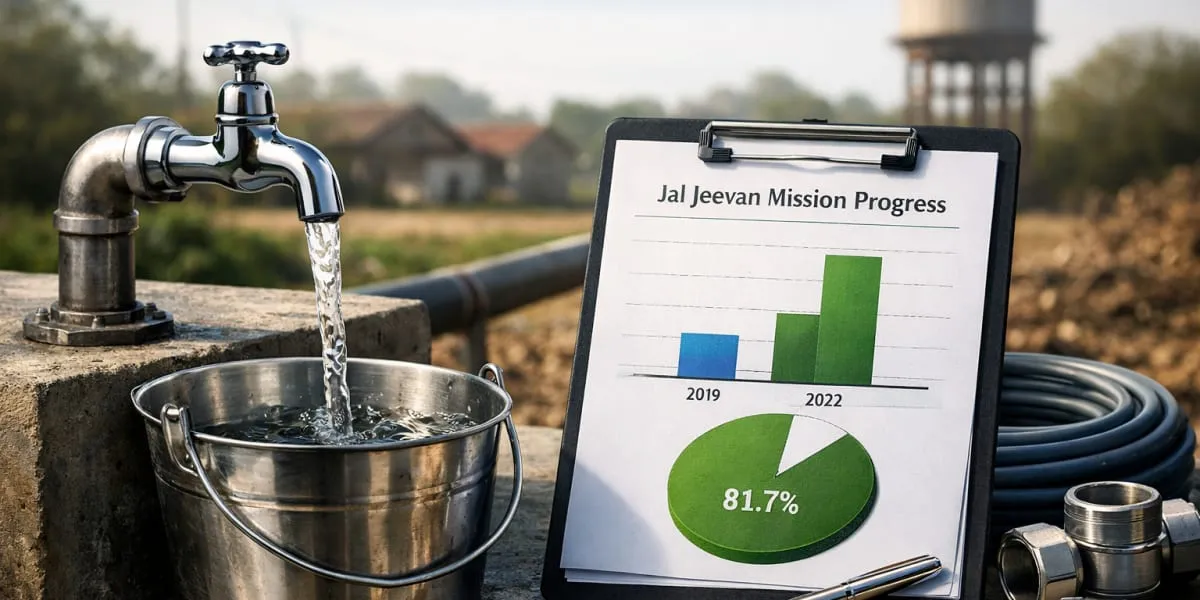
Since August 2019 the Government has implemented Jal Jeevan Mission to provide assured potable water through household tap connections in rural India. At the start of the mission only 32.3 million (mn) rural households, representing 16.7 per cent, were reported to have tap water connections. States and union territories have reported that 125.8 mn additional rural households have since been provided with tap connections. As a result, of about 193.6 mn rural households roughly 158.2 mn, or 81.71 per cent, are reported to have tap water supply at home.\n\nThe State, district and village level status of tap water connections is publicly available on the Jal Jeevan Mission dashboard. The data are published to enable transparency and to support monitoring of progress at local level.\n\nStates have identified challenges such as scarce dependable water sources in stressed areas, geogenic contamination, difficult terrain and scattered habitations, along with limited technical capacity and rising material costs. To address these challenges the Government introduced measures including Special Assistance for Capital Expenditure, appointment of nodal officers for faster clearances and the setting up of State Project Management Units and District Project Management Units. The Nal Jal Mitra initiative and the Jal Shakti Abhiyan Catch the Rain campaign have been promoted to strengthen local technical skills and support source sustainability.\n\nAn independent functionality assessment conducted in 2024 found high coverage in surveyed villages with 98.1 per cent of households having tap connections. The assessment reported that 87 per cent of households with connections received water in the past week and 84 per cent received water as per schedule. It found that 80 per cent of households received the minimum 55 litres per capita per day and that 76 per cent of households were free from bacteriological contamination while 81 per cent of supply sources were free from chemical contamination. Considering quantity, quality and regularity, 76 per cent of household tap connections were found to be functional.

Since August 2019 the Government has implemented Jal Jeevan Mission to provide assured potable water through household tap connections in rural India. At the start of the mission only 32.3 million (mn) rural households, representing 16.7 per cent, were reported to have tap water connections. States and union territories have reported that 125.8 mn additional rural households have since been provided with tap connections. As a result, of about 193.6 mn rural households roughly 158.2 mn, or 81.71 per cent, are reported to have tap water supply at home.\n\nThe State, district and village level status of tap water connections is publicly available on the Jal Jeevan Mission dashboard. The data are published to enable transparency and to support monitoring of progress at local level.\n\nStates have identified challenges such as scarce dependable water sources in stressed areas, geogenic contamination, difficult terrain and scattered habitations, along with limited technical capacity and rising material costs. To address these challenges the Government introduced measures including Special Assistance for Capital Expenditure, appointment of nodal officers for faster clearances and the setting up of State Project Management Units and District Project Management Units. The Nal Jal Mitra initiative and the Jal Shakti Abhiyan Catch the Rain campaign have been promoted to strengthen local technical skills and support source sustainability.\n\nAn independent functionality assessment conducted in 2024 found high coverage in surveyed villages with 98.1 per cent of households having tap connections. The assessment reported that 87 per cent of households with connections received water in the past week and 84 per cent received water as per schedule. It found that 80 per cent of households received the minimum 55 litres per capita per day and that 76 per cent of households were free from bacteriological contamination while 81 per cent of supply sources were free from chemical contamination. Considering quantity, quality and regularity, 76 per cent of household tap connections were found to be functional.

Next Story
Infrastructure Urban

Jal Jeevan Mission Reaches Eighty One Per Cent Rural Coverage

The Government reported substantial progress under the Jal Jeevan Mission, launched in August 2019 to provide tap water to every rural household. At launch only 32.3 million (mn) rural households had tap connections and states and Union territories reported provision of 125.8 mn additional households by March 2026. Consequently, out of about 193.6 mn rural households around 158.2 mn, or 81.71 per cent, are reported to have tap water at home. The Finance Minister announced extension of the mission until 2028 in the 2025-26 budget speech. The Swachh Bharat Mission Grameen, launched in October 20..

Next Story
Infrastructure Urban

Empowering Local Governance for Sustainable Rural Water Supply

The Ministry of Jal Shakti has aligned the Jal Jeevan Mission (JJM) with the 73rd Amendment to strengthen village level planning and community ownership of water supply. Gram Panchayats, village water and sanitation committees and Pani Samitis are to plan, implement, manage and maintain piped water systems, with gram sabha processes formalising handover and oversight. Implementation support agencies including non government organisations, community based organisations and self help groups have been empanelled to train local committees and promote women participation. Under JJM, the department ..

Next Story
Infrastructure Urban

PDUNASS Sets Strategic Vision for EPFO Training

The Pandit Deendayal Upadhyaya National Academy of Social Security (PDUNASS), the apex training institute of the Employees' Provident Fund Organisation (EPFO), inaugurated a high-level five-day training programme on exemption management, legal framework and valuation of securities, running from nine to 13 March 2026. The session was opened by Shri Kumar Rohit, Director, PDUNASS, who outlined the critical importance of specialised training in the modern social security landscape and the need to strengthen regulatory and financial oversight across regions. He emphasised that regulation of exempt..

Advertisement

Subscribe to Our Newsletter

Get daily newsletters around different themes from Construction world.

STAY CONNECTED

Advertisement

Advertisement

Advertisement