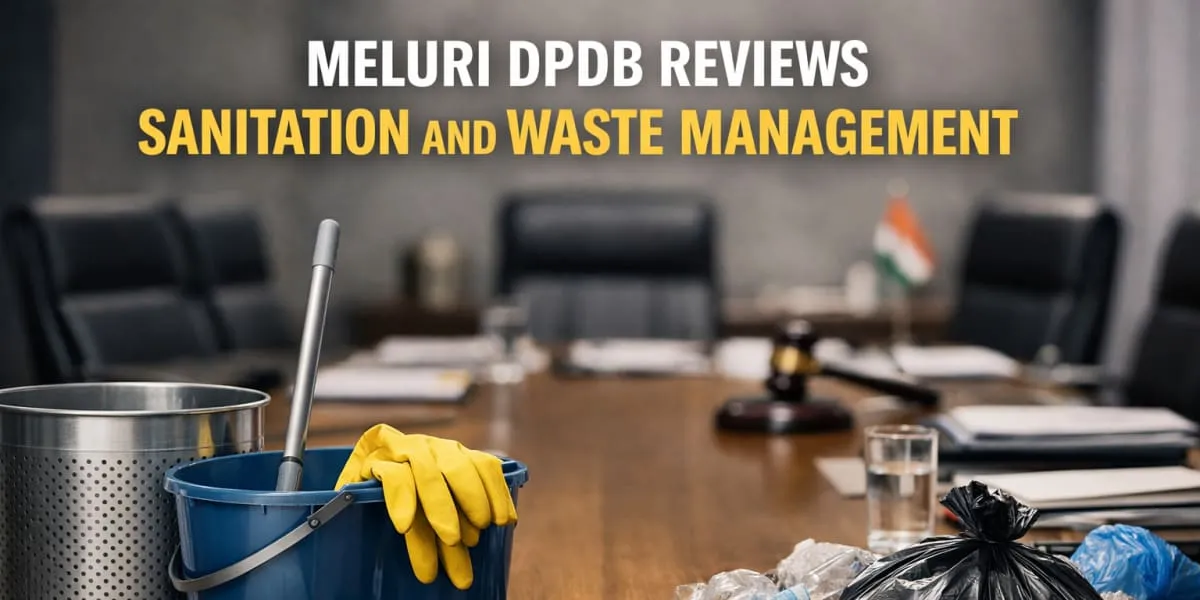



Meluri DPDB Reviews Sanitation And Waste Management
WATER & WASTE

Meluri DPDB Reviews Sanitation And Waste Management

The District Planning and Development Board (DPDB) of Meluri District met at the DB's Court in the Deputy Commissioner's office, Meluri, on 25 August under the chairmanship of Deputy Commissioner Phuleshe K. Yepthomi, NCS. The meeting reviewed the minutes of the previous DPDB session and considered a range of developmental and administrative matters affecting the district. Officials from several departments attended to present updates and proposals for ongoing works.

Sanitation and waste management formed a principal agenda item with particular attention to the segregation and proper disposal of single-use plastics and plastic bottles. The Deputy Commissioner highlighted adherence to newly issued government guidelines on sanitation management across the four categories and stressed coordinated action to ensure effective implementation. Departments were urged to strengthen local systems for collection, segregation and disposal to maintain cleanliness in public spaces.

Participants discussed a proposal for scheduled monthly visits by different departments to Government Higher Secondary Schools across Meluri District so that each department may interact with students and explain its activities, programmes and services. The initiative was presented as a means to raise awareness among young people about public service functions and available schemes. The Deputy Commissioner called for enhanced inter-departmental coordination and collective effort to advance the district's development agenda.

A PowerPoint presentation by the Sub-Divisional Officer, Public Works Department (Roads and Buildings) (SDO, PWD (R&B)), Khontsa Perry, outlined recent works and achievements of the department and its priorities. The meeting concluded with a reaffirmation of commitments to sustainability and effective delivery of government programmes, and departments were directed to follow up on actions and report progress at the next DPDB meeting. Officials were asked to submit detailed action plans and timelines to the Deputy Commissioner ahead of the next meeting. This will help monitor implementation effectively and address bottlenecks promptly and urgently.

The District Planning and Development Board (DPDB) of Meluri District met at the DB's Court in the Deputy Commissioner's office, Meluri, on 25 August under the chairmanship of Deputy Commissioner Phuleshe K. Yepthomi, NCS. The meeting reviewed the minutes of the previous DPDB session and considered a range of developmental and administrative matters affecting the district. Officials from several departments attended to present updates and proposals for ongoing works. Sanitation and waste management formed a principal agenda item with particular attention to the segregation and proper disposal of single-use plastics and plastic bottles. The Deputy Commissioner highlighted adherence to newly issued government guidelines on sanitation management across the four categories and stressed coordinated action to ensure effective implementation. Departments were urged to strengthen local systems for collection, segregation and disposal to maintain cleanliness in public spaces. Participants discussed a proposal for scheduled monthly visits by different departments to Government Higher Secondary Schools across Meluri District so that each department may interact with students and explain its activities, programmes and services. The initiative was presented as a means to raise awareness among young people about public service functions and available schemes. The Deputy Commissioner called for enhanced inter-departmental coordination and collective effort to advance the district's development agenda. A PowerPoint presentation by the Sub-Divisional Officer, Public Works Department (Roads and Buildings) (SDO, PWD (R&B)), Khontsa Perry, outlined recent works and achievements of the department and its priorities. The meeting concluded with a reaffirmation of commitments to sustainability and effective delivery of government programmes, and departments were directed to follow up on actions and report progress at the next DPDB meeting. Officials were asked to submit detailed action plans and timelines to the Deputy Commissioner ahead of the next meeting. This will help monitor implementation effectively and address bottlenecks promptly and urgently.

Related Stories

Gold Stories

Next Story
Infrastructure Urban

Bajaj Auto to Raise Monthly Electric 2W Capacity to 80,000 by March

Bajaj Auto plans to raise monthly production capacity for electric two-wheelers to around 80,000 units by the end of March, as demand for its Chetak electric scooter continues to exceed available output. The company currently has capacity for around 60,000 electric two-wheelers a month. Joint Managing Director Rakesh Sharma said production had returned to the existing full capacity after a supply chain disruption affected output. The issue had reduced recent production to around 40,000 units, resulting in a shortfall of 20,000 vehicles despite strong demand. The company expects to remove produ..

Next Story
Infrastructure Transport

India’s Domestic Air Passenger Traffic Falls 6.5% in September

India’s domestic air passenger traffic declined 6.49 per cent month on month to 11.8 mn in September, according to data released by the Directorate General of Civil Aviation (DGCA). IndiGo retained its leading position, carrying nearly two-thirds of domestic passengers, while the Air India Group remained the second-largest operator. IndiGo held a 65.4 per cent market share and transported 7.73 mn passengers during the month. The Air India Group accounted for 26.8 per cent of the market, carrying 3.165 mn passengers, based on data from the aviation regulator. Akasa Air ranked third with a 5.6..

Next Story
Infrastructure Urban

DPIIT Advances Trust-Based Governance Across India

The Department for Promotion of Industry and Internal Trade (DPIIT), under the Ministry of Commerce and Industry, is shifting India’s regulatory approach from permission-based administration to trust-based governance. The reforms seek to reduce business compliance, support startups, attract investment and simplify approvals across the country. According to an official statement, 47,957 compliance requirements have been reduced across Central Ministries and States and Union Territories. Of these, 22,290 have been digitised, 16,141 simplified, 5,255 decriminalised and 4,271 eliminated. The Jan..

Advertisement

Subscribe to Our Newsletter

Get daily newsletters around different themes from Construction world.

STAY CONNECTED

Advertisement

SPECIAL OFFER
QR Code