Technical And Financial Assistance For Water Conservation
WATER & WASTE

Technical And Financial Assistance For Water Conservation

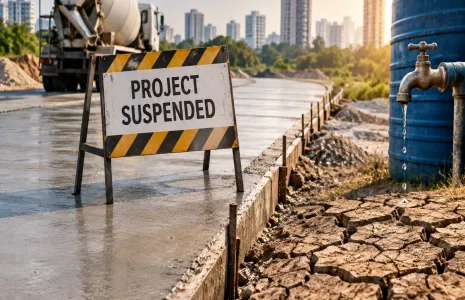
The central government supplements state measures in water resource conservation while states study, plan, fund and execute actions as water is a state subject. The Jal Sanchay Jan Bhagidari (JSJB) initiative was launched in Surat on six September 2024 to intensify community action in building low cost rainwater harvesting structures. The initiative mobilises community contributions, individual donations and Corporate Social Responsibility funds to construct borewells, recharge shafts and pits using local materials. JSJB aims to boost groundwater levels and provide local solutions to water scarcity through community participation.

The initiative emphasises convergent financing from central, state and local schemes including the Mahatma Gandhi National Rural Employment Guarantee Scheme, AMRUT and the Pradhan Mantri Krishi Sinchai Yojana. Central Ministerial Nodal Officers from the Central Ground Water Board (CGWB) and the Central Water Commission (CWC) are deployed to provide technical guidance and verify structures while state nodal officers oversee implementation. Support is provided under River Basin Management by the Brahmaputra Board for flood and erosion control.

The National River Conservation Plan (NRCP) provides technical and financial assistance for pollution abatement outside the Ganga basin and supports interception and diversion of raw sewage, sewerage systems, sewage treatment plants, low cost sanitation and riverfront works. NRCP has covered 58 rivers in 100 towns across 17 States at a total sanctioned cost of Rs 89705.1 mn and a sewage treatment capacity of 3019 mn litre per day. The Namami Gange Programme addresses wastewater, solid waste, riverfront management, environmental flows, afforestation and biodiversity conservation for rejuvenation.

Jal Jeevan Mission sets central to state fund sharing ratios of 100 to zero for Union Territories without legislature, 90 to 10 for North Eastern and Himalayan States and UTs with legislature and 50 to 50 for other States. Watershed development under PMKSY two point zero and minor irrigation schemes provide technical support and grants, and transparency is ensured through the Public Financial Management System (PFMS), General Financial Rules 2017, online monitoring and utilisation certificates.

The central government supplements state measures in water resource conservation while states study, plan, fund and execute actions as water is a state subject. The Jal Sanchay Jan Bhagidari (JSJB) initiative was launched in Surat on six September 2024 to intensify community action in building low cost rainwater harvesting structures. The initiative mobilises community contributions, individual donations and Corporate Social Responsibility funds to construct borewells, recharge shafts and pits using local materials. JSJB aims to boost groundwater levels and provide local solutions to water scarcity through community participation. The initiative emphasises convergent financing from central, state and local schemes including the Mahatma Gandhi National Rural Employment Guarantee Scheme, AMRUT and the Pradhan Mantri Krishi Sinchai Yojana. Central Ministerial Nodal Officers from the Central Ground Water Board (CGWB) and the Central Water Commission (CWC) are deployed to provide technical guidance and verify structures while state nodal officers oversee implementation. Support is provided under River Basin Management by the Brahmaputra Board for flood and erosion control. The National River Conservation Plan (NRCP) provides technical and financial assistance for pollution abatement outside the Ganga basin and supports interception and diversion of raw sewage, sewerage systems, sewage treatment plants, low cost sanitation and riverfront works. NRCP has covered 58 rivers in 100 towns across 17 States at a total sanctioned cost of Rs 89705.1 mn and a sewage treatment capacity of 3019 mn litre per day. The Namami Gange Programme addresses wastewater, solid waste, riverfront management, environmental flows, afforestation and biodiversity conservation for rejuvenation. Jal Jeevan Mission sets central to state fund sharing ratios of 100 to zero for Union Territories without legislature, 90 to 10 for North Eastern and Himalayan States and UTs with legislature and 50 to 50 for other States. Watershed development under PMKSY two point zero and minor irrigation schemes provide technical support and grants, and transparency is ensured through the Public Financial Management System (PFMS), General Financial Rules 2017, online monitoring and utilisation certificates.

Next Story
Infrastructure Urban

Flender Unveils N-ZAPEX Gear Couplings for Cost-Effective Operation

Flender has unveiled its new N-ZAPEX gear couplings, setting a new industry standard for drive applications in harsh conditions, such as those found in steel, cement, mining, and oil & gas industries. Designed to deliver economic benefits over the entire lifecycle, the N-ZAPEX series offers the highest torque density and misalignment capacities on the market.The N-ZAPEX is available in two versions, XN and XW, each tailored to meet different customer requirements. The XN variant focuses on standardisation, reduced complexity, and cost-effectiveness for smaller sizes, featuring reusable com..

Next Story
Infrastructure Urban

Anil Agarwal Calls for Entrepreneurial Role in Natural Resource PSUs

Anil Agarwal, Chairman of Vedanta, has highlighted the transformative potential of greater entrepreneurial involvement in India's public sector companies within the natural resources space. In a LinkedIn post, he emphasised the importance of empowering India’s pool of entrepreneurs alongside skilled public-sector talent to strengthen domestic production and reduce the country’s reliance on imports.Agarwal drew comparisons with India’s agricultural success, where self-sufficiency and surplus production were achieved. He suggested that a similar approach could unlock substantial value in p..

Next Story
Technology

Advaiya Launches Change Log Archival App for Microsoft Dynamics 365

Advaiya has launched its Change Log Archival app for Microsoft Dynamics 365 Business Central on the Microsoft Marketplace. The app enables organisations to securely archive large volumes of change log data outside the core ERP system while ensuring auditability, compliance, and traceability.As organisations face growing change log records that increase database size and impact system performance, the Change Log Archival app addresses these challenges by archiving historical logs to Azure Blob Storage. This solution optimises storage, maintains data integrity, and ensures accessibility, allowin..

Advertisement

Subscribe to Our Newsletter

Get daily newsletters around different themes from Construction world.

STAY CONNECTED

Advertisement

Advertisement

Advertisement